Review
. 2016:2016:1958174.
doi: 10.1155/2016/1958174. Epub 2015 Nov 30.

The Nrf2/HO-1 Axis in Cancer Cell Growth and Chemoresistance

Affiliations
Review

The Nrf2/HO-1 Axis in Cancer Cell Growth and Chemoresistance

A L Furfaro et al. Oxid Med Cell Longev. 2016.

Abstract

The transcription factor, nuclear factor erythroid 2 p45-related factor 2 (Nrf2), acts as a sensor of oxidative or electrophilic stresses and plays a pivotal role in redox homeostasis. Oxidative or electrophilic agents cause a conformational change in the Nrf2 inhibitory protein Keap1 inducing the nuclear translocation of the transcription factor which, through its binding to the antioxidant/electrophilic response element (ARE/EpRE), regulates the expression of antioxidant and detoxifying genes such as heme oxygenase 1 (HO-1). Nrf2 and HO-1 are frequently upregulated in different types of tumours and correlate with tumour progression, aggressiveness, resistance to therapy, and poor prognosis. This review focuses on the Nrf2/HO-1 stress response mechanism as a promising target for anticancer treatment which is able to overcome resistance to therapies.


Figures
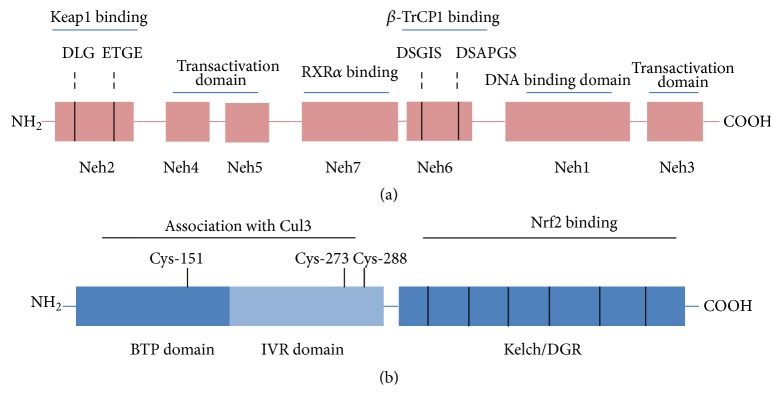
Figure 1
Figure 1
Schematic representation of Nrf2 and Keap1 structures. (a) Nrf2 contains seven domains, Neh1–Neh7. The Neh2 domain contains two binding motifs, DLG and ETGE, responsible for the interaction with Keap1. The Neh4, Neh5, and Neh3 domains are important for the transactivation activity of Nrf2. The Neh7 domain is critical for RXRα binding. The Neh6 domain regulates Nrf2 degradation by β-TrCP1. The Neh1 domain has a basic region leucine zipper motif for DNA binding. (b) Keap1 contains three major domains. The BTB domain mediates Keap1 homodimerisation and the IVR domain contains critical cysteine residues and together they associate with Cul3. The Kelch/DGR domain mediates the binding with the Neh2 domain of Nrf2.
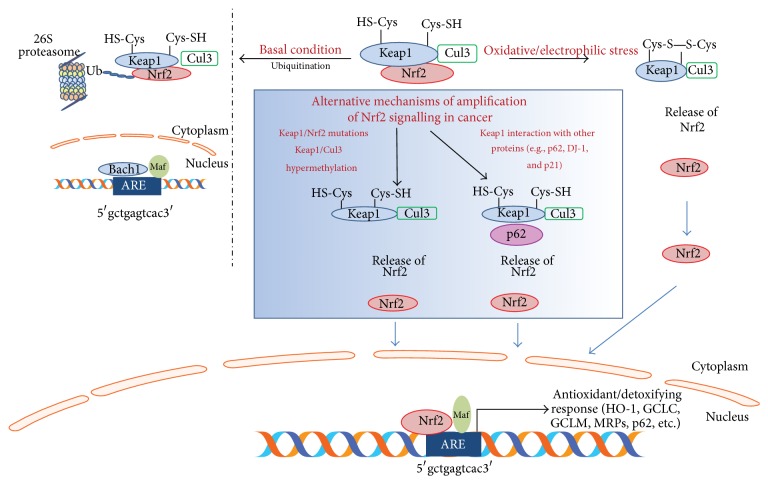
Figure 2
Figure 2
Nrf2 activity regulation. In a resting state, Nrf2 is sequestered in the cytoplasm through the binding with Keap1, responsible for Nrf2 ubiquitination and proteasomal degradation via Cul3. Oxidative/electrophilic stress causes a conformational change in Keap1-Cul3, by acting on specific cysteine residues in Keap1, leading to Nrf2 dissociation. Thus, free Nrf2 translocates to the nucleus, which dimerises with small Maf protein and binds to ARE/EpRE sequence within regulatory regions of a wide variety of target genes (e.g., HO-1, GCLC, GCLM, MRPs, and p62). In cancer cells (blue box), Keap1/Nrf2 mutations and Keap1/Cul3 aberrant hypermethylations as well as Keap1 interactions with ETGE motif-containing proteins lead to an increased Nrf2 activation and induction of target genes.
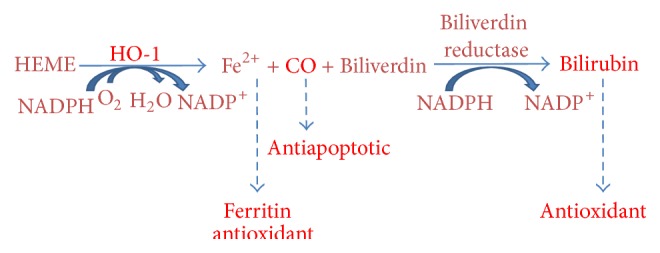
Figure 3
Figure 3
Heme catabolic pathway. HO-1 catalyses the degradation of heme into biliverdin/bilirubin (antioxidant), carbon monoxide (antiapoptotic), and ferritin (antioxidant) induced by free iron release.

References

    1. Gupta S. C., Hevia D., Patchva S., Park B., Koh W., Aggarwal B. B. Upsides and downsides of reactive oxygen species for Cancer: the roles of reactive oxygen species in tumorigenesis, prevention, and therapy. Antioxidants and Redox Signaling. 2012;16(11):1295–1322. doi: 10.1089/ars.2011.4414. - DOI - PMC - PubMed
    1. Ishii T., Itoh K., Takahashi S., et al. Transcription factor Nrf2 coordinately regulates a group of oxidative stress-inducible genes in macrophages. Journal of Biological Chemistry. 2000;275(21):16023–16029. doi: 10.1074/jbc.275.21.16023. - DOI - PubMed
    1. Ishii T., Itoh K., Ruiz E., et al. Role of Nrf2 in the regulation of CD36 and stress protein expression in murine macrophages: activation by oxidatively modified LDL and 4-hydroxynonenal. Circulation Research. 2004;94(5):609–616. doi: 10.1161/01.res.0000119171.44657.45. - DOI - PubMed
    1. Itoh K., Mimura J., Yamamoto M. Discovery of the negative regulator of Nrf2, keap1: a historical overview. Antioxidants and Redox Signaling. 2010;13(11):1665–1678. doi: 10.1089/ars.2010.3222. - DOI - PubMed
    1. Weinberg F., Chandel N. S. Reactive oxygen species-dependent signaling regulates cancer. Cellular and Molecular Life Sciences. 2009;66(23):3663–3673. doi: 10.1007/s00018-009-0099-y. - DOI - PMC - PubMed

Publication types

LinkOut - more resources