Survival following reirradiation using intensity-modulated radiation therapy with temozolomide in selected patients with recurrent high grade gliomas
- PMID: 26697464
- PMCID: PMC4669324
- DOI: 10.3978/j.issn.2305-5839.2015.11.29
Survival following reirradiation using intensity-modulated radiation therapy with temozolomide in selected patients with recurrent high grade gliomas
Abstract
Background: High grade gliomas often recur after initial treatment. Despite so many treatment options, there is no standard treatment for recurrent gliomas. The aim of this study is to offer survival following reirradiation (re-RT) using intensity-modulated radiation therapy (IMRT) with temozolomide in selected patients with recurrent high grade gliomas.
Methods: We examined the medical records of 21 adult patients with recurrent high grade gliomas who were reirradiated with IMRT at the time of tumor recurrence or progression. Tumor recurrence was shown by gadolinium-enhanced magnetic resonance imaging (MRI) and diagnosis was established by pathology review. Statistical analyses were performed with SPSS version 18.0.1 using Cox regression analyses, log-rank test and Kaplan-Meier method.
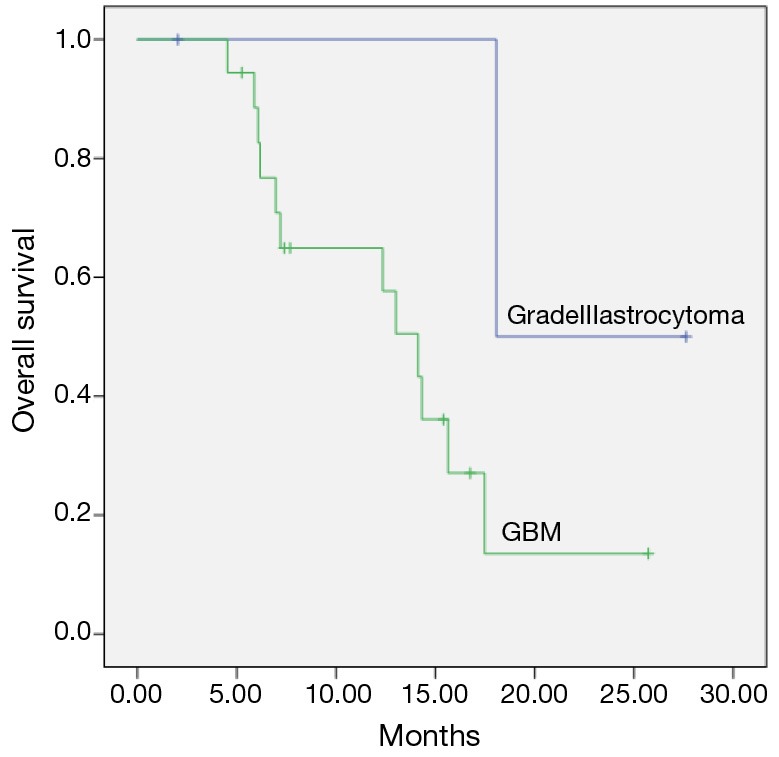
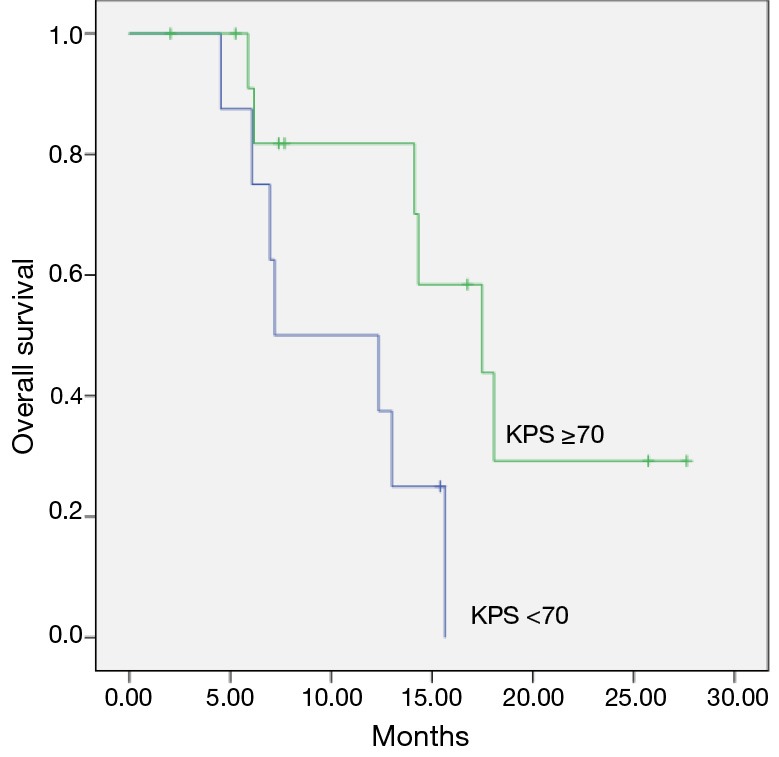
Results: Eighteen patients presented by localized recurrence, three patients with diffuse recurrence. Median radiotherapy (RT) dose was 54 Gy. About 81% patients received temozolomide with re-RT. The time interval between two courses RT was median 39.3 months (range, 9.6-140.8 months). The response was checked by MRI. About 24% patients achieved complete response (CR) and 29% patient partial response (PR). Stable disease (SD) was observed in 47% patients. Median follow-up time from diagnosis was 41.4 months (range, 16.6-145.4 months) and 12.3 months (range, 2-27.6 months) from re-RT. Median time to recurrence was 39.3 months (range, 9.6-140.8 months). Median survival after re-RT was 18 months for anaplastic astrocytoma (AA), 14.1 months for glioblastoma multiforme (GBM) (range, 11-17.2 months) (P=0.1) and 7.1 months for patients with Karnofsky performance status (KPS) <70 before re-RT and 17.4 months for KPS >70 (P=0.02).
Conclusions: re-RT is one of the treatment options for recurrent high grade gliomas and IMRT can be an effective treatment modality for recurrent high grade brain tumors with only mild side effects. Survival is better in patients with good performance status and in recurrent anaplastic tumors after re-RT.
Keywords: Glioma; glioblastoma; intensity modulated radiotherapy; reirradiation (re-RT); survival.
Conflict of interest statement
Figures
References
-
- Wen PY, Kesari S. Malignant gliomas in adults. N Engl J Med 2008;359:492-507. - PubMed
-
- Stupp R, Hegi ME, Mason WP, et al. Effects of radiotherapy with concomitant and adjuvant temozolomide versus radiotherapy alone on survival in glioblastoma in a randomised phase III study: 5-year analysis of the EORTC-NCIC trial. Lancet Oncol 2009;10:459-66. - PubMed
-
- Melissa LB, El-Zein R, Scheurer ME. Epidemiology of brain tumors, Chapter1. In: DeMonte F, Gilbert MR, Mahajan A, et al. editors. Tumors of the brain and spine. M.D. Anderson Cancer Care Series. Berlin: Springer Science Business Media; 2007.
LinkOut - more resources
Full Text Sources
Research Materials