. 2016 Feb:61:108-20.
doi: 10.1016/j.neubiorev.2015.12.007. Epub 2015 Dec 14.

Cognition and resting-state functional connectivity in schizophrenia

Affiliations

Cognition and resting-state functional connectivity in schizophrenia

Julia M Sheffield et al. Neurosci Biobehav Rev. 2016 Feb.

Abstract

Individuals with schizophrenia consistently display deficits in a multitude of cognitive domains, but the neurobiological source of these cognitive impairments remains unclear. By analyzing the functional connectivity of resting-state functional magnetic resonance imaging (rs-fcMRI) data in clinical populations like schizophrenia, research groups have begun elucidating abnormalities in the intrinsic communication between specific brain regions, and assessing relationships between these abnormalities and cognitive performance in schizophrenia. Here we review studies that have reported analysis of these brain-behavior relationships. Through this systematic review we found that patients with schizophrenia display abnormalities within and between regions comprising (1) the cortico-cerebellar-striatal-thalamic loop and (2) task-positive and task-negative cortical networks. Importantly, we did not observe unique relationships between specific functional connectivity abnormalities and distinct cognitive domains, suggesting that the observed functional systems may underlie mechanisms that are shared across cognitive abilities, the disturbance of which could contribute to the "generalized" cognitive deficit found in schizophrenia. We also note several areas of methodological change that we believe will strengthen this literature.

Keywords: Cognition; Cognitive dysmetria; Default mode network; Executive functioning; Functional brain networks; Functional connectivity; Generalized cognitive deficit; Go/NoGo; IQ; Reinforcement learning; Resting-state fMRI; Schizophrenia; Task-positive networks.


Figures

Figure 1
Figure 1
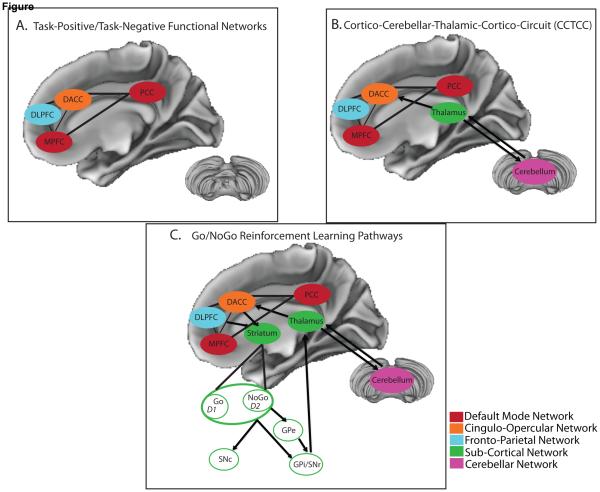
Here we present a heuristic model of how several neural systems - whose functional connectivity has been associated with cognitive ability in schizophrenia - may interact with one another to contribute to cognitive deficits. This model is based on results from the review of 16 articles that correlated resting-state functional connectivity (rs-fcMRI) measures with cognitive performance in schizophrenia. Although the reviewed studies yielded fairly heterogenous findings, they converged on associations between cognitive ability and the rs-fcMRI of regions comprising: A) task-positive and task-negative functional brain networks, B) Cortico-Cerebellar-Thalamic-Cortico Circuit (CCTCC), and C) the Go/NoGo pathway of reinforcement learning. Here, we present how these models build on one another, to create a final integrated model (presented in (C)), such that the cortical networks presented in (A) interact with the thalamus and cerebellum, as presented in (B), which in turn are connected with the striatum, integrating the Go/NoGo reinforcement learning pathways, as presented in (C). Based on findings from the current review, we suggest that interactions between task-positive/task-negative functional networks provide the basis for a more complex interaction between the cortex, thalamus, and cerebellum than was originally proposed by cognitive dysmetria (i.e. CCTCC). Additionally, the cortex, thalamus, and cerebellum interact with the striatum, integrating the Go/NoGo pathways involved in the process of reinforcement learning. These Go/NoGo pathways are believed to influence activity in the thalamus and cerebellum, which feedback to cortical networks, in order to control cognitive functioning. In sum, the regions presented in this figure not only represent common hubs for multiple models of cognitive ability, but also all exhibited abnormal functional connectivity in schizophrenia, which in turn was related to cognitive impairment. These findings suggest that abnormal functional connectivity between regions that comprise the task-positive/task-negative networks, the CCTCC, and reinforcement learning pathways together may contribute to the generalized cognitive deficit observed in schizophrenia. Go/NoGo Model modified from Frank et al. (2004). CCTCC model modified from Andreasen (1999). DLPFC =Dorsolateral Prefrontal Cortex; DACC = Dorsal Anterior Cingulate Cortex; GPe = external segment of the Globus Pallidus; GPi = internal segment of the Globus Pallidus; MPFC = Medial Prefrontal Cortex; PCC = Posterior Cingulate Cortex; SNc = Substantia Nigra pars compacta; SNr = Substantia Nigra pars reticula

References

    1. Alexander GE, DeLong MR, Strick PL. Parallel organization of functionally segregated circuits linking basal ganglia and cortex. Annual review of neuroscience. 1986;9(1):357–381. - PubMed
    1. Andreasen NC, Carpenter WT., Jr Diagnosis and classification of schizophrenia. Schizophrenia Bulletin. 1993;19(2):199. - PubMed
    1. Andreasen NC. A unitary model of schizophrenia: Bleuler's fragmented phrene as schizencephaly. Archives of general psychiatry. 1999;56(9):781–787. - PubMed
    1. Andreasen NC, O'Leary DS, Cizadlo T, Arndt S, Rezai K, Ponto LL, Hichwa RD. Schizophrenia and cognitive dysmetria: a positron-emission tomography study of dysfunctional prefrontal-thalamic-cerebellar circuitry. Proceedings of the National Academy of Sciences. 1996;93(18):9985–9990. - PMC - PubMed
    1. Andreasen NC, Arndt S, Swayze V, Cizadlo T, Flaum M, O'Leary D, Yuh WT. Thalamic abnormalities in schizophrenia visualized through magnetic resonance image averaging. Science. 1994;266(5183):294–298. - PubMed

Publication types