. 2015 Dec;5(1):82.
doi: 10.1186/s13568-015-0167-7. Epub 2015 Dec 23.

Glycolipids produced by Rouxiella sp. DSM 100043 and isolation of the biosurfactants via foam-fractionation

Affiliations

Glycolipids produced by Rouxiella sp. DSM 100043 and isolation of the biosurfactants via foam-fractionation

Johannes H Kügler et al. AMB Express. 2015 Dec.

Abstract

Microorganisms produce a great variety of secondary metabolites that feature surface active and bioactive properties. Those possessing an amphiphilc molecular structure are also termed biosurfactant and are of great interest due to their often unique properties. Rouxiella sp. DSM 100043 is a gram negative enterobacter isolated from peat-bog soil and described as a new biosurfactant producing species in this study. Rouxiella sp. produces glycolipids, biosurfactants with a carbohydrate moiety in its structure. This study characterizes the composition of glycolipids with different hydrophobicities that have been produced during cultivation in a bioreactor and been extracted and purified from separated foam. Using two dimensional nuclear magnetic resonance spectroscopy, the hydrophilic moieties are elucidated as glucose with various acylation sites and as talose within the most polar glycolipids. The presence of 3' hydroxy lauroleic acid as well as myristic and myristoleic acid has been detected.

Keywords: Biosurfactant; Emulsifier; Glycolipid; Hydroxy linoleic acid; Myristic acid; Myristoleic acid; Rouxiella; Serratia; Surfactant; Talose.


Figures

Fig. 1
Fig. 1
Growth parameters of Rouxiella sp. DSM 100043 during biosurfactant production. Time course of a dissolved oxygen (solid line) and dry cell mass (open circle) in the bioreactor system and b of dry cell mass (black line) and surface tension (grey line) examined from fractionated foam. c Time course of the surface tension (grey square) in the reactor as well as depletion of glycerol (open triangle) and ammonium (filled inverted triangle)
Fig. 2
Fig. 2
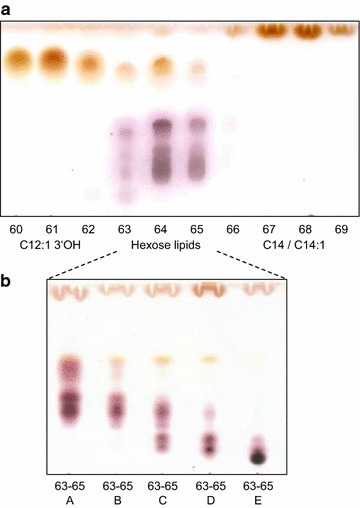
Thin layer chromatography (TLC) of glycolipids extracted and purified from foam fractionated during cultivation. TLC plates are stained with sulphuric acid. a 3′ hydroxyl lauroleic acid present in fractions 60–62, glycolipids present in fractions 63–65 and myristic as well as myristoleic acids present in fractions 67–69. b TLC of further purified glycolipids from fraction 63–65 resulting in subfractions 63–65 A to 63–65 E with the most hydrophilic glycolipids in 63–65 E containing talose as carbohydrate moieties
Fig. 3
Fig. 3
Assigned spectra of two dimensional 1H/1H correlated spectroscopy (COSY). a Derived from fractions 60–61 elucidated as 3′ hydroxy lauroleic acid and b derived from fractions 67–69 elucidated as a mixture of myristic and myristoleic acids. Both are shown as molecular structures
Fig. 4
Fig. 4
NMR spectra of Rouxiella sp. DSM 100043 glycolipids present in fractions 64–65. Close-up of the carbohydrate region is shown: a 1H spectrum, b two dimensional 1H/1H COSY and c two dimensional 1H/13C HSQC spectrum. Anomeric C1 of the glucose moieties A to D in both, α and β configuration is shown in c, molecular structures in d. The more dominant form of sugar A, carrying acylation at C2 and C3 is exemplarily assigned in red in a 1H spectrum and b as red lines in the COSY spectrum
Fig. 5
Fig. 5
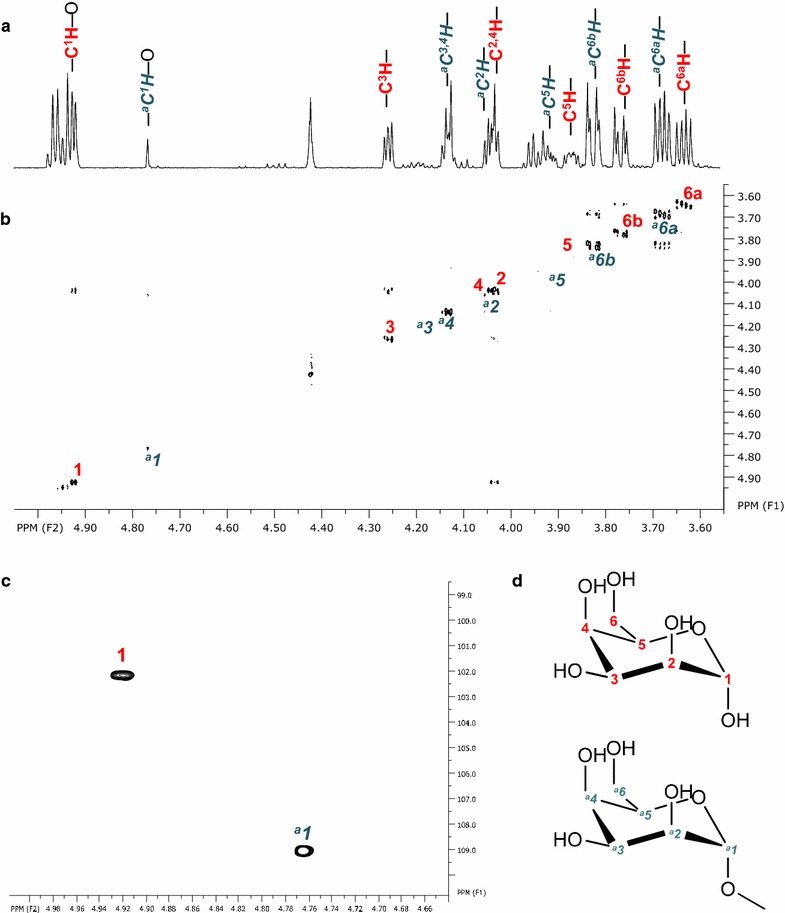
NMR spectra of glycolipids produced by Rouxiella sp. DSM 100043 present in subfraction 63–65 E. Close-up of the carbohydrate region in a 1H spectrum and b two dimensional 1H/1H COSY spectrum and assignment of signals for two sugar moieties C1–6 in red and a C 16 in blue. c Two dimensional 1H/13C HSQC spectrum revealing two anomeric nuclei: C1 and a C 1, the latter downshifted and indicating an acetylation. d Potentional molecular structures and assigned C atoms of talopyranose (red) and 1′ acetyl talosepyranose (blue)

References

    1. Chen CY, Baker SC, Darton RC. Batch production of biosurfactant with foam fractionation. J Chem Technol Biotechnol. 2006;81:1923–1931. doi: 10.1002/jctb.1625. - DOI
    1. Davis D, Lynch H, Varley J. The application of foaming for the recovery of surfactin from B. subtilis ATCC 21332 cultures. Enzyme Microb Technol. 2001;28:346–354. doi: 10.1016/S0141-0229(00)00327-6. - DOI - PubMed
    1. Dusane DH, Pawar VS, Nancharaiah Y, Venugopalan V, Kumar AR, Zinjarde SS. Anti-biofilm potential of a glycolipid surfactant produced by a tropical marine strain of Serratia marcescens. Biofouling. 2011;27:645–654. doi: 10.1080/08927014.2011.594883. - DOI - PubMed
    1. Hausmann R, Syldatk C (2014) Types and classification of microbial surfactants. In: Kosaric, Vardar-Sukan (eds) Biosurfactants: production and utilization—processes, technologies, and economics. London, New York: CRC Press, Taylor & Francis Group, Boca Raton, vol 159, pp 165.
    1. Kügler JH, Le Roes-Hill M, Syldatk C, Hausmann R. Surfactants tailored by the class Actinobacteria. Front Microbiol. 2015;6:212. - PMC - PubMed

LinkOut - more resources