


Mortality Associated With Heart Failure After Myocardial Infarction: A Contemporary Community Perspective
- PMID: 26699392
- PMCID: PMC4692179
- DOI: 10.1161/CIRCHEARTFAILURE.115.002460
Mortality Associated With Heart Failure After Myocardial Infarction: A Contemporary Community Perspective
Abstract
Background: Contemporary data are lacking on the prognostic importance of heart failure (HF) after myocardial infarction (MI). We evaluated the prognostic impact of HF post MI according to preserved/reduced ejection fraction and the timing of its occurrence.
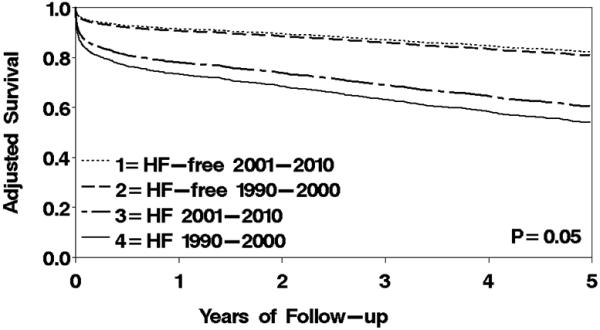
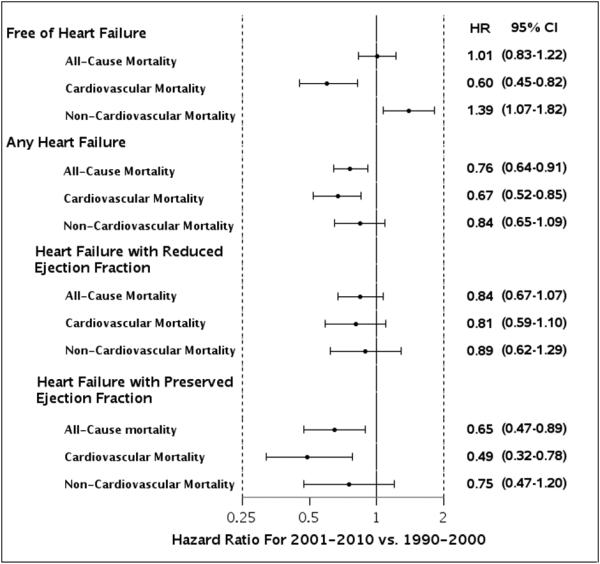
Methods and results: All Olmsted County, Minnesota, residents (n=2596) with incident MI diagnosed in 1990 to 2010 and no prior HF were followed through March 2013. Cox models were used to examine (1) the hazard ratios for death associated with HF type and timing and (2) secular trends in survival by HF status. During a mean follow-up of 7.6 years, there were 1116 deaths, 634 in the 902 patients who developed HF (70%) and 482 in the 1694 patients who did not develop HF (28%). After adjustment for age and sex, HF as a time-dependent variable was strongly associated with mortality (hazard ratio =3.31, 95% confidence interval: 2.93-3.75), particularly from cardiovascular causes (hazard ratio =4.20, 95% confidence interval: 3.50-5.03). Further adjustment for MI severity and comorbidity, acute treatment, and recurrent MI moderately attenuated these associations (hazard ratio =2.49 and 2.94 for all-cause and cardiovascular mortality, respectively). Mortality did not differ by ejection fraction, but was higher for delayed- versus early-onset HF (P for heterogeneity =0.002). The age- and sex-adjusted 5-year survival estimates in 2001 to 2010 versus 1990 to 2000 were 82% and 81% among HF-free and 61% and 54% among HF patients, respectively (P for heterogeneity of trends =0.05).
Conclusions: HF markedly increases the risk of death after MI. This excess risk is similar regardless of ejection fraction but greater for delayed- versus early-onset HF. Mortality after MI declined over time, primarily as a result of improved HF survival.
Keywords: cohort studies; ejection fraction; epidemiology; heart failure; mortality; myocardial infarction; secondary prevention; trends.
© 2015 American Heart Association, Inc.
Figures
References
-
- Kostis WJ, Deng Y, Moreyra AE, Pantazopoulos JS, Kostis JB. No decrease in the incidence of heart failure following acute myocardial infarction in the years 1994-2006. Circulation. 2011;124:A17546.
-
- Ezekowitz JA, Kaul P, Bakal JA, Armstrong PW, Welsh RC, McAlister FA. Declining in-hospital mortality and increasing heart failure incidence in elderly patients with first myocardial infarction. J Am Coll Cardiol. 2009;53:13–20. - PubMed
-
- Gheorghiade M, Bonow RO. Chronic heart failure in the United States: a manifestation of coronary artery disease. Circulation. 1998;97:282–289. - PubMed
Publication types
MeSH terms
Grants and funding
LinkOut - more resources
Full Text Sources
Other Literature Sources
Medical
Research Materials
Miscellaneous
