


Comment
doi: 10.1073/pnas.1522316113.
Epub 2015 Dec 23.
How the brain represents other minds
Affiliations
- PMID: 26699493
- PMCID: PMC4711830
- DOI: 10.1073/pnas.1522316113
Item in Clipboard
Comment
How the brain represents other minds
Proc Natl Acad Sci U S A.
.
No abstract available
Conflict of interest statement
The authors declare no conflict of interest.
Figures
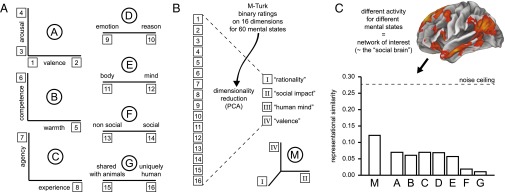
Summary of the study by Tamir et al. (1). (A) Seven existing psychological models (A through G) encompassed different dimensions (1 through 16) along which the mental states of others are represented psychologically. (B) Online ratings for 60 mental states on these 16 dimensions, together with dimensionality reduction, resulted in four new dimensions for mental state representation. Three of these dimensions fit the data best, and were combined into a new 3D model, M. PCA, principal components analysis. (C) Brain regions differentially activated by mental states (statistical parametric map displayed on brain surface) were used in a representational similarity analysis to test extant psychological models (A through G) as well as the new model M. Model M was found to fit the neural data best, although there is room for improvement because it was still below the noise ceiling [the best possible fit (dotted line)].
Comment on
-
Neural evidence that three dimensions organize mental state representation: Rationality, social impact, and valence.Proc Natl Acad Sci U S A. 2016 Jan 5;113(1):194-9. doi: 10.1073/pnas.1511905112. Epub 2015 Nov 30. Proc Natl Acad Sci U S A. 2016. PMID: 26621704 Free PMC article.
References
-
- Schurz M, Radua J, Aichhorn M, Richlan F, Perner J. Fractionating theory of mind: A meta-analysis of functional brain imaging studies. Neurosci Biobehav Rev. 2014;42:9–34. - PubMed
Publication types
MeSH terms
Grants and funding
LinkOut - more resources
Full Text Sources
Other Literature Sources
