


doi: 10.1128/JCM.02035-15.
Epub 2015 Dec 23.
Two Listeria monocytogenes Pseudo-outbreaks Caused by Contaminated Laboratory Culture Media
Affiliations
- PMID: 26699704
- PMCID: PMC4767998
- DOI: 10.1128/JCM.02035-15
Item in Clipboard
Two Listeria monocytogenes Pseudo-outbreaks Caused by Contaminated Laboratory Culture Media
J Clin Microbiol.
2016 Mar.
Abstract
Listeriosis is a serious foodborne infection that disproportionately affects elderly adults, pregnant women, newborns, and immunocompromised individuals. Diagnosis is made by culturing Listeria monocytogenes from sterile body fluids or from products of conception. This report describes the investigations of two listeriosis pseudo-outbreaks caused by contaminated laboratory media made from sheep blood.
Copyright © 2016, American Society for Microbiology. All Rights Reserved.
Figures
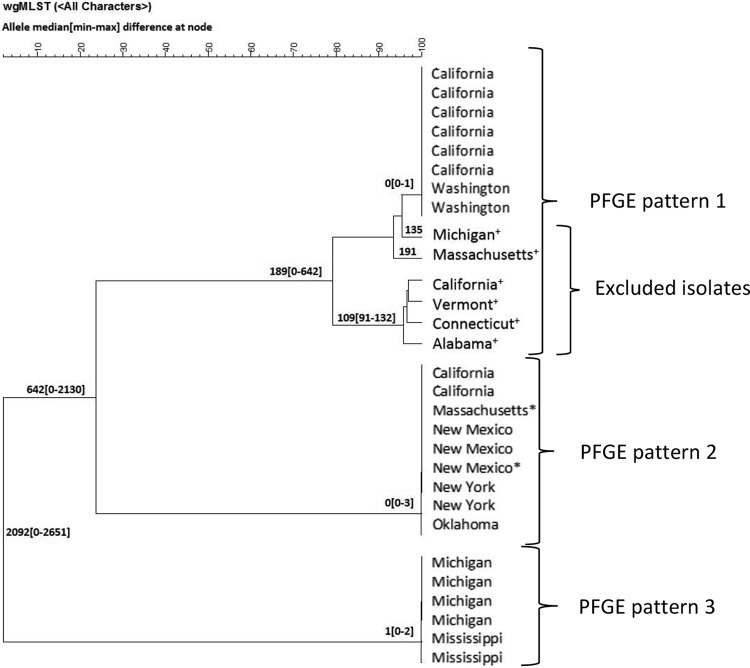
Relationships by whole-genome multilocus sequencing type (wgMLST) of Listeria monocytogenes isolates with three pulsed-field gel electrophoresis (PFGE) patterns from 11 U.S. states associated with the 2014 pseudo-outbreak. Median (minimum to maximum) allele differences at node by wgMLST analysis performed using BioNumerics 7.5 and alleles were defined using an allele database generated to reflect the diversity of L. monocytogenes (Listeria database v.3). *, Isolates from uninoculated laboratory media plates; +, Isolates excluded from the pseudo-outbreak because of a clinical history compatible with listeriosis.
References
-
- Carleton HA, Katz LS, Stroika S, Sabol A, Roache K, Kucerova Z, Ribot EM, Evans P, Holt K, Kubota K, Pouseele H, Besser J, Tarr C, Trees E, Gerner-Smidt P. 2015. The application of whole genome multi-locus sequence typing to characterize Listeria Monocytogenes, p 57 In International Conference on Emerging Infectious Diseases Program and Abstracts Book. American Society for Microbiology, Washington, DC.
-
- Wesley IV. 2007. Listeriosis in animals, p 56–60. In Ryser ET, Marth EH (ed), Listeria, listeriosis, and food safety. Taylor and Francis Group, Boca Raton, FL.
MeSH terms
Substances
LinkOut - more resources
Full Text Sources
Medical
