


Supramolecular host-guest interaction of trityl-nitroxide biradicals with cyclodextrins: modulation of spin-spin interaction and redox sensitivity
- PMID: 26700002
- PMCID: PMC4823007
- DOI: 10.1039/c5ob02450a
Supramolecular host-guest interaction of trityl-nitroxide biradicals with cyclodextrins: modulation of spin-spin interaction and redox sensitivity
Abstract
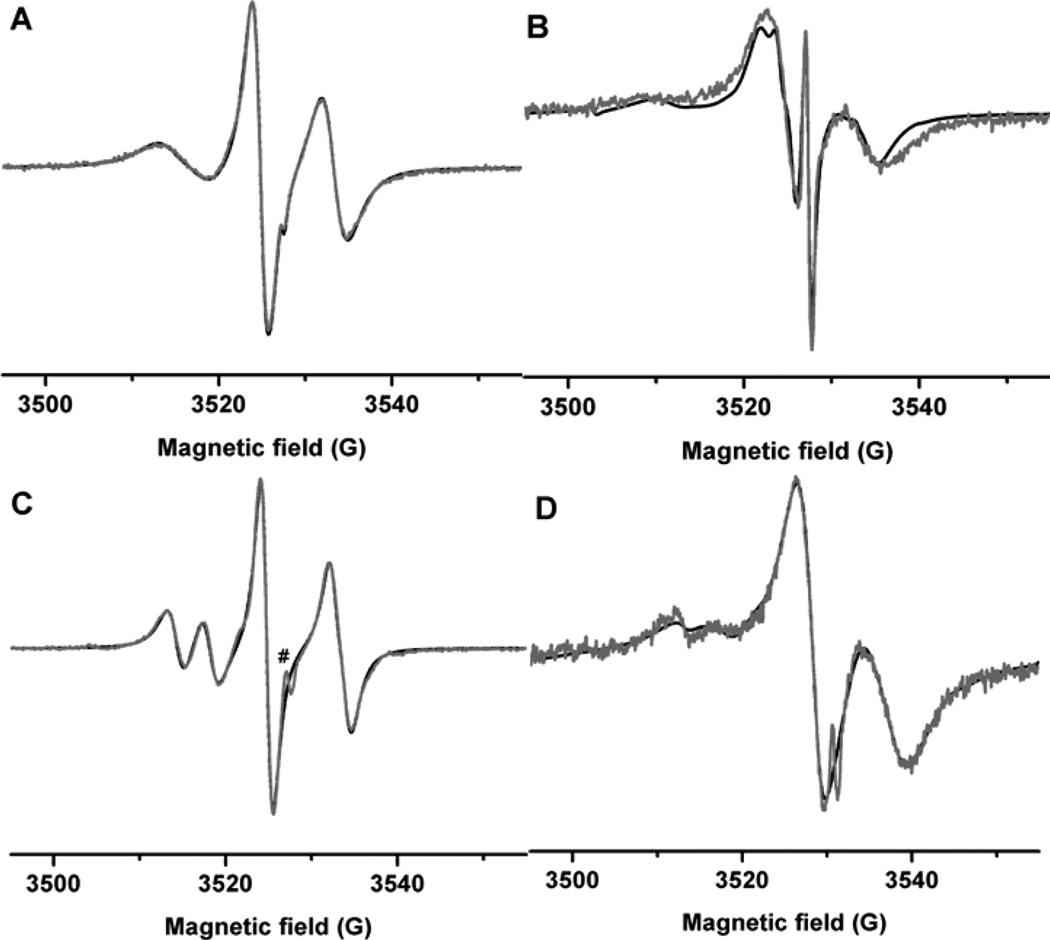
Supramolecular host-guest interactions of trityl-nitroxide (TN) biradicals CT02-VT, CT02-AT and CT02-GT with methyl-β-cyclodextrin (M-β-CD), hydroxypropyl-β-cyclodextrin (H-β-CD) and γ-cyclodextrin (γ-CD) were investigated by EPR spectroscopy. In the presence of cyclodextrins (i.e., γ-CD, M-β-CD and H-β-CD), host-guest complexes of CT02-VT are formed where the nitroxide and linker parts possibly interact with the cyclodextrins' cavities. Complexation with cyclodextrins leads to suppression of the intramolecular through-space spin-spin exchange coupling in CT02-VT, thus allowing the determination of the through-bond spin-spin exchange coupling which was calculated to be 1.6 G using EPR simulations. Different types of cyclodextrins have different binding affinities with CT02-VT in the order of γ-CD (95 M(-1)) > M-β-CD (70 M(-1)) > H-β-CD (32 M(-1)). In addition, the effect of the linkers in TN biradicals on the host-guest interactions was also investigated. Among the three TN biradicals studied, CT02-VT has the highest association constant with one designated cyclodextrin derivative. On the other hand, the complexes of CT02-GT (∼ 22 G) and CT02-AT (7.7-9.0 G) with cyclodextrins have much higher through-bond spin-spin exchange couplings than those of CT02-VT (1.6 G) due to the shorter linkers than those of CT02-VT. Furthermore, the stability of TN biradicals towards ascorbate was significantly enhanced after the complexation with CDs, with an almost 2-fold attenuation of the second-order rate constants for all the biradicals. Therefore, the supramolecular host-guest interactions with cyclodextrins will be an alternative method to modulate the magnitude of the spin-spin interactions and redox sensitivity of TN biradicals, and the resulting complexes are promising as highly efficient DNP polarizing agents as well as EPR redox probes.
Figures




References
-
- Ysacco C, Karoui H, Casano G, Le Moigne F, Combes S, Rockenbauer A, Rosay M, Maas W, Ouari O, Tordo P. Appl. Magn. Reson. 2012;43:251–261.
-
- Munoz-Gomez JL, Marin-Montesinos I, Lloveras V, Pons M, Vidal-Gancedo J, Veciana J. Org. Lett. 2014;16:5402–5405. - PubMed
-
- Miller JS, Drillon M, editors. Magnetism: Molecules to Materials. Weinheim, Germany: Wiley-VCH; 2001–2003.
Publication types
MeSH terms
Substances
Grants and funding
LinkOut - more resources
Full Text Sources
Other Literature Sources
Miscellaneous
