


Comment
doi: 10.1016/j.molmed.2015.11.009.
Epub 2015 Dec 11.
Epithelial Plasticity versus EMT in Kidney Fibrosis
Affiliations
- PMID: 26700490
- PMCID: PMC4854190
- DOI: 10.1016/j.molmed.2015.11.009
Item in Clipboard
Comment
Epithelial Plasticity versus EMT in Kidney Fibrosis
Trends Mol Med.
2016 Jan.
Abstract
Ten percent of the population worldwide suffers from chronic kidney disease (CKD), characterized by fibrotic changes in the kidney. Fibrosis is associated with loss of epithelial parenchyma, and accumulation of myofibroblasts, fibrillary collagen, and inflammatory cells. Two recent papers highlight the critical role of Twist and Snai1 transcription factors in kidney fibrosis.
Copyright © 2015 Elsevier Ltd. All rights reserved.
Figures
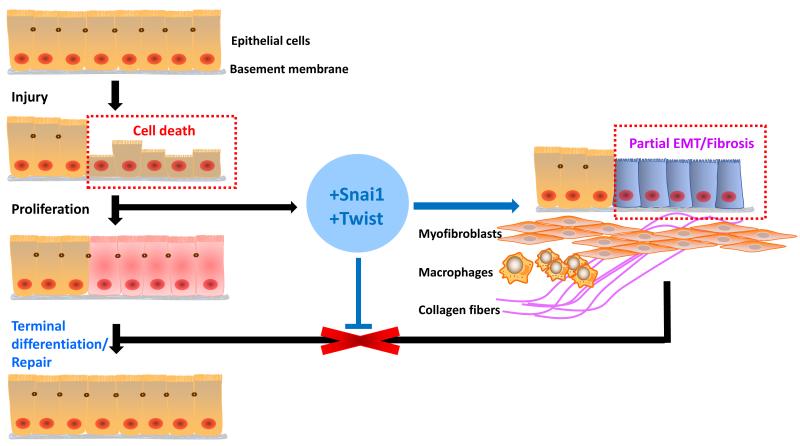
Chronic kidney disease is characterized by increased TEC death. Cell death triggers a regenerative process, including epithelial cell proliferation. Expression of Snai1 and Twist prohibits TEC differentiation and results in myofibroblast and inflammatory cell accumulation and fibrosis development. Blocking Snai1 and Twist expression allows the differentiation of epithelial cells and ameliorates fibrosis.
Comment on
-
Snail1-induced partial epithelial-to-mesenchymal transition drives renal fibrosis in mice and can be targeted to reverse established disease.Nat Med. 2015 Sep;21(9):989-97. doi: 10.1038/nm.3901. Epub 2015 Aug 3. Nat Med. 2015. PMID: 26236989
-
Epithelial-to-mesenchymal transition induces cell cycle arrest and parenchymal damage in renal fibrosis.Nat Med. 2015 Sep;21(9):998-1009. doi: 10.1038/nm.3902. Epub 2015 Aug 3. Nat Med. 2015. PMID: 26236991 Free PMC article.
References
-
- Grande MT, Sanchez-Laorden B, Lopez-Blau C, De Frutos CA, Boutet A, Arevalo M, Nieto MA. Snail1-induced partial epithelial-to mesenchymal transition drives renal fibrosis in mice and can be targeted to reverse established disease. Nat Med. 2015 - PubMed
Publication types
MeSH terms
Substances
Grants and funding
LinkOut - more resources
Full Text Sources
Other Literature Sources
Research Materials
