Comparative Study
. 2016 Mar;91(3):322-9.
doi: 10.1002/ajh.24285.

Pediatric-inspired therapy compared to allografting for Philadelphia chromosome-negative adult ALL in first complete remission

Affiliations
Comparative Study

Pediatric-inspired therapy compared to allografting for Philadelphia chromosome-negative adult ALL in first complete remission

Matthew D Seftel et al. Am J Hematol. 2016 Mar.

Abstract

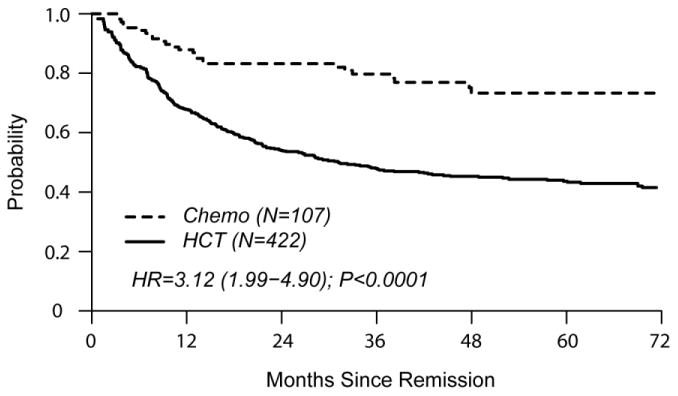
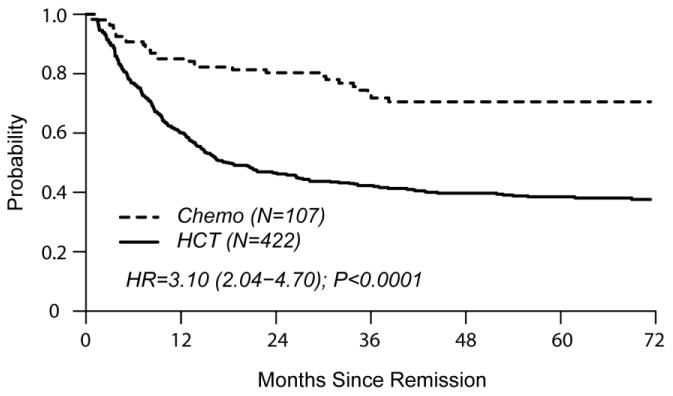
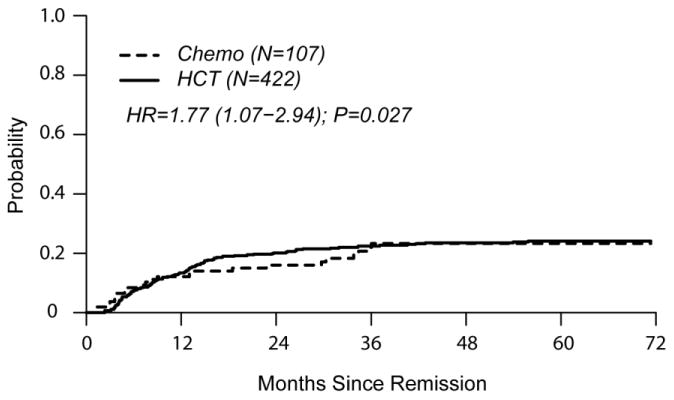
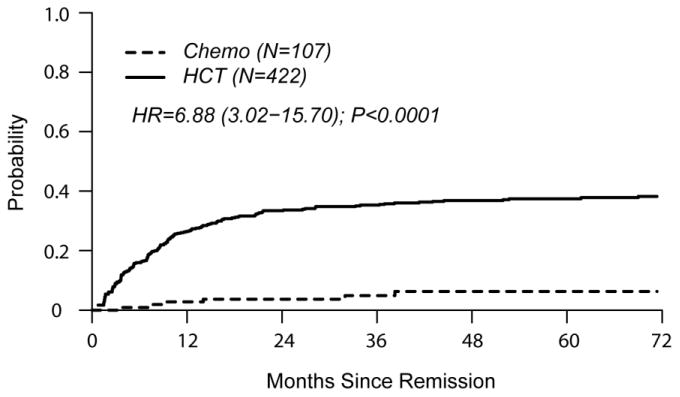
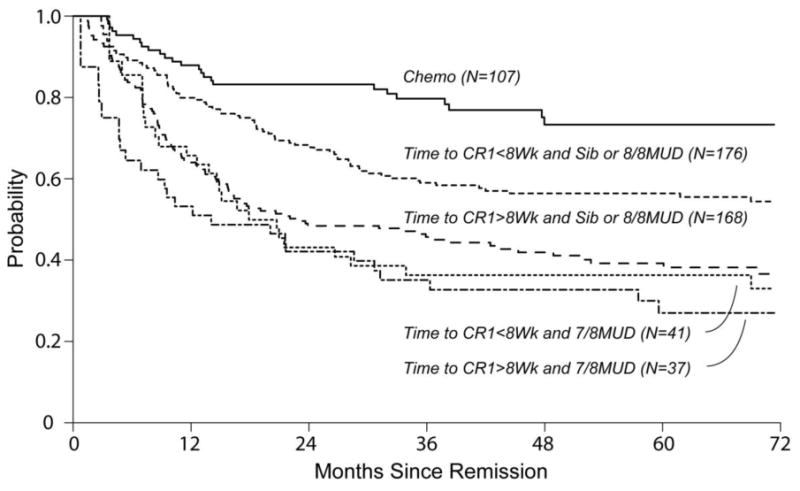
For adults with Philadelphia chromosome-negative (Ph-) acute lymphoblastic leukemia (ALL) in first complete remission (CR1), allogeneic hematopoietic cell transplantation (HCT) is an established curative strategy. However, pediatric-inspired chemotherapy may also offer durable leukemia-free survival in the absence of HCT. We compared 422 HCT recipients aged 18-50 years with Ph-ALL in CR1 reported to the CIBMTR with an age-matched concurrent cohort of 108 Ph- ALL CR1 patients who received a Dana-Farber Consortium pediatric-inspired non-HCT regimen. At 4 years of follow-up, incidence of relapse after HCT was 24% (95% CI 19-28) versus 23% (95% CI 15-32) for the non-HCT (chemo) cohort (P=0.97). Treatment-related mortality (TRM) was higher in the HCT cohort [HCT 37% (95% CI 31-42) versus chemo 6% (95% CI 3-12), P<0.0001]. DFS in the HCT cohort was 40% (95% CI 35-45) versus 71% (95% CI 60-79) for chemo, P<0.0001. Similarly, OS favored chemo [HCT 45% (95% CI 40-50)] versus chemo 73% [(95% CI 63-81), P<0.0001]. In multivariable analysis, the sole factor predictive of shorter OS was the administration of HCT [hazard ratio 3.12 (1.99-4.90), P<0.0001]. For younger adults with Ph- ALL, pediatric-inspired chemotherapy had lower TRM, no increase in relapse, and superior overall survival compared to HCT. Am. J. Hematol. 91:322-329, 2016. © 2015 Wiley Periodicals, Inc.


Conflict of interest statement

Conflict-of-interest disclosure: The authors do not have conflicts of interest to declare.

Figures

Figure 1
Figure 1
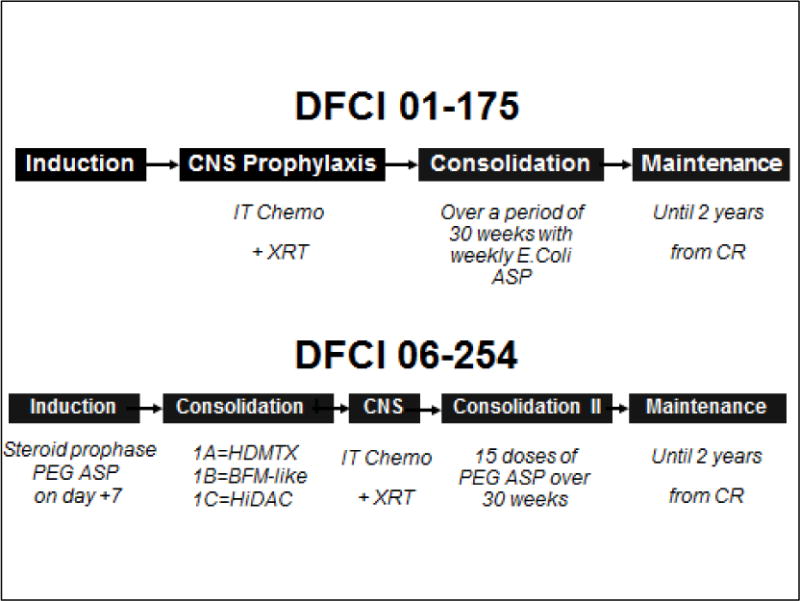
Overall Schema of the Dana Farber Cancer Institute (DFCI) adult ALL Consortium regimens in trials 01-175 and 06-254 trials, CNS: Central Nervous System; IT: Intrathecal; XRT: Cranial Irradiation; ASP: L-Asparaginase; CR: Complete Remission; PEG: Pegylated; HDMTX: High dose Methotrexate; BFML Berlin-Frankfurt-Münster; HiDAC: High dose cytarabine;
Figure 2
Figure 2
Comparison of outcomes of Chemotherapy only regimen (chemo) and allogeneic hematopoietic cell transplantation (HCT) (a) Overall Survival (b) Disease Free Survival (c) Cumulative Incidence of Relapse (d) Cumulative Incidence of Treatment Related Mortality (e) Kaplan Meier Estimate of Overall Survival Comparing Chemotherapy Patients To Sub-Groups Of HCT Recipients
Figure 2
Figure 2
Comparison of outcomes of Chemotherapy only regimen (chemo) and allogeneic hematopoietic cell transplantation (HCT) (a) Overall Survival (b) Disease Free Survival (c) Cumulative Incidence of Relapse (d) Cumulative Incidence of Treatment Related Mortality (e) Kaplan Meier Estimate of Overall Survival Comparing Chemotherapy Patients To Sub-Groups Of HCT Recipients
Figure 2
Figure 2
Comparison of outcomes of Chemotherapy only regimen (chemo) and allogeneic hematopoietic cell transplantation (HCT) (a) Overall Survival (b) Disease Free Survival (c) Cumulative Incidence of Relapse (d) Cumulative Incidence of Treatment Related Mortality (e) Kaplan Meier Estimate of Overall Survival Comparing Chemotherapy Patients To Sub-Groups Of HCT Recipients
Figure 2
Figure 2
Comparison of outcomes of Chemotherapy only regimen (chemo) and allogeneic hematopoietic cell transplantation (HCT) (a) Overall Survival (b) Disease Free Survival (c) Cumulative Incidence of Relapse (d) Cumulative Incidence of Treatment Related Mortality (e) Kaplan Meier Estimate of Overall Survival Comparing Chemotherapy Patients To Sub-Groups Of HCT Recipients
Figure 2
Figure 2
Comparison of outcomes of Chemotherapy only regimen (chemo) and allogeneic hematopoietic cell transplantation (HCT) (a) Overall Survival (b) Disease Free Survival (c) Cumulative Incidence of Relapse (d) Cumulative Incidence of Treatment Related Mortality (e) Kaplan Meier Estimate of Overall Survival Comparing Chemotherapy Patients To Sub-Groups Of HCT Recipients

References

    1. Stock W, Johnson JL, Stone RM, et al. Dose intensification of daunorubicin and cytarabine during treatment of adult acute lymphoblastic leukemia: results of Cancer and Leukemia Group B Study 19802. Cancer. 2013;119(1):90. - PMC - PubMed
    1. Thomas D, O'Brien S, Faderl S, et al. Anthracycline dose intensification in adult acute lymphoblastic leukemia: lack of benefit in the context of the fractionated cyclophosphamide, vincristine, doxorubicin, and dexamethasone regimen. Cancer. 2010;116(19):4580–458. - PMC - PubMed
    1. Goldstone AH, Richards SM, Lazarus HM, et al. In adults with standard-risk acute lymphoblastic leukemia, the greatest benefit is achieved from a matched sibling allogeneic transplantation in first complete remission, and an autologous transplantation is less effective than conventional consolidation/maintenance chemotherapy in all patients: final results of the International ALL Trial (MRC UKALL XII/ECOG E2993) Blood. 2008;111(4):1827–1833. - PubMed
    1. Silverman LB, Stevenson KE, O'Brien JE, et al. Long-term results of Dana-Farber Cancer Institute ALL Consortium protocols for children with newly diagnosed acute lymphoblastic leukemia (1985-2000) Leukemia. 2010;24(2):320–334. - PMC - PubMed
    1. Barry E, DeAngelo DJ, Neuberg D, et al. Favorable outcome for adolescents with acute lymphoblastic leukemia treated on Dana-Farber Cancer Institute Acute Lymphoblastic Leukemia Consortium Protocols. J Clin Oncol. 2007;25(7):813–819. - PubMed

Publication types

MeSH terms