


Sequence variation of 22 autosomal STR loci detected by next generation sequencing
- PMID: 26701720
- PMCID: PMC5093907
- DOI: 10.1016/j.fsigen.2015.11.005
Sequence variation of 22 autosomal STR loci detected by next generation sequencing
Abstract
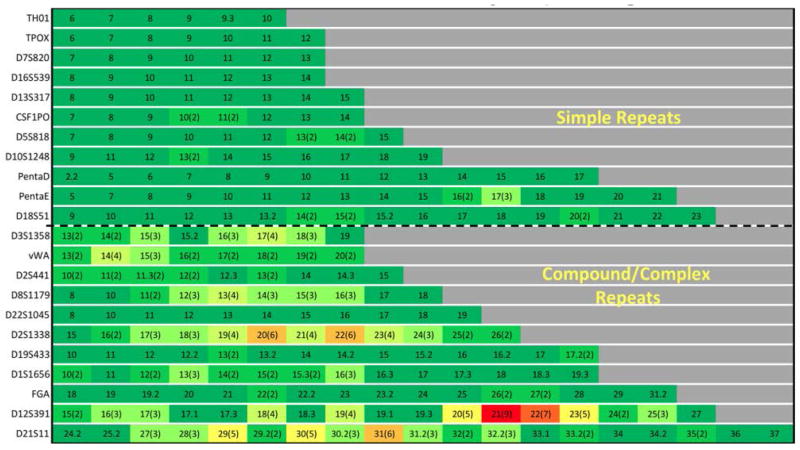
Sequencing short tandem repeat (STR) loci allows for determination of repeat motif variations within the STR (or entire PCR amplicon) which cannot be ascertained by size-based PCR fragment analysis. Sanger sequencing has been used in research laboratories to further characterize STR loci, but is impractical for routine forensic use due to the laborious nature of the procedure in general and additional steps required to separate heterozygous alleles. Recent advances in library preparation methods enable high-throughput next generation sequencing (NGS) and technological improvements in sequencing chemistries now offer sufficient read lengths to encompass STR alleles. Herein, we present sequencing results from 183 DNA samples, including African American, Caucasian, and Hispanic individuals, at 22 autosomal forensic STR loci using an assay designed for NGS. The resulting dataset has been used to perform population genetic analyses of allelic diversity by length compared to sequence, and exemplifies which loci are likely to achieve the greatest gains in discrimination via sequencing. Within this data set, six loci demonstrate greater than double the number of alleles obtained by sequence compared to the number of alleles obtained by length: D12S391, D2S1338, D21S11, D8S1179, vWA, and D3S1358. As expected, repeat region sequences which had not previously been reported in forensic literature were identified.
Keywords: Next generation sequencing; Population genetics; STR.
Published by Elsevier Ireland Ltd.
Figures
References
-
- Kline MC, Hill CR, Decker AE, Butler JM. STR sequence analysis for characterizing normal, variant, and null alleles. Forensic Sci Int Genet. 2011;5:329–332. - PubMed
-
- Allor C, Einum DD, Scarpetta M. Identification and characterization of variant alleles at CODIS STR loci. J Forensic Sci. 2005;50:1128–1133. - PubMed
-
- Dauber EM, Kratzer A, Neuhuber F, Parson W, Klintschar M, Bar W, et al. Germline mutations of STR-alleles include multi-step mutations as defined by sequencing of repeat and flanking regions. Forensic Sci Int Genet. 2012;6:381–386. - PubMed
-
- Griffiths RAL, Barber MD, Johnson PE, Gillbard SM, Haywood MD, Smith CD, et al. New reference allelic ladders to improve allelic designation in a multiplex STR system. Int J Legal Med. 1998;111:267–272. - PubMed
MeSH terms
Substances
Grants and funding
LinkOut - more resources
Full Text Sources
Other Literature Sources
Research Materials
