


Statistical Validation of a Web-Based GIS Application and Its Applicability to Cardiovascular-Related Studies
- PMID: 26703652
- PMCID: PMC4730393
- DOI: 10.3390/ijerph13010002
Statistical Validation of a Web-Based GIS Application and Its Applicability to Cardiovascular-Related Studies
Abstract
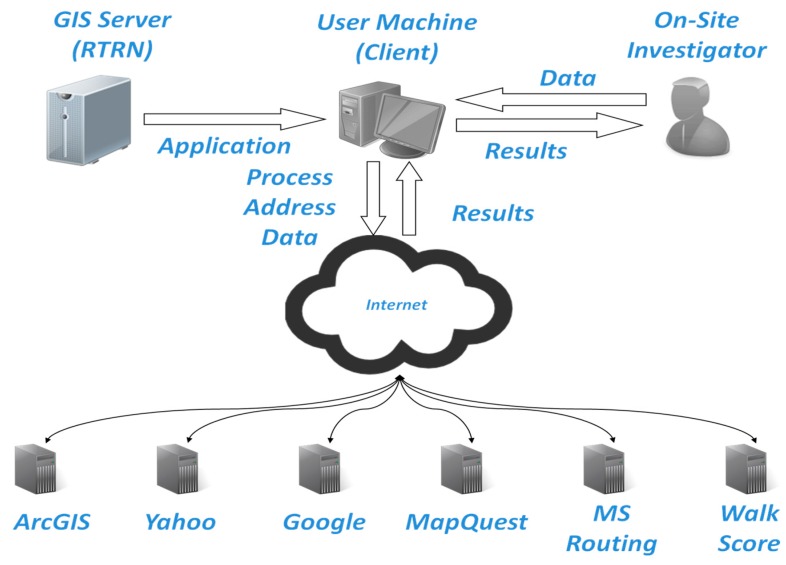
Purpose: There is abundant evidence that neighborhood characteristics are significantly linked to the health of the inhabitants of a given space within a given time frame. This study is to statistically validate a web-based GIS application designed to support cardiovascular-related research developed by the NIH funded Research Centers in Minority Institutions (RCMI) Translational Research Network (RTRN) Data Coordinating Center (DCC) and discuss its applicability to cardiovascular studies.
Methods: Geo-referencing, geocoding and geospatial analyses were conducted for 500 randomly selected home addresses in a U.S. southeastern Metropolitan area. The correlation coefficient, factor analysis and Cronbach's alpha (α) were estimated to quantify measures of the internal consistency, reliability and construct/criterion/discriminant validity of the cardiovascular-related geospatial variables (walk score, number of hospitals, fast food restaurants, parks and sidewalks).
Results: Cronbach's α for CVD GEOSPATIAL variables was 95.5%, implying successful internal consistency. Walk scores were significantly correlated with number of hospitals (r = 0.715; p < 0.0001), fast food restaurants (r = 0.729; p < 0.0001), parks (r = 0.773; p < 0.0001) and sidewalks (r = 0.648; p < 0.0001) within a mile from homes. It was also significantly associated with diversity index (r = 0.138, p = 0.0023), median household incomes (r = -0.181; p < 0.0001), and owner occupied rates (r = -0.440; p < 0.0001). However, its non-significant correlation was found with median age, vulnerability, unemployment rate, labor force, and population growth rate.
Conclusion: Our data demonstrates that geospatial data generated by the web-based application were internally consistent and demonstrated satisfactory validity. Therefore, the GIS application may be useful to apply to cardiovascular-related studies aimed to investigate potential impact of geospatial factors on diseases and/or the long-term effect of clinical trials.
Keywords: Statistical validation; accessibility to healthcare facilities; density of fast-food restaurant; social determinants of cardiovascular disease; walkability; web-based GIS application.
Figures

References
-
- Fradgley E.A., Paul C.L., Bryant J. A systematic review of barriers to optimal outpatient specialist services for individuals with prevalent chronic diseases: What are the unique and common barriers experienced by patients in high income countries? Int. J. Equity Health. 2015;14 doi: 10.1186/s12939-015-0179-6. - DOI - PMC - PubMed
-
- Yang Y.T., Iqbal U., Ko H.L., Wu C.R., Chiu H.T., Lin Y.C., Lin W., Elsa Y.H. The relationship between accessibility of healthcare facilities and medical care utilization among the middle-aged and elderly population in Taiwan. Int. J. Qual. Health Care. 2015;27:222–231. doi: 10.1093/intqhc/mzv024. - DOI - PubMed
-
- Casey A.A., Elliott M., Glanz K., Haire-Joshu D., Lovegreen S.L., Saelens B.E., Sallis J.F., Brownson R.C. Impact of the food environment and physical activity environment on behaviors and weight status in rural U.S. communities. Prev. Med. 2008;47:600–604. doi: 10.1016/j.ypmed.2008.10.001. - DOI - PMC - PubMed
Publication types
MeSH terms
Grants and funding
LinkOut - more resources
Full Text Sources
Other Literature Sources
Medical
