


Technologies for Arsenic Removal from Water: Current Status and Future Perspectives
- PMID: 26703687
- PMCID: PMC4730453
- DOI: 10.3390/ijerph13010062
Technologies for Arsenic Removal from Water: Current Status and Future Perspectives
Abstract
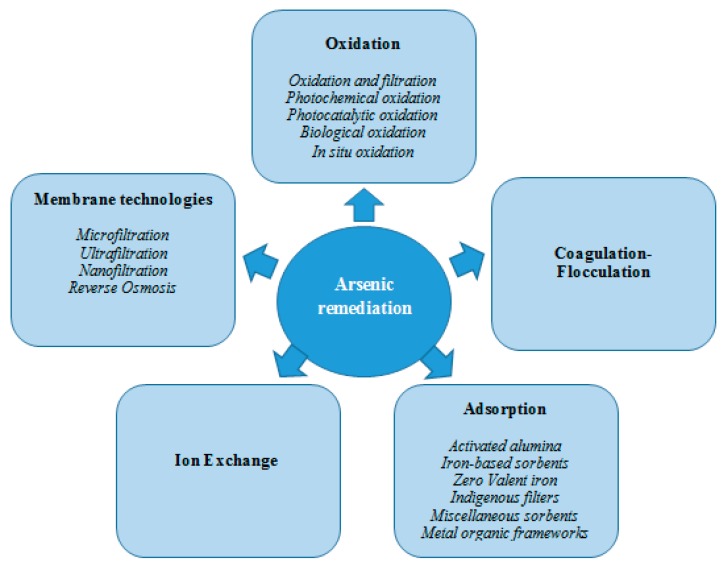
This review paper presents an overview of the available technologies used nowadays for the removal of arsenic species from water. Conventionally applied techniques to remove arsenic species include oxidation, coagulation-flocculation, and membrane techniques. Besides, progress has recently been made on the utility of various nanoparticles for the remediation of contaminated water. A critical analysis of the most widely investigated nanoparticles is presented and promising future research on novel porous materials, such as metal organic frameworks, is suggested.
Keywords: adsorption; arsenic; engineered nanoparticles; metal organic framework; pollution; water purification technology.
Figures

References
-
- Lowenbach W., Schlessinger J. Arsenic: A Preliminary Materials Balance. Lowenbach and Schlesinger Associates; Washington, DC, USA: 1979.
-
- Pous N., Casentini B., Rossetti S., Fazi S., Puig S., Aulenta F. Anaerobic arsenite oxidation with an electrode serving as the sole electron acceptor: A novel approach to the bioremediation of arsenic-polluted groundwater. J. Hazard. Mater. 2015;283:617–622. doi: 10.1016/j.jhazmat.2014.10.014. - DOI - PubMed
Publication types
MeSH terms
Substances
LinkOut - more resources
Full Text Sources
Other Literature Sources
Medical
