


Comparison of Transbronchial and Cryobiopsies in Evaluation of Diffuse Parenchymal Lung Disease
- PMID: 26705007
- PMCID: PMC4864578
- DOI: 10.1097/LBR.0000000000000246
Comparison of Transbronchial and Cryobiopsies in Evaluation of Diffuse Parenchymal Lung Disease
Abstract
Background: Diffuse parenchymal lung diseases (DPLDs) are common. An accurate diagnosis is essential due to differences in etiology, clinicopathologic features, therapeutic options, and prognosis. Transbronchial lung biopsies (TBLBs) are often limited by small specimen size, crush artifact, and other factors. Transbronchial lung cryobiopsies (TBLCs) are under investigation to overcome these limitations.
Methods: We conducted a retrospective study of 56 patients in a single, tertiary-care academic center to compare the yield of both techniques when performed in the same patient. Patients underwent flexible bronchoscopy using moderate sedation with TBLB followed by TBLC in the most radiographically abnormal areas. Clinical data and postprocedural outcomes were reviewed, with a final diagnosis made utilizing a multidisciplinary approach.
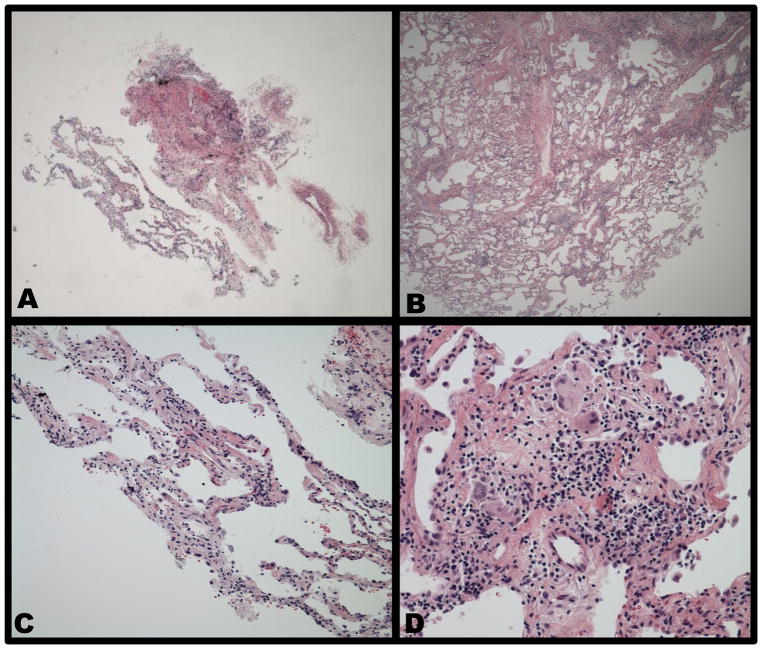
Results: The mean age of patients was 60 years and 54% were male. Comorbidities included COPD (14%) and prior malignancy (48%). The number of TBLB specimens ranged from 1 to 10 per patient (mean 4) and size varied from 0.1 to 0.8 cm. The number of TBLC specimens ranged from 1 to 4 per patient (mean 2) and size ranged from 0.4 to 2.6 cm. Both techniques provided the same diagnosis in 26 patients (46%). An additional 11 (20%) patients had a diagnosis established by adding TBLC to TBLB. Compared with TBLB, TBLC had a higher diagnostic yield in patients with hypersensitivity pneumonitis and interstitial lung disease. Only 2 patients required video-assisted thoracoscopic surgery to establish a diagnosis. Complications included pneumothorax (20%) and massive hemoptysis (2%).
Conclusion: TBLC used with TBLB can improve the diagnostic yield of flexible bronchoscopy in patients with DPLD.
Conflict of interest statement
Conflicts of Interest: None
Figures
Comment in
-
Cryobiopsy, Endobronchial Ultrasound Staging of the Mediastinum, and Endobronchial Coils.Am J Respir Crit Care Med. 2017 Feb 1;195(3):394-396. doi: 10.1164/rccm.201609-1840RR. Am J Respir Crit Care Med. 2017. PMID: 27911567 No abstract available.
References
-
- Maher TM. A Clinical Approach to Diffuse Parenchymal Lung Disease. Immunol Allergy Clin North Am. 2012 Nov;32(4):453–72. - PubMed
-
- Maher TM. Diffuse parenchymal lung disease. Medicine. 2012;40:314–21.
-
- Pajares V, Puzo C, Castillo D, et al. Diagnostic yield of transbronchial cryobiopsy in interstitial lung disease: a randomized trial. Respirology. 2014 Aug;19(6):900–6. - PubMed
-
- Poletti V, Casoni GL, Gurioli C, et al. Lung cryobiopsies: a paradigm shift in diagnostic bronchoscopy ? Respirology. 2014 Jul;19(5):645–54. - PubMed
-
- Hetzel J, Hetzel M, Hasel C, et al. Old Meets Modern : The use of traditional cryoprobes in the age of molecular biology. Respiration. 2008;76:193–197. - PubMed
Publication types
MeSH terms
Grants and funding
LinkOut - more resources
Full Text Sources
Other Literature Sources
Medical
