


Increased Risk of Dementia Among Sleep-Related Movement Disorders: A Population-Based Longitudinal Study in Taiwan
- PMID: 26705224
- PMCID: PMC4697990
- DOI: 10.1097/MD.0000000000002331
Increased Risk of Dementia Among Sleep-Related Movement Disorders: A Population-Based Longitudinal Study in Taiwan
Abstract
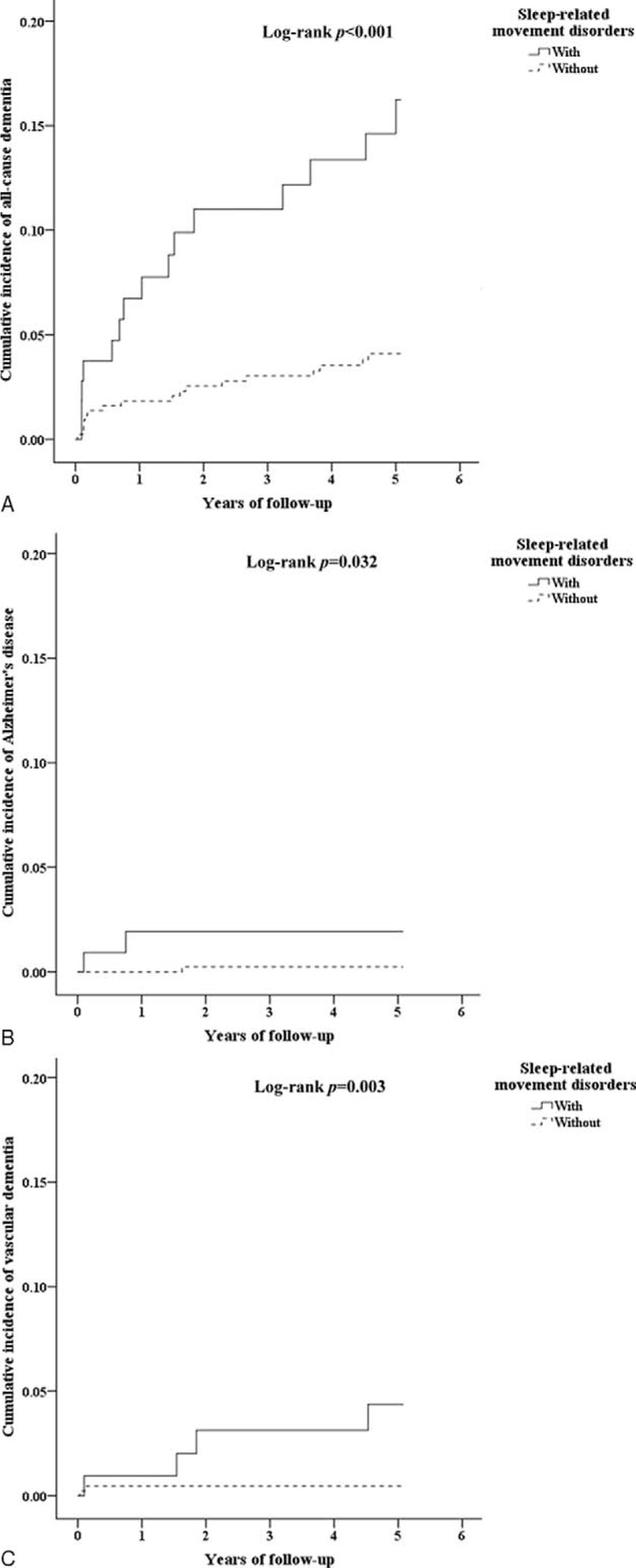
Sleep-related movement disorders (SRMD) are sleep disorders. As poor sleep quality is associated with cognitive impairment, we hypothesized that SRMD patients were exposed to a great risk for developing dementia.The present study was aimed to retrospectively examine the association of SRMD and dementia risk.A retrospective longitudinal study was conducted using the data obtained from the Longitudinal Health Insurance Database (LHID) in Taiwan. The study cohort enrolled 604 patients with SRMD who were initially diagnosed and 2416 patients who were randomly selected and age/gender matched with the study group. SRMD, dementia, and other confounding factors were defined according to International Classification of Diseases Clinical Modification Codes. Cox proportional-hazards regressions were employed to examine adjusted hazard ratios (HR) after adjusting with confounding factors.Our data revealed that patients with SRMD had a 3.952 times (95% CI = 1.124-4.767) higher risk to develop all-cause dementia compared with individuals without SRMD. The results showed that SRMD patients aged 45 to 64 exhibited highest risk of developing all-cause dementia (HR: 5.320, 95% CI = 1.770-5.991), followed by patients age ≥65 (HR: 4.123, 95% CI = 2.066-6.972) and <45 (HR: 3.170, 95% CI = 1.050-4.128), respectively. Females with SRMD were at greater risk to develop all-cause dementia (HR: 4.372, 95% CI = 1.175-5.624). The impact of SRMD on dementia risk was progressively increased by various follow-up time intervals (<1 year, 1-2 years, and ≥2 years).The results suggest that SRMD is linked to an increased risk for dementia with gender-dependent and time-dependent characteristics.
Conflict of interest statement
The authors have no funding and conflicts of interest to disclose.
Figures
References
-
- Badran M, Yassin BA, Fox N, et al. Epidemiology of sleep disturbances and cardiovascular consequences. Can J Cardiol 2015; 31:873. - PubMed
-
- Larcher S, Benhamou PY, Pepin JL, et al. Sleep habits and diabetes. Diabetes Metab 2015; 41:263. - PubMed
-
- Gama RL, Tavora DG, Bomfim RC, et al. Sleep disturbances and brain MRI morphometry in Parkinson's disease, multiple system atrophy and progressive supranuclear palsy – a comparative study. Parkinsonism Relat Disord 2010; 16:275. - PubMed
-
- Rye DB. Excessive daytime sleepiness and unintended sleep in Parkinson's disease. Curr Neurol Neurosci Rep 2006; 6:169. - PubMed
-
- Zucconi M, Ferini-Strambi L. Epidemiology and clinical findings of restless legs syndrome. Sleep Med 2004; 5:293. - PubMed
Publication types
MeSH terms
LinkOut - more resources
Full Text Sources
Medical
