


Impairments in the Face-Processing Network in Developmental Prosopagnosia and Semantic Dementia
- PMID: 26705265
- PMCID: PMC4692170
- DOI: 10.1097/WNN.0000000000000077
Impairments in the Face-Processing Network in Developmental Prosopagnosia and Semantic Dementia
Abstract
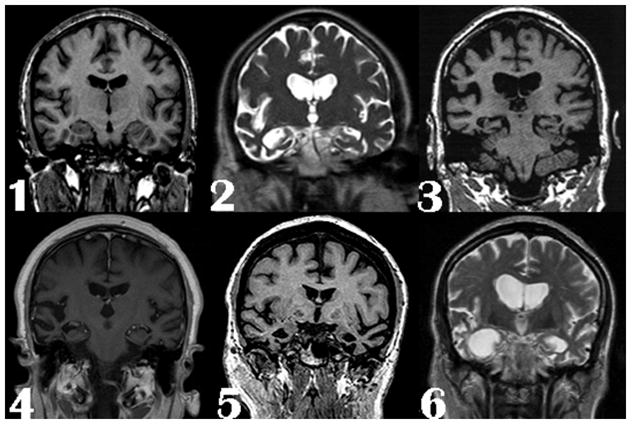
Background: Developmental prosopagnosia (DP) and semantic dementia (SD) may be the two most common neurologic disorders of face processing, but their main clinical and pathophysiologic differences have not been established. To identify those features, we compared patients with DP and SD.
Methods: Five patients with DP, five with right temporal-predominant SD, and ten normal controls underwent cognitive, visual perceptual, and face-processing tasks.
Results: Although the patients with SD were more cognitively impaired than those with DP, the two groups did not differ statistically on the visual perceptual tests. On the face-processing tasks, the DP group had difficulty with configural analysis and they reported relying on serial, feature-by-feature analysis or awareness of salient features to recognize faces. By contrast, the SD group had problems with person knowledge and made semantically related errors. The SD group had better face familiarity scores, suggesting a potentially useful clinical test for distinguishing SD from DP.
Conclusions: These two disorders of face processing represent clinically distinguishable disturbances along a right hemisphere face-processing network: DP, characterized by early configural agnosia for faces, and SD, characterized primarily by a multimodal person knowledge disorder. We discuss these preliminary findings in the context of the current literature on the face-processing network; recent studies suggest an additional right anterior temporal, unimodal face familiarity-memory deficit consistent with an "associative prosopagnosia."
Conflict of interest statement
The authors declare no conflicts of interest.
Figures
References
-
- Avidan G, Hasson U, Malach R, et al. Detailed exploration of face-related processing in congenital prosopagnosia: 2. Functional neuroimaging findings. J Cogn Neurosci. 2005;17:1150–1167. - PubMed
-
- Baron-Cohen S, Wheelwright S, Skinner R, et al. The autism-spectrum quotient (AQ): evidence from Asperger syndrome/high-functioning autism, males and females, scientists and mathematicians. J Autism Dev Disord. 2001;31:5–17. - PubMed
-
- Barton JJ. Structure and function in acquired prosopagnosia: lessons from a series of 10 patients with brain damage. J Neuropsychol. 2008;2(Pt 1):197–225. - PubMed
-
- Barton JJ. What is meant by impaired configural processing in acquired prosopagnosia? Perception. 2009;38:242–260. - PubMed
Publication types
MeSH terms
Grants and funding
LinkOut - more resources
Full Text Sources
