


Comparing the Cost of Care Provided to Medicare Beneficiaries Assigned to Primary Care Nurse Practitioners and Physicians
- PMID: 26707840
- PMCID: PMC4946030
- DOI: 10.1111/1475-6773.12425
Comparing the Cost of Care Provided to Medicare Beneficiaries Assigned to Primary Care Nurse Practitioners and Physicians
Abstract
Objective: This study is designed to assess the cost of services provided to Medicare beneficiaries by nurse practitioners (NPs) billing under their own National Provider Identification number as compared to primary care physicians (PCMDs).
Data source: Medicare Part A (inpatient) and Part B (office visit) claims for 2009-2010.
Study design: Retrospective cohort design using propensity score weighted regression.
Data extraction methods: Beneficiaries cared for by a random sample of NPs and primary care physicians.
Principal findings: After adjusting for demographic characteristics, geography, comorbidities, and the propensity to see an NP, Medicare evaluation and management payments for beneficiaries assigned to an NP were $207, or 29 percent, less than PCMD assigned beneficiaries. The same pattern was observed for inpatient and total office visit paid amounts, with 11 and 18 percent less for NP assigned beneficiaries, respectively. Results are similar for the work component of relative value units as well.
Conclusions: This study provides new evidence of the lower cost of care for beneficiaries managed by NPs, as compared to those managed by PCMDs across inpatient and office-based settings. Results suggest that increasing access to NP primary care will not increase costs for the Medicare program and may be cost saving.
Keywords: Nurse practitioner; cost; primary care.
© Health Research and Educational Trust.
Figures
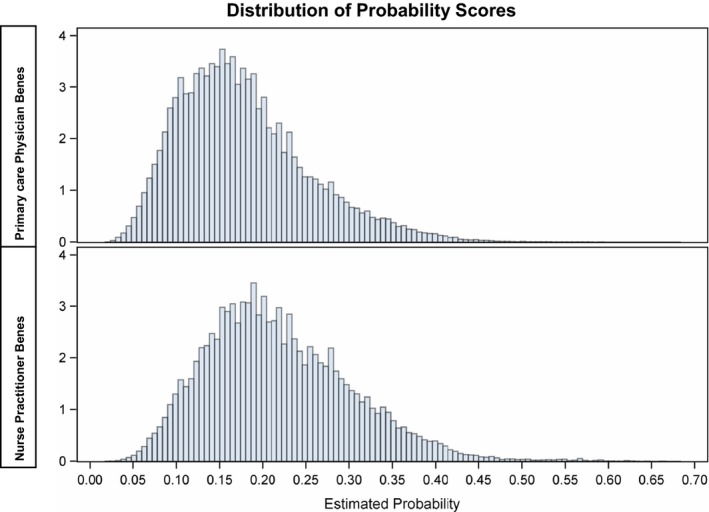
Note: Results based on 30 percent attribution threshold.
References
-
- Berenson, R. A. , and Kaye D. R.. 2013. “Grading a Physician's Value — The Misapplication of Performance Measurement.” New England Journal of Medicine 369 (22): 2079–81. - PubMed
-
- Bodenheimer, T. S. , and Smith M. D.. 2013. “Primary Care: Proposed Solutions to the Physician Shortage without Training More Physicians.” Health Affairs 32 (11): 1881–6. - PubMed
-
- Brooten, D. , Naylor M. D., York R., Brown L. P., Munro B. H., Hollingsworth A. O., Cohen S. M., Finkler S., Deatrick J., and Youngblut J. M.. 2002. “Lessons Learned from Testing the Quality Cost Model of Advanced Practice Nursing (APN) Transitional Care.” Journal of Nursing Scholarship 34 (4): 369–75. - PMC - PubMed
-
- Caliendo, M. , and Kopeining S.. 2008. “Some Practical Guidance for the Implementation of Propensity Score Matching.” Journal of Economic Surveys 22 (1): 31–72.
-
- Chien, A. T. , and Rosenthal M. B.. 2013. “Medicare's Physician Value‐Based Payment Modifier — Will the Tectonic Shift Create Waves?” New England Journal of Medicine 369 (22): 2076–8. - PubMed
Publication types
MeSH terms
LinkOut - more resources
Full Text Sources
Other Literature Sources
Medical
Miscellaneous
