


VDAC-2: Mitochondrial outer membrane regulator masquerading as a channel?
- PMID: 26709731
- PMCID: PMC6258906
- DOI: 10.1111/febs.13637
VDAC-2: Mitochondrial outer membrane regulator masquerading as a channel?
Abstract
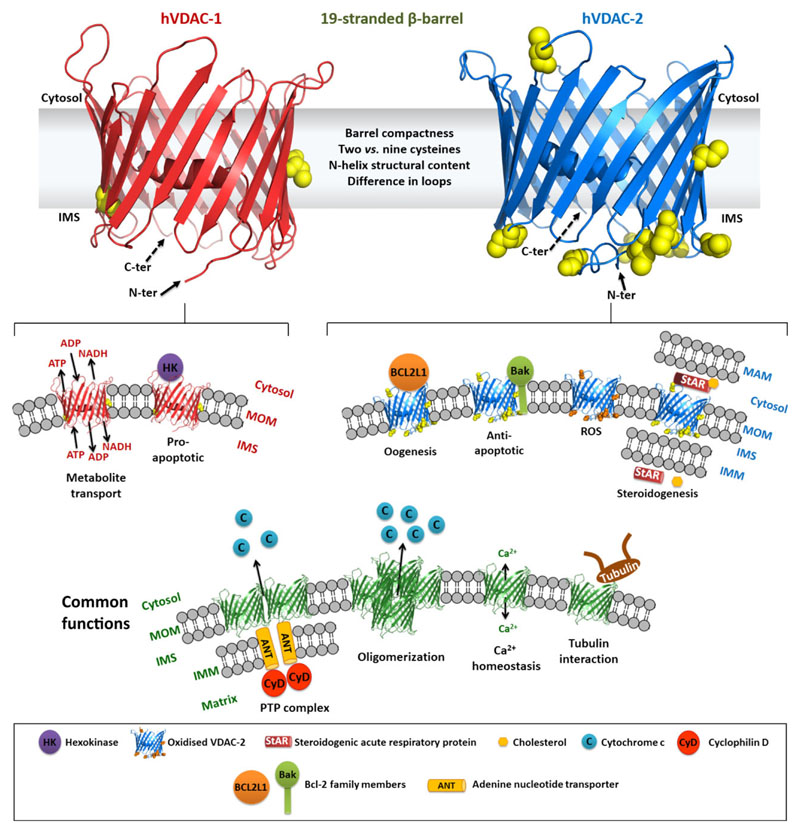
The voltage-dependent anion channels (VDACs) are the workforce of mitochondrial transport and as such are required for cellular metabolism. The elaborate interplay between mitochondria and the apoptotic pathway supports a role for VDACs as a major regulator of cell death. Although VDAC-1 has an established role in apoptosis and cell homeostasis, the role of VDAC-2 has been controversial. In humans, VDAC-2 is best known for its anti-apoptotic properties. In this Viewpoint, we associate the various functional studies on VDAC-2 with structural reports, to decode its unique behavior. The well-structured N-terminus, compact barrel form, differences in the loop regions, specific transmembrane segments and the abundance of thiols in VDAC-2 enable this isoform to perform a different subset of regulatory functions, establish anti-apoptotic features and contribute to gametogenesis. VDAC-2 structural features that demarcate it from VDAC-1 suggest that this particular isoform is better suited for regulating reactive oxygen species, steroidogenesis and mitochondria-associated endoplasmic reticulum membrane regulatory pathways, with ion transport forming a secondary role. A better understanding of the unique structural features of the VDAC family will aid in the design of inhibitors that could alleviate irregularities in VDAC-controlled pathways.
Keywords: apoptosis; cysteines; mitochondrial outer membrane; voltage-dependent anion channel; β-barrel proteins.
© 2015 Federation of European Biochemical Societies.
Figures
References
-
- Shoshan-Barmatz V, Israelson A, Brdiczka D, Sheu SS. The voltage-dependent anion channel (VDAC): function in intracellular signalling, cell life and cell death. Curr Pharm Des. 2006;12:2249–2270. - PubMed
-
- Shoshan-Barmatz V, Ben-Hail D, Admoni L, Krelin Y, Tripathi SS. The mitochondrial voltagedependent anion channel 1 in tumor cells. Biochim Biophys Acta. 2015;1848:2547–2575. - PubMed
-
- Messina A, Reina S, Guarino F, De Pinto V. VDAC isoforms in mammals. Biochim Biophys Acta. 2012;1818:1466–1476. - PubMed
-
- Vianello A, Casolo V, Petrussa E, Peresson C, Patui S, Bertolini A, Passamonti S, Braidot E, Zancani M. The mitochondrial permeability transition pore (PTP) - an example of multiple molecular exaptation? Biochim Biophys Acta. 2012;1817:2072–2086. - PubMed
-
- Cheng EH, Sheiko TV, Fisher JK, Craigen WJ, Korsmeyer SJ. VDAC2 inhibits BAK activation and mitochondrial apoptosis. Science. 2003;301:513–517. - PubMed
Publication types
MeSH terms
Substances
Grants and funding
LinkOut - more resources
Full Text Sources
Other Literature Sources
