


Brief Motivational Interviewing and Normative Feedback for Adolescents: Change Language and Alcohol Use Outcomes
- PMID: 26710670
- PMCID: PMC5333945
- DOI: 10.1016/j.jsat.2015.10.004
Brief Motivational Interviewing and Normative Feedback for Adolescents: Change Language and Alcohol Use Outcomes
Abstract
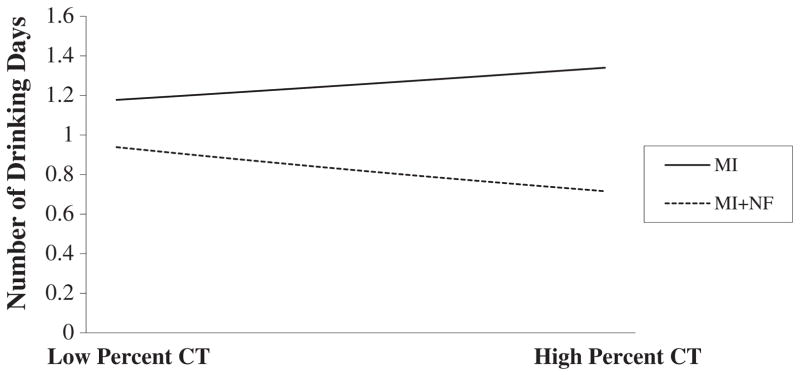
Few studies have investigated the impact of adolescent change language on substance use treatment outcomes and even fewer have examined how adolescents respond to normative feedback. The purpose of this study was to understand the influence normative feedback has on adolescent change language and subsequent alcohol and cannabis use 3months later. We examined how percent change talk (PCT) was associated with subsequent alcohol and drug use outcomes. Adolescents (N=48) were randomly assigned to receive brief motivational interviewing (MI) or MI plus normative feedback (NF). Audio recordings were coded with high interrater reliability. Adolescents with high PCT who received MI+NF had significantly fewer days of alcohol and binge drinking at follow up. There were no differences between groups on cannabis use or treatment engagement. Findings indicate that NF may be useful for adolescents with higher amount of change talk during sessions and may be detrimental for individuals with higher sustain talk.
Keywords: Adolescents; Alcohol treatment; Cannabis use; Change talk; Motivational interviewing.
Copyright © 2015 Elsevier Inc. All rights reserved.
Figures


References
-
- Allison PD. Missing data: Quantitative applications in the social sciences. British Journal of Mathematical and Statistical Psychology. 2002;55(1):193–196.
-
- American Psychiatric Association. Diagnostic and statistical manual of mental disorders. 5. Arlington, VA: American Psychiatric Publishing; 2013.
-
- Amrhein PC, Miller WR, Yahne CE, Palmer M, Fulcher L. Client commitment language during motivational interviewing predicts drug use outcomes. Journal of Consulting and Clinical Psychology. 2003;71(5):862–878. - PubMed
Publication types
MeSH terms
Grants and funding
LinkOut - more resources
Full Text Sources
Other Literature Sources
Medical
