Review
. 2016 Feb;28(1):45-53.
doi: 10.1016/j.smim.2015.11.006. Epub 2015 Dec 20.

Enhancing adoptive T cell immunotherapy with microRNA therapeutics

Affiliations
Review

Enhancing adoptive T cell immunotherapy with microRNA therapeutics

Yun Ji et al. Semin Immunol. 2016 Feb.

Abstract

Adoptive T cell-based immunotherapies can mediate complete and durable regressions in patients with advanced cancer, but current response rates remain inadequate. Maneuvers to improve the fitness and antitumor efficacy of transferred T cells have been under extensive exploration in the field. Small non-coding microRNAs have emerged as critical modulators of immune system homeostasis and T cell immunity. Here, we summarize recent advances in our understanding of the role of microRNAs in regulating T cell activation, differentiation, and function. We also discuss how microRNA therapeutics could be employed to fine-tune T cell receptor signaling and enhance T cell persistence and effector functions, paving the way for the next generation of adoptive immunotherapies.

Keywords: Adoptive cell transfer; CD8(+) T cells; Microrna (miRNA); T cell differentiation; Tumor immunotherapy.


Figures

Fig. 1
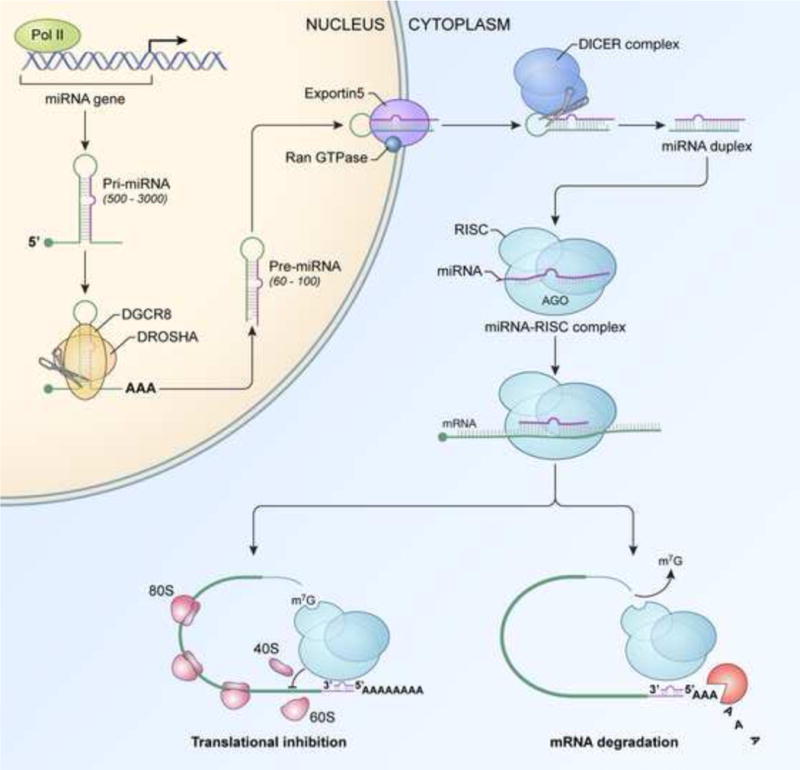
Fig. 1. MicroRNA biogenesis
The miRNA gene is transcribed into pri-miRNA by RNA polymerase II (Pol II) within the nucleus and processed into Pre-miRNA by the DROSHA-DGCR8 complex. Pre-miRNA is subsequently transported by Exportin5 and Ran GTPase into the cytoplasm and further processed by the DICER complex into a miRNA:miRNA duplex. Finally, mature miRNA binds to AGO (Argonaute) and is incorporated into the RISC (RNA-induced silencing complex), leading to mRNA degradation and inhibition of protein translation.
Fig. 2
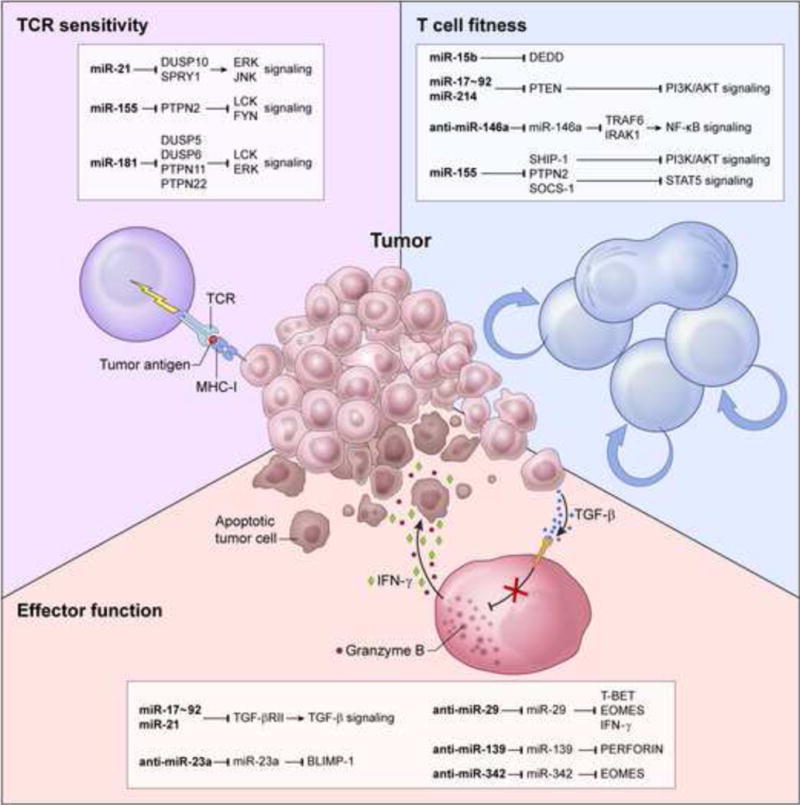
Fig. 2. Harnessing miRNA biology to enhance adoptive T cell immunotherapy
miRNA, anti-miRNA (bold font) and their downstream targets could be employed to augment tumor destruction by enhancing T cell receptor (TCR) sensitivity (upper left), T cell fitness (upper right), and effector functions (lower panel). DUSP, Dual Specificity Phosphatase; SPRY1, Sprouty Homolog 1; PTPN, Protein Tyrosine Phosphatase, Non-Receptor Type; JNK, JUN N-Terminal Kinase; DEDD, Death Effector Domain Containing; PTEN, Phosphatase And Tensin Homolog; TRAF6, TNF Receptor-Associated Factor 6; IRAK1, Interleukin-1 Receptor-Associated Kinase 1; SHIP-1, SH2 Domain-Containing Inositol 5-Phosphatase 1; SOCS-1, Suppressor Of Cytokine Signaling 1; PI3K, Phosphatidylinositol 3-Kinase; STAT5, Signal Transducer And Activator Of Transcription 5; TGF-β, Transforming Growth Factor, Beta; TGF-βRII, Transforming Growth Factor, Beta Receptor II; BLIMP1, B lymphocyte-induced maturation protein-1; EOMES, Eomesodermin; IFN-γ, interferon gamma.

References

    1. Maus MV, Fraietta JA, Levine BL, Kalos M, Zhao Y, June CH. Adoptive immunotherapy for cancer or viruses. Annual review of immunology. 2014;32:189–225. - PMC - PubMed
    1. Restifo NP, Dudley ME, Rosenberg SA. Adoptive immunotherapy for cancer: harnessing the T cell response. Nature reviews Immunology. 2012;12:269–281. - PMC - PubMed
    1. Gattinoni L, Klebanoff CA, Restifo NP. Paths to stemness: building the ultimate antitumour T cell. Nature reviews Cancer. 2012;12:671–684. - PMC - PubMed
    1. Joyce JA, Fearon DT. T cell exclusion, immune privilege, and the tumor microenvironment. Science. 2015;348:74–80. - PubMed
    1. Zou W. Immunosuppressive networks in the tumour environment and their therapeutic relevance. Nature reviews Cancer. 2005;5:263–274. - PubMed

Publication types

MeSH terms