. 2015 Dec 28;82(5):1569-76.
doi: 10.1128/AEM.03473-15.

Important Metabolic Pathways and Biological Processes Expressed by Chicken Cecal Microbiota

Affiliations

Important Metabolic Pathways and Biological Processes Expressed by Chicken Cecal Microbiota

Ondrej Polansky et al. Appl Environ Microbiol. .

Abstract

The gut microbiota plays important roles in its host. However, how each microbiota member contributes to the behavior of the whole population is not known. In this study, we therefore determined protein expression in the cecal microbiota in chickens of selected ages and in 7-day-old chickens inoculated with different cecal extracts on the day of hatching. Campylobacter, Helicobacter, Mucispirillum, and Megamonas overgrew in the ceca of 7-day-old chickens inoculated with cecal extracts from donor hens. Firmicutes were characterized by ABC and phosphotransferase system (PTS) transporters, extensive acyl coenzyme A (acyl-CoA) metabolism, and expression of l-fucose isomerase. Anaerostipes, Anaerotruncus, Pseudoflavonifractor, Dorea, Blautia, and Subdoligranulum expressed spore proteins. Firmicutes (Faecalibacterium, Butyrivibrio, Megasphaera, Subdoligranulum, Oscillibacter, Anaerostipes, and Anaerotruncus) expressed enzymes required for butyrate production. Megamonas, Phascolarctobacterium, and Blautia (exceptions from the phylum Firmicutes) and all Bacteroidetes expressed enzymes for propionate production pathways. Representatives of Bacteroidetes also expressed xylose isomerase, enzymes required for polysaccharide degradation, and ExbBD, TonB, and outer membrane receptors likely to be involved in oligosaccharide transport. Based on our data, Anaerostipes, Anaerotruncus, and Subdoligranulum might be optimal probiotic strains, since these represent spore-forming butyrate producers. However, certain care should be taken during microbiota transplantation because the microbiota may behave differently in the intestinal tract of a recipient depending on how well the existing communities are established.


Figures

FIG 1
FIG 1
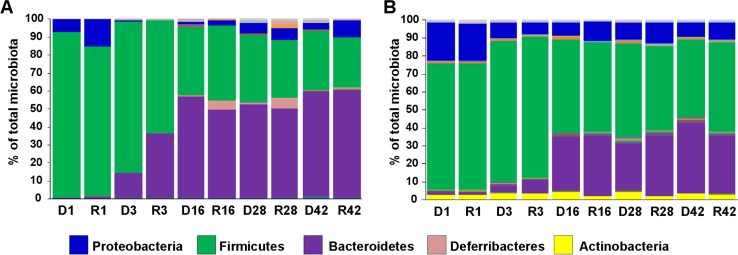
Microbiota composition in the ceca of donor chickens and hens and recipient chickens. Recipient chickens were inoculated on the day of hatching with the cecal extracts of donor hens (ages are indicated) and sacrificed 7 days later. (A) Cecal microbiota composition determined by sequencing of the V3/V4 variable regions of 16S rRNA genes. (B) Cecal microbiota composition determined by protein mass spectrometry. Blue, Proteobacteria; green, Firmicutes; purple, Bacteroidetes; pink, Deferribacteres; yellow, Actinobacteria. Deferribacteres were represented mainly by the genus Mucispirillum. However, since the complete proteome of this genus is not known, its proteins were not present in the protein database, and its overgrowth in 7-day-old chickens inoculated with cecal microbiota of 16- and 28-day-old donors could not be confirmed using protein mass spectrometry. D, donor birds aged 1, 3, 16, 28, and 42 weeks. R, recipient chickens receiving microbiota from birds aged 1, 3, 16, 28, and 42 weeks.
FIG 2
FIG 2
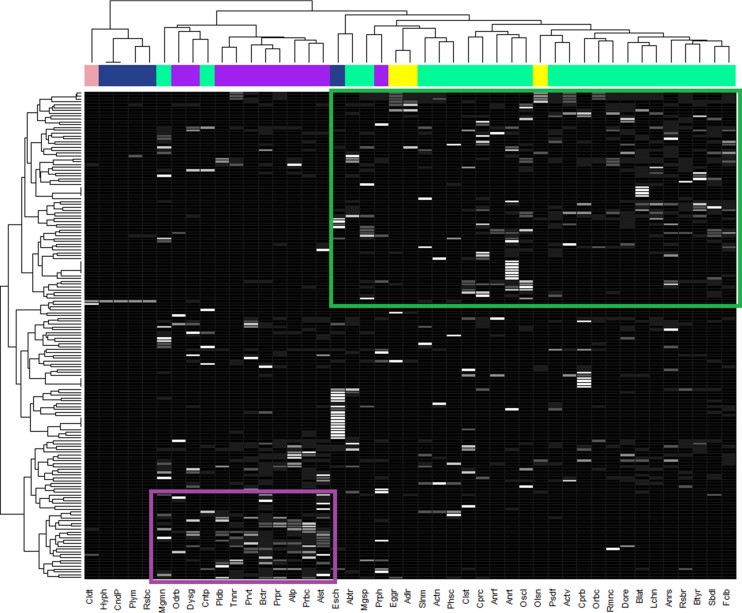
Bacterial genera and expressed enzymes involved in metabolism. The heat map was generated using total PSMs detected for each genus and particular protein. The heat map therefore integrates both relative expression within a given species and its numerical presence. color scaling is over the rows. Green box, enzymes characteristic of colonizers from the phylum Firmicutes. Purple box, enzyme characteristic of colonizers from the phylum Bacteroidetes. Color coding at the top: green, Firmicutes; purple, Bacteroidetes; blue, Proteobacteria; yellow, Actinobacteria; pink, Deferribacteres. Abtr, Abiotrophia; Actn, Acetonema; Actv, Acetivibrio; Adlr, Adlercreutzia; Allp, Alloprevotella; Alst, Alistipes; Anrf, Anaerofustis; Anrs, Anaerostipes; Anrt, Anaerotruncus; Bctr, Bacteroides; Blat, Blautia; Btyr, Butyrivibrio; Cldt, Calditerrivibrio; Clst, Clostridium; CndP, “Candidatus Pelagibacter”; Cntp, Centipeda; Cprb, Coprobacillus; Cprc, Coprococcus; Dore, Dorea; Dysg, Dysgonomonas; Eggr, Eggerthella; Esch, Escherichia; Fclb, Faecalibacterium; Hyph, Hyphomicrobium; Lchn, Lachnoanaerobaculum; Mgmn, Megamonas; Mgsp, Megasphaera; Odrb, Odoribacter; Olsn, Olsenella; Orbc, Oribacterium; Oscl, Oscillibacter; Phsc, Phascolarctobacterium; Pldb, Paludibacter; Plym, Polymorphum; Prbc, Parabacteroides; Prph, Porphyromonas; Prpr, Paraprevotella; Prvt, Prevotella; Psdf, Pseudoflavonifractor; Rmnc, Ruminococcus; Rsbc, Roseobacter; Rsbr, Roseburia; Sbdl, Subdoligranulum; Slnm, Selenomonas; Tnnr, Tannerella. For protein identification, see Fig. S1 in the supplemental material.
FIG 3
FIG 3
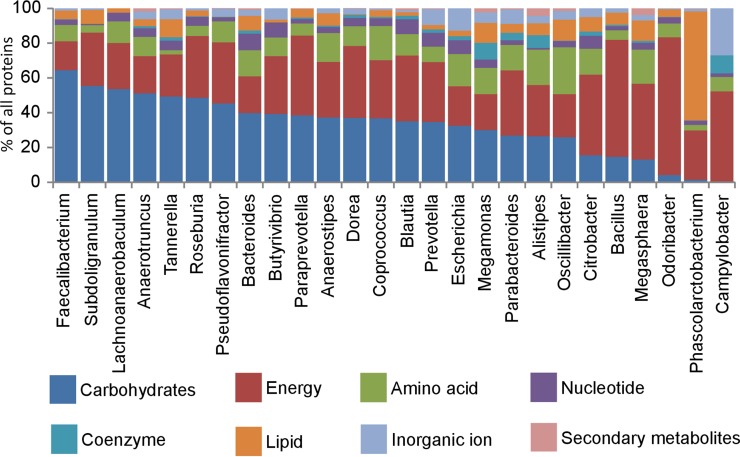
Classification of expressed proteins in the major colonizers of the chicken cecum within the category “metabolism.” Individual genera are ordered according to decreasing preference for carbohydrate metabolism.
FIG 4
FIG 4
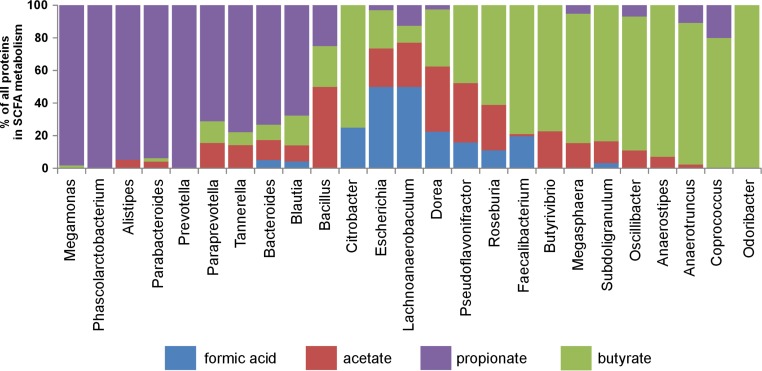
Expression of enzymes involved in SCFA biosynthesis. PSMs of proteins belonging to the COGs specified below were summarized for the major cecum colonizers and main SCFA (butyrate, propionate, acetate, and formic acid) biosynthesis pathways. For butyrate biosynthesis, PSMs of proteins belonging to the following COGs were summarized: COG4770, acetyl/propionyl-CoA carboxylase; COG0183, acetyl-CoA acetyltransferase; COG1979, alcohol dehydrogenase YqhD; COG1454, class IV alcohol dehydrogenase; COG3426, butyrate kinase; COG1250, 3-hydroxyacyl-CoA dehydrogenase; and COG1024, enoyl-CoA hydratase. For propionate biosynthesis, PSMs of proteins belonging to the following COGs were summarized: COG0777, acetyl-CoA carboxylase; COG4799, acetyl-CoA carboxylase; COG0439, biotin carboxylase; COG0346, catechol 2,3-dioxygenase; COG2185, methylmalonyl-CoA mutase; COG1884, methylmalonyl-CoA mutase; and COG4869, propanediol utilization protein. For acetate biosynthesis, PSMs of proteins belonging to the following COGs were summarized: COG0282, acetate kinase; COG0280, phosphotransacetylase; and COG1012, NAD-dependent aldehyde dehydrogenase. For formic acid production, PSMs of proteins belonging to the following COG were summarized: COG1882, pyruvate-formate lyase.

References

    1. Whitman WB, Coleman DC, Wiebe WJ. 1998. Prokaryotes: the unseen majority. Proc Natl Acad Sci U S A 95:6578–6583. doi: 10.1073/pnas.95.12.6578. - DOI - PMC - PubMed
    1. Backhed F, Ley RE, Sonnenburg JL, Peterson DA, Gordon JI. 2005. Host-bacterial mutualism in the human intestine. Science 307:1915–1920. doi: 10.1126/science.1104816. - DOI - PubMed
    1. Fleming SE, Fitch MD, DeVries S, Liu ML, Kight C. 1991. Nutrient utilization by cells isolated from rat jejunum, cecum and colon. J Nutr 121:869–878. - PubMed
    1. Boyen F, Haesebrouck F, Vanparys A, Volf J, Mahu M, Van Immerseel F, Rychlik I, Dewulf J, Ducatelle R, Pasmans F. 2008. Coated fatty acids alter virulence properties of Salmonella Typhimurium and decrease intestinal colonization of pigs. Vet Microbiol 132:319–327. doi: 10.1016/j.vetmic.2008.05.008. - DOI - PubMed
    1. O'Hara AM, Shanahan F. 2006. The gut flora as a forgotten organ. EMBO Rep 7:688–693. doi: 10.1038/sj.embor.7400731. - DOI - PMC - PubMed

Publication types

LinkOut - more resources