


Discontinuous and Continuous Indoor Air Quality Monitoring in Homes with Fireplaces or Wood Stoves as Heating System
- PMID: 26712773
- PMCID: PMC4730469
- DOI: 10.3390/ijerph13010078
Discontinuous and Continuous Indoor Air Quality Monitoring in Homes with Fireplaces or Wood Stoves as Heating System
Abstract
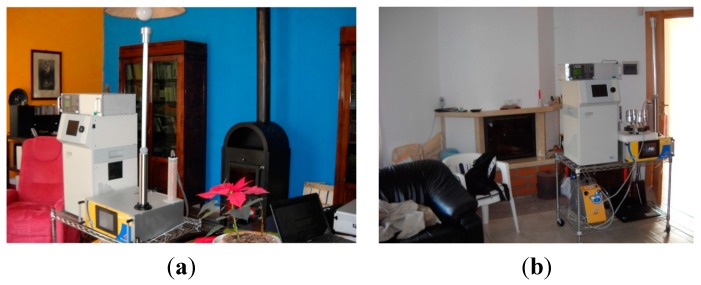
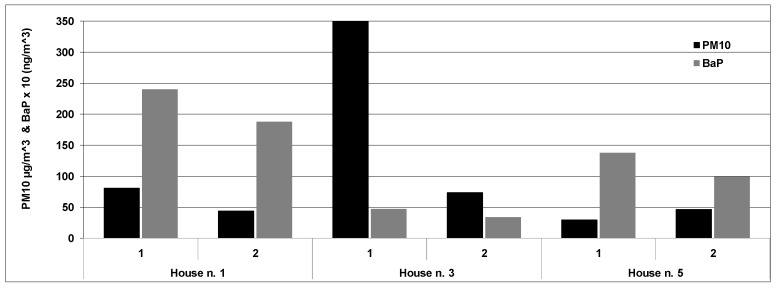
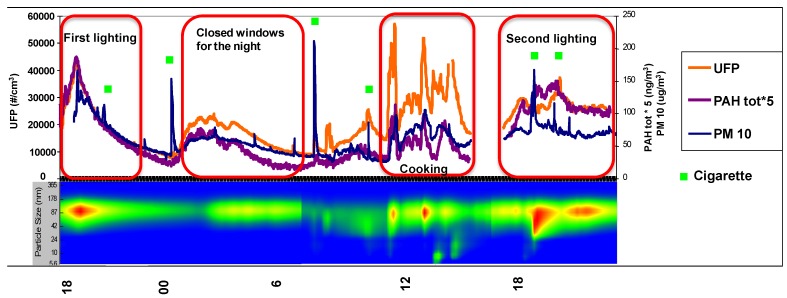
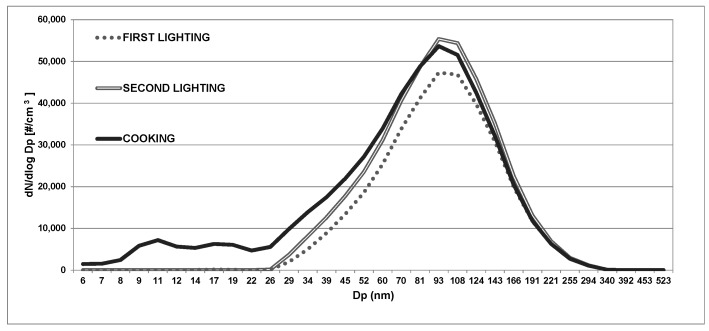
Around 50% of the world's population, particularly in developing countries, uses biomass as one of the most common fuels. Biomass combustion releases a considerable amount of various incomplete combustion products, including particulate matter (PM) and polycyclic aromatic hydrocarbons (PAHs). The paper presents the results of Indoor Air Quality (IAQ) measurements in six houses equipped with wood burning stoves or fireplaces as heating systems. The houses were monitored for 48-h periods in order to collect PM10 samples and measure PAH concentrations. The average, the maximum and the lowest values of the 12-h PM10 concentration were 68.6 μg/m³, 350.7 μg/m³ and 16.8 μg/m³ respectively. The average benzo[a]pyrene 12-h concentration was 9.4 ng/m³, while the maximum and the minimum values were 24.0 ng/m³ and 1.5 ng/m³, respectively. Continuous monitoring of PM10, PAHs, Ultra Fine Particle (UFP) and Total Volatile Organic Compounds (TVOC) was performed in order to study the progress of pollution phenomena due to biomass burning, their trends and contributions to IAQ. The results show a great heterogeneity of impacts on IAQ in terms of magnitude and behavior of the considered pollutants' concentrations. This variability is determined by not only different combustion technologies or biomass quality, but overall by different ignition mode, feeding and flame management, which can also be different for the same house. Moreover, room dimensions and ventilation were significant factors for pollution dispersion. The increase of PM10, UFP and PAH concentrations, during lighting, was always detected and relevant. Continuous monitoring allowed singling out contributions of other domestic sources of considered pollutants such as cooking and cigarettes. Cooking contribution produced an impact on IAQ in same cases higher than that of the biomass heating system.
Keywords: fireplace; indoor air quality; stove; ultrafine particles; wood combustion.
Figures
Similar articles
-
Particulate matter exposure from different heating stoves and fuels in UK homes.Sci Rep. 2025 Jul 1;15(1):21394. doi: 10.1038/s41598-025-05886-1. Sci Rep. 2025. PMID: 40594781 Free PMC article.
-
Impact of operating wood-burning fireplace ovens on indoor air quality.Chemosphere. 2014 May;103:205-11. doi: 10.1016/j.chemosphere.2013.11.067. Epub 2013 Dec 22. Chemosphere. 2014. PMID: 24364889
-
Personal and ambient exposures to air toxics in Camden, New Jersey.Res Rep Health Eff Inst. 2011 Aug;(160):3-127; discussion 129-51. Res Rep Health Eff Inst. 2011. PMID: 22097188
-
Indoor Exposure to Selected Air Pollutants in the Home Environment: A Systematic Review.Int J Environ Res Public Health. 2020 Dec 2;17(23):8972. doi: 10.3390/ijerph17238972. Int J Environ Res Public Health. 2020. PMID: 33276576 Free PMC article.
-
A review of the physicochemical characteristics of ultrafine particle emissions from domestic solid fuel combustion during cooking and heating.Sci Total Environ. 2023 Aug 15;886:163747. doi: 10.1016/j.scitotenv.2023.163747. Epub 2023 May 3. Sci Total Environ. 2023. PMID: 37146811 Review.
Cited by
-
Characteristics and Influencing Factors of Polycyclic Aromatic Hydrocarbons Emitted from Open Burning and Stove Burning of Biomass: A Brief Review.Int J Environ Res Public Health. 2022 Mar 25;19(7):3944. doi: 10.3390/ijerph19073944. Int J Environ Res Public Health. 2022. PMID: 35409624 Free PMC article. Review.
-
Particulate matter exposure from different heating stoves and fuels in UK homes.Sci Rep. 2025 Jul 1;15(1):21394. doi: 10.1038/s41598-025-05886-1. Sci Rep. 2025. PMID: 40594781 Free PMC article.
-
Evaluation of Second-Hand Exposure to Electronic Cigarette Vaping under a Real Scenario: Measurements of Ultrafine Particle Number Concentration and Size Distribution and Comparison with Traditional Tobacco Smoke.Toxics. 2019 Nov 25;7(4):59. doi: 10.3390/toxics7040059. Toxics. 2019. PMID: 31775282 Free PMC article.
-
A review of critical residential buildings parameters and activities when investigating indoor air quality and pollutants.Indoor Air. 2022 Nov;32(11):e13144. doi: 10.1111/ina.13144. Indoor Air. 2022. PMID: 36437669 Free PMC article. Review.
-
Assessment of Multipollutant Exposures During Pregnancy Using Silicone Wristbands.Front Public Health. 2020 Sep 29;8:547239. doi: 10.3389/fpubh.2020.547239. eCollection 2020. Front Public Health. 2020. PMID: 33117768 Free PMC article.
References
-
- Ashmore M.R., Dimitroulopoulou C. Personal exposure of children to air pollution. Atmos. Environ. 2009;43:128–141. doi: 10.1016/j.atmosenv.2008.09.024. - DOI
-
- Weschler C.J. Changes in indoor pollutants since the 1950s. Atmos. Environ. 2009;43:153–169. doi: 10.1016/j.atmosenv.2008.09.044. - DOI
-
- Park H.S., Ji C., Hong T. Methodology for assessing human health impacts due to pollutants emitted from building materials. Build. Environ. 2016;95:133–144. doi: 10.1016/j.buildenv.2015.09.001. - DOI
-
- Isaxon C., Gudmundsson A., Nordin E.Z., Lönnblad L., Dahl A., Wieslander G., Bohgard M., Wierzbicka A. Contribution of indoor-generated particles to residential exposure. Atmos. Environ. 2015;106:458–466. doi: 10.1016/j.atmosenv.2014.07.053. - DOI
MeSH terms
Substances
LinkOut - more resources
Full Text Sources
Other Literature Sources
Medical
