


Vocabulary Knowledge of Children With Cochlear Implants: A Meta-Analysis
- PMID: 26712811
- PMCID: PMC4886318
- DOI: 10.1093/deafed/env060
Vocabulary Knowledge of Children With Cochlear Implants: A Meta-Analysis
Abstract
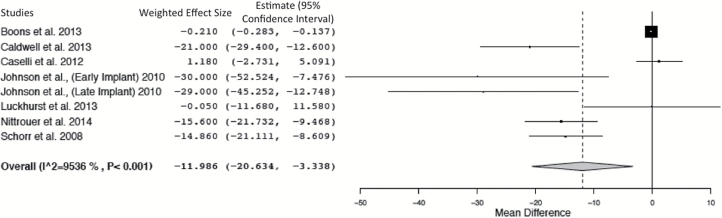
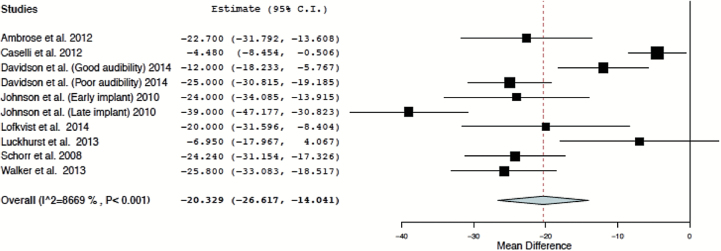
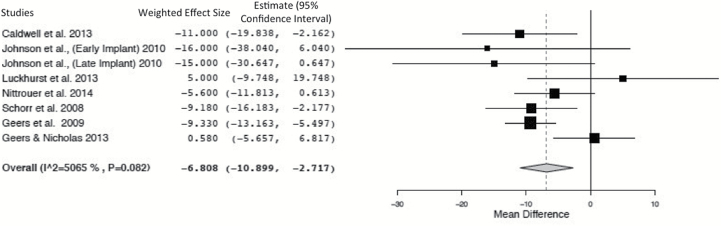
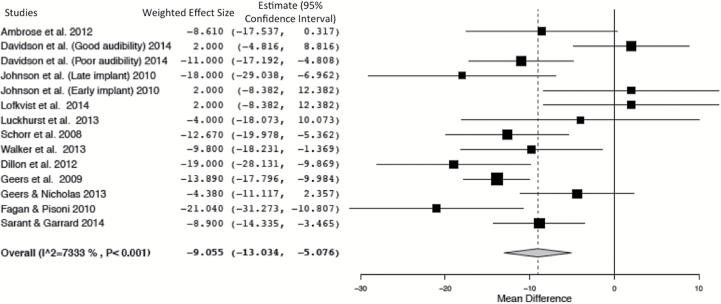
This article employs meta-analysis procedures to evaluate whether children with cochlear implants demonstrate lower spoken-language vocabulary knowledge than peers with normal hearing. Of the 754 articles screened and 52 articles coded, 12 articles met predetermined inclusion criteria (with an additional 5 included for one analysis). Effect sizes were calculated for relevant studies and forest plots were used to compare differences between groups of children with normal hearing and children with cochlear implants. Weighted effect size averages for expressive vocabulary measures (g = -11.99; p < .001) and for receptive vocabulary measures (g = -20.33; p < .001) indicated that children with cochlear implants demonstrate lower vocabulary knowledge than children with normal hearing. Additional analyses confirmed the value of comparing vocabulary knowledge of children with hearing loss to a tightly matched (e.g., socioeconomic status-matched) sample. Age of implantation, duration of implantation, and chronological age at testing were not significantly related to magnitude of weighted effect size. Findings from this analysis represent a first step toward resolving discrepancies in the vocabulary knowledge literature.
© The Author 2015. Published by Oxford University Press. All rights reserved. For Permissions, please email: journals.permissions@oup.com.
Figures
References
-
- Bedore L. M. Pena E. D. Garcia M., & Cortez C (2005). Conceptual versus monolingual scoring: When does it make a difference? Language, Speech, and Hearing Services in Schools, 36, 188–200. doi:10.1044/0161-1461(2005/020) - PubMed
-
- Bloom L. (2002). How children learn the meanings of words. Cambridge, MA: MIT Press.
-
- Boons T. De Raeve L. Langereis M. Peeraer L. Wouters J., & van Wieringen A (2013). Expressive vocabulary, morphology, syntax, and narrative skills in profoundly deaf children after early cochlear implantation. Research in Developmental Disabilities, 34, 2008–2022. doi:10.1016/j.ridd.2013.03.003 - PubMed
Publication types
MeSH terms
LinkOut - more resources
Full Text Sources
Other Literature Sources
Medical
Miscellaneous
