


Cognitive Ageing in Great Britain in the New Century: Cohort Differences in Episodic Memory
- PMID: 26713627
- PMCID: PMC4699214
- DOI: 10.1371/journal.pone.0144907
Cognitive Ageing in Great Britain in the New Century: Cohort Differences in Episodic Memory
Abstract
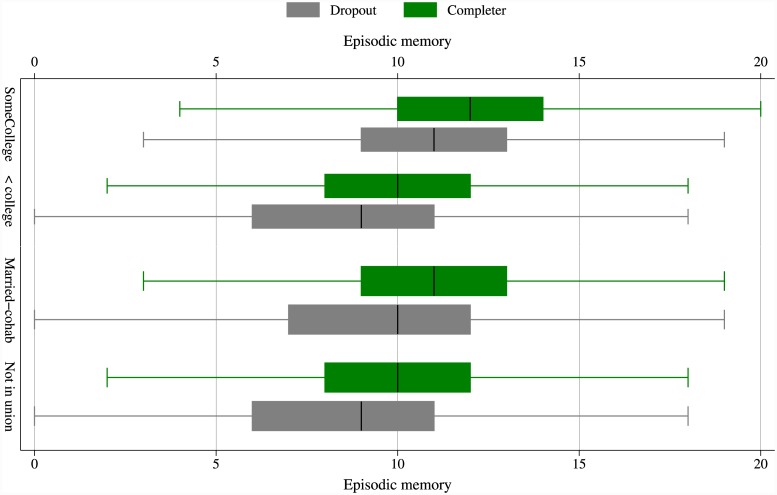
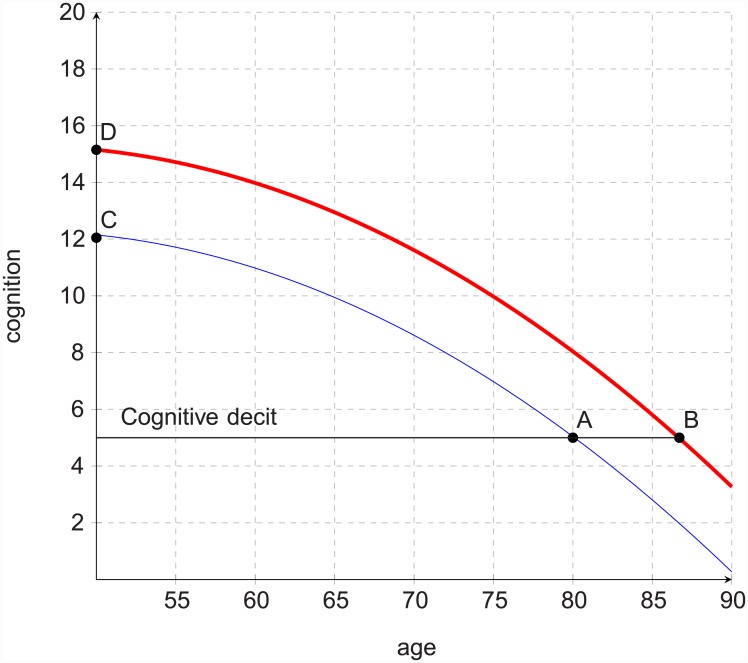
Background: Dementias in high income countries are set to be the third major burden of disease even as older people are increasingly required to think for themselves how to provide for their lives in retirement. Meanwhile the period of older age continues to extend with increase in life expectancy. This challenge demands an understanding of how cognition changes over an extended period in later life. But studying cognitive ageing in the population faces a difficulty from the fact that older respondents are liable to leave (attrite) before study completion. This study tested three hypotheses: trajectories of cognitive ageing in Britain show an improvement beyond the age of 50; and they are lifted by secular improvement in cognition across cohorts; lastly they are susceptible to distortion due to attrition.
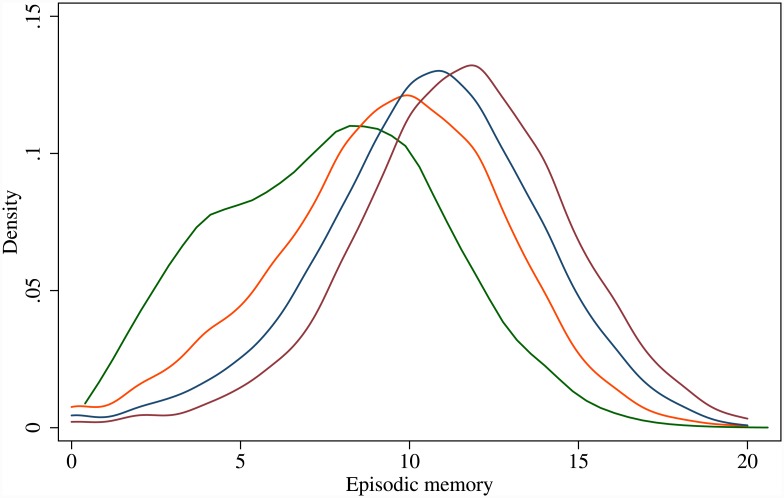
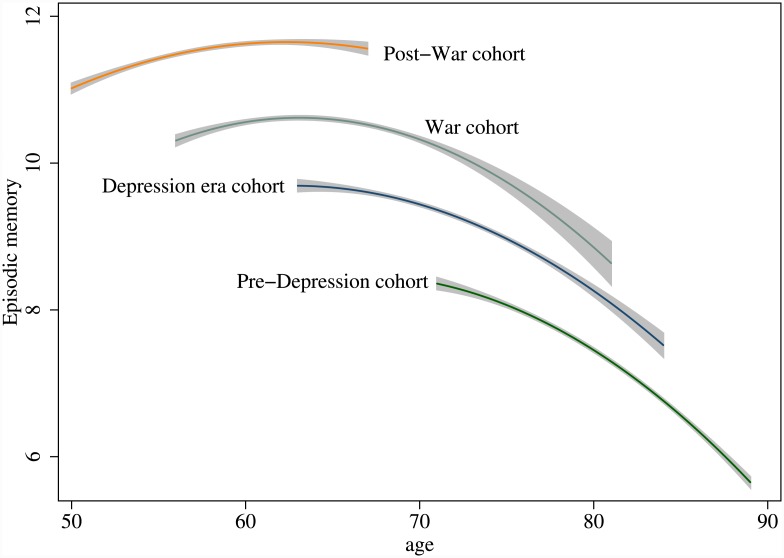
Methods and findings: Using the English Longitudinal Study of Ageing, this paper studied trajectories of episodic memory of Britons aged 50-89 from 2002 to 2013 (N = 5931). Using joint models the analysis found that levels of episodic memory follow a curvilinear shape, not a steady decline, in later life. The findings also revealed secular improvement in cognitive ageing such that as a cohort is being replaced episodic memory levels in the population improve. The analysis lastly demonstrated that failure to simultaneously model attrition can produce distorted pictures of cognitive ageing.
Conclusion: Old age in this century is not necessarily a period dominated by cognitive decline. In identifying behavioural factors associated with better cognitive ageing, such as social connections of traditional and online kinds, the paper raises possibilities of mustering an adequate response to the cognition challenge.
Conflict of interest statement
Figures
References
-
- Yaffe K, editor. Chronic Medical Disease & Cognitive Aging: Toward a Healthy Body and Brain. Oxford: Oxford University Press; 2013.
-
- Banks J, Emmerson C, Oldfield Z, Tetlow G. Prepared for Retirement? The Adequacy and Distribution of Retirement Resources in England. London: The Institute for Fiscal Studies; 2005.
-
- Fenge R, Pestieau P. Social Security and Early Retirement. Cambridge, MA: MIT Press; 2005.
Publication types
MeSH terms
Grants and funding
LinkOut - more resources
Full Text Sources
Other Literature Sources
