


Discovery of the gray phenotype and white-gray-opaque tristable phenotypic transitions in Candida dubliniensis
- PMID: 26714067
- PMCID: PMC4871672
- DOI: 10.1080/21505594.2015.1135287
Discovery of the gray phenotype and white-gray-opaque tristable phenotypic transitions in Candida dubliniensis
Abstract
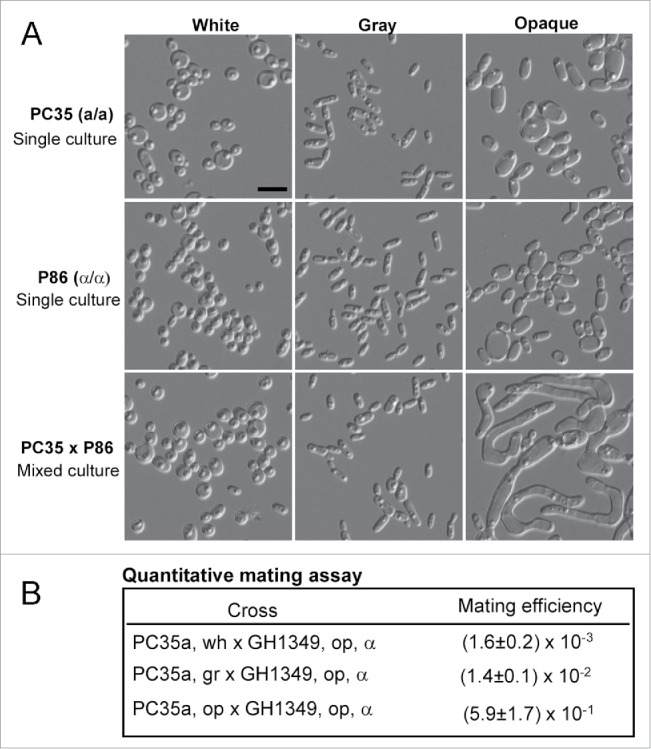
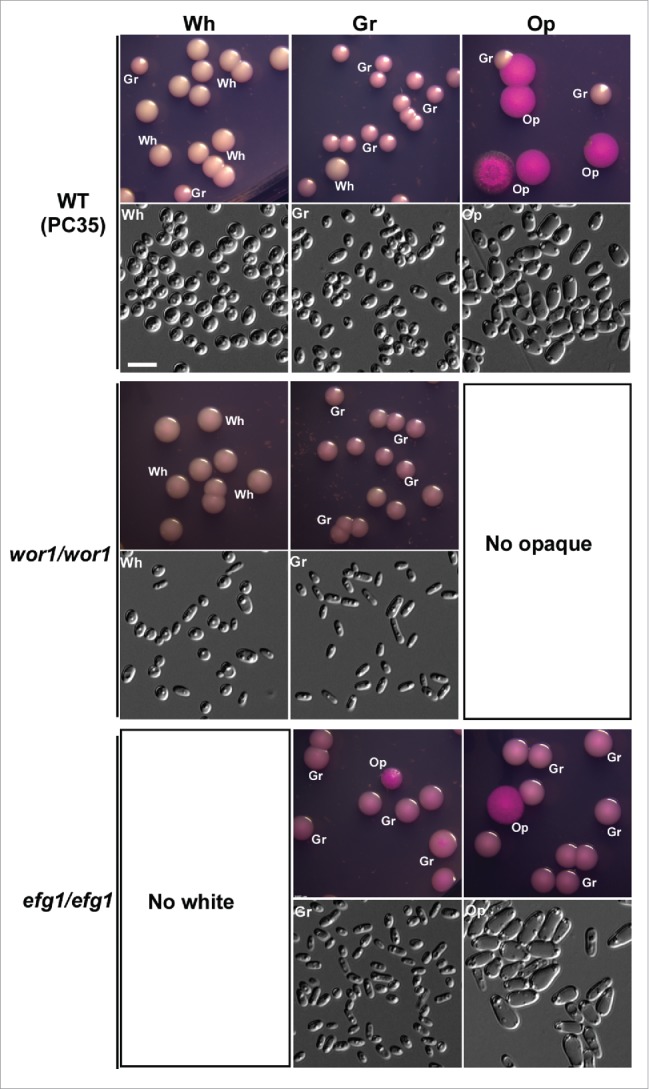
Candida dubliniensis is closely related to Candida albicans, a major causative agent of candidiasis, and is primarily associated with oral colonization and infection in human immunodeficiency virus (HIV)-positive patients. Despite the high similarity of genomic and phenotypic features between the 2 species, C. dubliniensis is much less virulent and less prevalent than C. albicans. The ability to change morphological phenotypes is a striking feature of Candida species and is linked to virulence. In this study, we report a novel phenotype, the gray phenotype, in C. dubliniensis. Together with the previously reported white and opaque cell types, the gray phenotype forms a tristable phenotypic switching system in C. dubliniensis that is similar to the white-gray-opaque tristable switching system in C. albicans. Gray cells of C. dubliniensis are similar to their counterparts in C. albicans in terms of several biological aspects including cellular morphology, mating competence, and genetic regulatory mechanisms. However, the gray phenotypes of the 2 species have some distinguishing features. For example, the secreted aspartyl protease (Sap) activity is induced by bovine serum albumin (BSA) in gray cells of C. albicans, but not in gray cells of C. dubliniensis. Taken together, our results demonstrate that the biological features and regulatory mechanisms of white-gray-opaque tristable transitions are largely conserved in the 2 pathogenic Candida species.
Keywords: Candida dubliniensis; Efg1; Wor1; pathogenesis; phenotypic switching.
Figures
Comment in
-
Gray phenotype: Enhanced fitness strategy for Candida dubliniensis?Virulence. 2016 Apr 2;7(3):211-3. doi: 10.1080/21505594.2016.1142641. Epub 2016 Jan 19. Virulence. 2016. PMID: 26786843 Free PMC article. No abstract available.
References
-
- Pfaller MA. Epidemiology of candidiasis. J Hosp Infect 1995; 30 Suppl:329-38; PMID:7560969; http://dx.doi.org/ 10.1016/0195-6701(95)90036-5 - DOI - PubMed
-
- Biswas S, Van Dijck P, Datta A. Environmental sensing and signal transduction pathways regulating morphopathogenic determinants of Candida albicans. Microbiol Mol Biol Rev 2007; 71:348-76; PMID:17554048; http://dx.doi.org/ 10.1128/MMBR.00009-06 - DOI - PMC - PubMed
-
- Pfaller MA, Diekema DJ. Epidemiology of invasive candidiasis: a persistent public health problem. Clin Microbiol Rev 2007; 20:133-63; PMID:17223626; http://dx.doi.org/ 10.1128/CMR.00029-06 - DOI - PMC - PubMed
-
- Whiteway M, Bachewich C. Morphogenesis in Candida albicans. Annu Rev Microbiol 2007; 61:529-53; PMID:17506678; http://dx.doi.org/ 10.1146/annurev.micro.61.080706.093341 - DOI - PMC - PubMed
-
- Huang G. Regulation of phenotypic transitions in the fungal pathogen Candida albicans. Virulence 2012; 3; 251-61; PMID:22546903; http://dx.doi.org/ 10.4161/viru.20010 - DOI - PMC - PubMed
MeSH terms
Substances
LinkOut - more resources
Full Text Sources
Other Literature Sources
Miscellaneous
