Review
. 2016 Feb 15;310(4):E249-57.
doi: 10.1152/ajpendo.00478.2015. Epub 2015 Dec 29.

The glucocorticoid receptor: cause of or cure for obesity?

Affiliations
Review

The glucocorticoid receptor: cause of or cure for obesity?

Kezia John et al. Am J Physiol Endocrinol Metab. .

Abstract

Glucocorticoid hormones (GCs) are important regulators of lipid metabolism, promoting lipolysis with acute treatment but lipogenesis with chronic exposure. Conventional wisdom posits that these disparate outcomes are mediated by the classical glucocorticoid receptor GRα. There is insufficient knowledge of the GC receptors (GRα and GRβ) in metabolic conditions such as obesity and diabetes. We present acute models of GC exposure that induce lipolysis, such as exercise, as well as chronic-excess models that cause obesity and lipid accumulation in the liver, such as hepatic steatosis. Alternative mechanisms are then proposed for the lipogenic actions of GCs, including induction of GC resistance by the GRβ isoform, and promotion of lipogenesis by GC activation of the mineralocorticoid receptor (MR). Finally, the potential involvement of chaperone proteins in the regulation of adipogenesis is considered. This reevaluation may prove useful to future studies on the steroidal basis of adipogenesis and obesity.

Keywords: adipogenesis; adipose differentiation; glucocorticoid receptor; glucocorticoid receptor-α; glucocorticoid receptor-β; glucocorticoids; lipolysis.


Figures

Fig. 1.
Fig. 1.
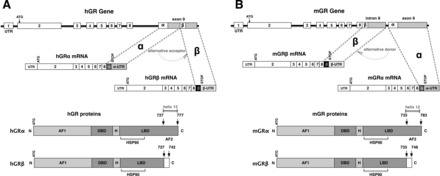
Alternative splicing of the human (hGR) and mouse glucocorticoid (GC) receptor (hGR) genes. Alternative splicing of the hGR (A) and mGR genes (B) constructs the GRα and GRβ isoforms. The mGRβ isoform exhibits a functional domain structure that is nearly identical to hGRβ, and both have 15 amino acids as a result of an alternative acceptor for human and alternative donor for mouse from the β-exon. Compared with the GRα protein, the β-isoforms of both species have reduced and distinct COOH-terminal regions that have a truncated ligand binding AF-2 domain (helix 12). These features account for their lack of ability to bind hormone. AF, activation function; DBD, DNA-binding domain; H, hinge region; LBD, ligand-binding domain; ATG, ATG start site; N, NH2 terminus; UTR, untranslated region. Heat shock protein 90 (HSP90) binding regions for human and mouse GRα and GRβ are shown.
Fig. 2.
Fig. 2.
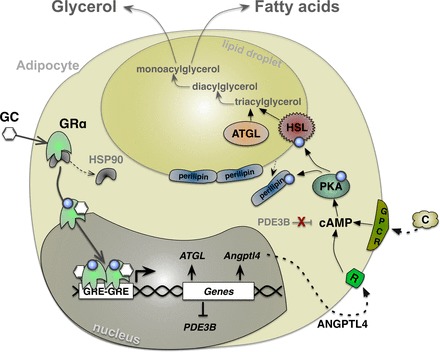
GCs induce lipolysis through enhancement of lipase genes. GCs bind to GRα, causing phosphorylation, dissociation of HSP90, translocation to the nucleus, and binding to GC response elements (GREs) in promoters of genes. In adipocytes, GRα enhances genes involved in lipolysis [adipose triglyceride lipase (ATGL) and angiopoietin-like 4 (Angptl4)] and suppresses genes that are lipogenic [phosphodiesterase 3B (PDE3B)]. Catecholamines (C) and ANGPTL4 bind to their receptors and increase cellular cAMP levels, which activate PKA, causing phosphorylation of hormone-sensitive lipase (HSL) and perilipins. Phosphorylation causes the release of perilipins from the lipid droplet and exposure of HSL to triacylglycerol, resulting in breakdown and release of glycerol and fatty acids in the blood. GPCR, G protein-coupled receptor.
Fig. 3.
Fig. 3.
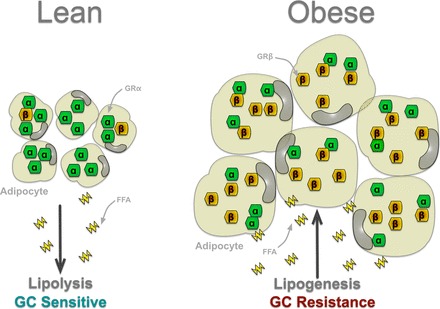
Speculation that obesity is a state of GC resistance and the relationship of GRα and GRβ. The participation of the GR isoforms in obesity and adipocyte hypertrophy is unknown. However, the role of GCs and GRα in lipolysis has been demonstrated. Therefore, lean patients may have GC sensitivity that enhances GRα activity in adipocytes, which elevates lipolysis and the release of free fatty acids (FFA), whereas obese patients may have GC resistance by increasing levels of GRβ, resulting in adipocyte hypertrophy, lipogenesis, and FFA uptake.
Fig. 4.
Fig. 4.
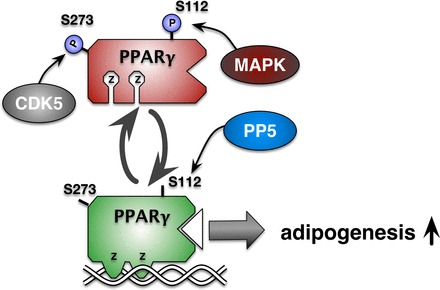
Protein phosphatase (PP5) dephosphorylates peroxisome proliferator-activated receptor-γ (PPARγ) to increase adipogenesis. In adipocytes, PP5 dephosphorylates Ser112 (S112) in PPARγ, increasing adipogenic gene expression. The MAPK pathway causes phosphorylation (P) of S112, resulting in the inhibition of lipid accumulation. Cyclin-dependent kinase-5 (CDK5) targeting of Ser273 (S273) leads to insulin resistance. At present, phosphatase targeting of S273 is unknown. Z, zinc finger DNA-binding domain.

References

    1. Adams M, Reginato MJ, Shao D, Lazar MA, Chatterjee VK. Transcriptional activation by peroxisome proliferator-activated receptor gamma is inhibited by phosphorylation at a consensus mitogen-activated protein kinase site. J Biol Chem 272: 5128–5132, 1997. - PubMed
    1. Arriza JL, Weinberger C, Cerelli G, Glaser TM, Handelin BL, Housman DE, Evans RM. Cloning of human mineralocorticoid receptor complementary DNA: structural and functional kinship with the glucocorticoid receptor. Science 237: 268–275, 1987. - PubMed
    1. Bamberger CM, Bamberger AM, de Castro M, Chrousos GP. Glucocorticoid receptor beta, a potential endogenous inhibitor of glucocorticoid action in humans. J Clin Invest 95: 2435–2441, 1995. - PMC - PubMed
    1. Barak Y, Nelson MC, Ong ES, Jones YZ, Ruiz-Lozano P, Chien KR, Koder A, Evans RM. PPAR gamma is required for placental, cardiac, and adipose tissue development. Mol Cell 4: 585–595, 1999. - PubMed
    1. Berson A, De Beco V, Letteron P, Robin MA, Moreau C, El Kahwaji J, Verthier N, Feldmann G, Fromenty B, Pessayre D. Steatohepatitis-inducing drugs cause mitochondrial dysfunction and lipid peroxidation in rat hepatocytes. Gastroenterology 114: 764–774, 1998. - PubMed

Publication types

Substances

LinkOut - more resources