


Pleural mesothelioma and lung cancer risks in relation to occupational history and asbestos lung burden
- PMID: 26715106
- PMCID: PMC4853597
- DOI: 10.1136/oemed-2015-103074
Pleural mesothelioma and lung cancer risks in relation to occupational history and asbestos lung burden
Abstract
Background: We have conducted a population-based study of pleural mesothelioma patients with occupational histories and measured asbestos lung burdens in occupationally exposed workers and in the general population. The relationship between lung burden and risk, particularly at environmental exposure levels, will enable future mesothelioma rates in people born after 1965 who never installed asbestos to be predicted from their asbestos lung burdens.
Methods: Following personal interview asbestos fibres longer than 5 µm were counted by transmission electron microscopy in lung samples obtained from 133 patients with mesothelioma and 262 patients with lung cancer. ORs for mesothelioma were converted to lifetime risks.
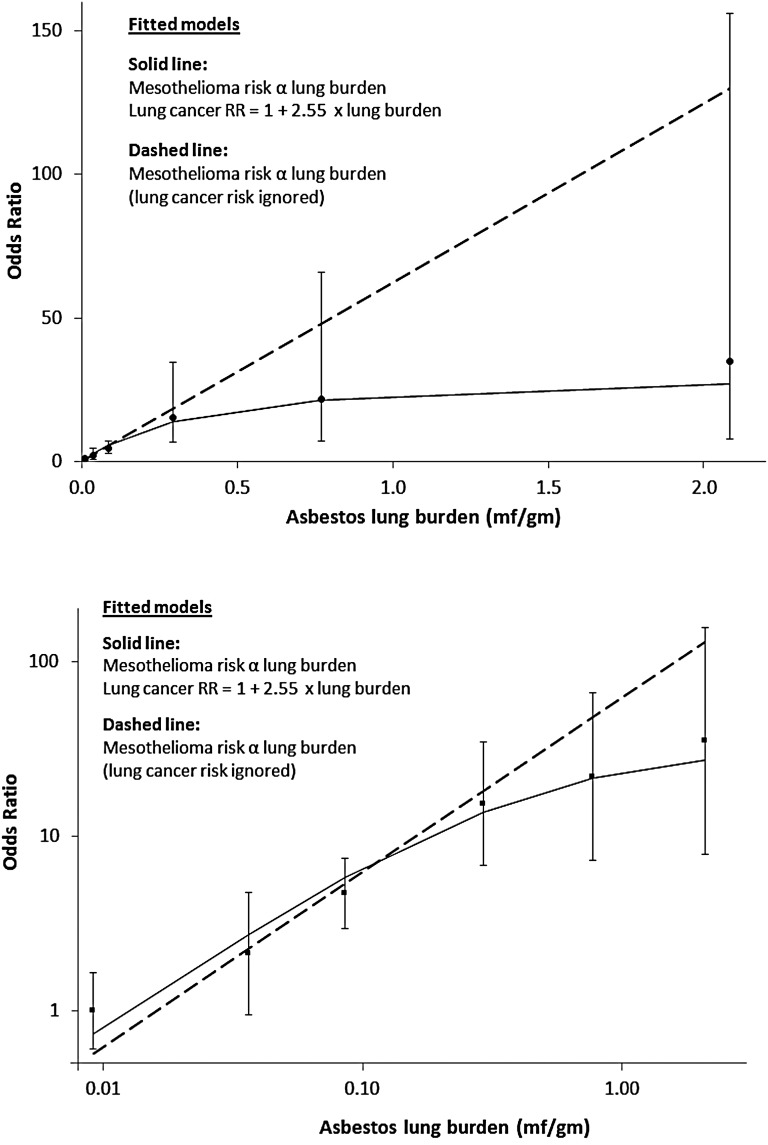
Results: Lifetime mesothelioma risk is approximately 0.02% per 1000 amphibole fibres per gram of dry lung tissue over a more than 100-fold range, from 1 to 4 in the most heavily exposed building workers to less than 1 in 500 in most of the population. The asbestos fibres counted were amosite (75%), crocidolite (18%), other amphiboles (5%) and chrysotile (2%).
Conclusions: The approximate linearity of the dose-response together with lung burden measurements in younger people will provide reasonably reliable predictions of future mesothelioma rates in those born since 1965 whose risks cannot yet be seen in national rates. Burdens in those born more recently will indicate the continuing occupational and environmental hazards under current asbestos control regulations. Our results confirm the major contribution of amosite to UK mesothelioma incidence and the substantial contribution of non-occupational exposure, particularly in women.
Published by the BMJ Publishing Group Limited. For permission to use (where not already granted under a licence) please go to http://www.bmj.com/company/products-services/rights-and-licensing/
Figures
Comment in
-
Setting new standards for epidemiological research on mesothelioma.Occup Environ Med. 2016 May;73(5):289. doi: 10.1136/oemed-2015-103479. Epub 2016 Feb 16. Occup Environ Med. 2016. PMID: 26884050 No abstract available.
-
Unreliable proposed 'new standard' for assessing asbestos exposure.Occup Environ Med. 2016 Oct;73(10):709. doi: 10.1136/oemed-2016-103704. Epub 2016 Jul 27. Occup Environ Med. 2016. PMID: 27466612 No abstract available.
-
Authors' reply to letters from Egilman et al and Oliver et al.Occup Environ Med. 2016 Oct;73(10):710-1. doi: 10.1136/oemed-2016-103870. Epub 2016 Jul 27. Occup Environ Med. 2016. PMID: 27466613 Free PMC article. No abstract available.
-
New standard for assessing asbestos exposure and its consequences?Occup Environ Med. 2016 Oct;73(10):709-10. doi: 10.1136/oemed-2016-103693. Epub 2016 Jul 27. Occup Environ Med. 2016. PMID: 27466614 No abstract available.
References
-
- Peto J, Rake C, Gilham C, et al. . et al Occupational, domestic and environmental mesothelioma risks in Britain: a case-control study. http://www.hse.gov.uk/research/rrhtm/rr696.htm:2009 - PMC - PubMed
Publication types
MeSH terms
Substances
Grants and funding
LinkOut - more resources
Full Text Sources
Other Literature Sources
Medical
