. 2016 Mar;27(3):255-66.
doi: 10.1089/hum.2015.110. Epub 2016 Mar 15.

Insulated Foamy Viral Vectors

Affiliations

Insulated Foamy Viral Vectors

Diana L Browning et al. Hum Gene Ther. 2016 Mar.

Abstract

Retroviral vector-mediated gene therapy is promising, but genotoxicity has limited its use in the clinic. Genotoxicity is highly dependent on the retroviral vector used, and foamy viral (FV) vectors appear relatively safe. However, internal promoters may still potentially activate nearby genes. We developed insulated FV vectors, using four previously described insulators: a version of the well-studied chicken hypersensitivity site 4 insulator (650cHS4), two synthetic CCCTC-binding factor (CTCF)-based insulators, and an insulator based on the CCAAT box-binding transcription factor/nuclear factor I (7xCTF/NF1). We directly compared these insulators for enhancer-blocking activity, effect on FV vector titer, and fidelity of transfer to both proviral long terminal repeats. The synthetic CTCF-based insulators had the strongest insulating activity, but reduced titers significantly. The 7xCTF/NF1 insulator did not reduce titers but had weak insulating activity. The 650cHS4-insulated FV vector was identified as the overall most promising vector. Uninsulated and 650cHS4-insulated FV vectors were both significantly less genotoxic than gammaretroviral vectors. Integration sites were evaluated in cord blood CD34(+) cells and the 650cHS4-insulated FV vector had fewer hotspots compared with an uninsulated FV vector. These data suggest that insulated FV vectors are promising for hematopoietic stem cell gene therapy.


Figures
<b>Figure 1.</b>
Figure 1.
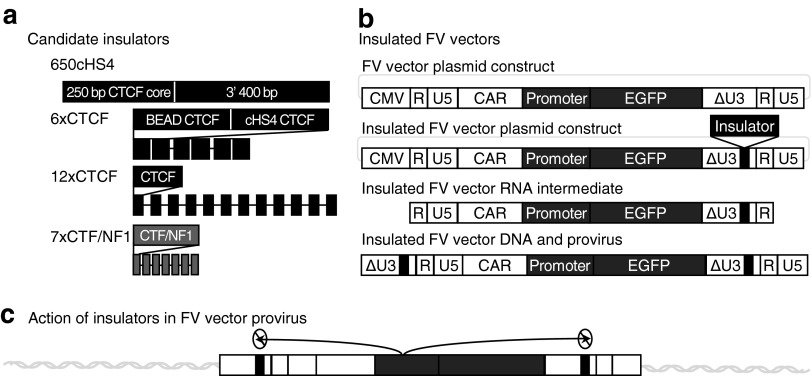
Insulated foamy viral (FV) vectors. (a) Candidate insulators. The 650cHS4 insulator is derived from the 1.2-kbp chicken hypersensitivity site 4 (cHS4) from the chicken β-globin locus. This insulator contains the 5′-most 250-bp core containing the CCCTC-binding factor (CTCF)-binding domain and the terminal 400-bp portion. The 6xCTCF insulator contains alternating repeats of the CTCF-binding domain from blocking element α/δ (BEAD) and the cHS4 CTCF-binding domain. The 12xCTCF insulator contains consecutive repeats of a CTCF-binding domain consensus sequence separated by unique spacers. The 7xCTF/NF1 insulator contains consecutive repeats of the CTF/NF1-binding domain. (b) Insulated FV vector construction. Insulators were inserted into the U3 deletion site of the 3′ LTR. The FV vector DNA is transfected into HEK293 cells to make vector virions. During vector preparation the vector DNA is initially transcribed into RNA, which is encapsidated and reverse transcribed into DNA that is integrated into the host genome. During the process of reverse transcription, the 3′ LTR, including the insulator, is copied to the 5′ LTR so that the integrated provirus is flanked by the insulators. CAR is the cis-acting region containing the remaining portions of the FV gag, pol, and env sequences necessary for vector genome packaging and integration. (c) Insulators block the internal promoter from acting on adjacent host genes.
<b>Figure 2.</b>
Figure 2.
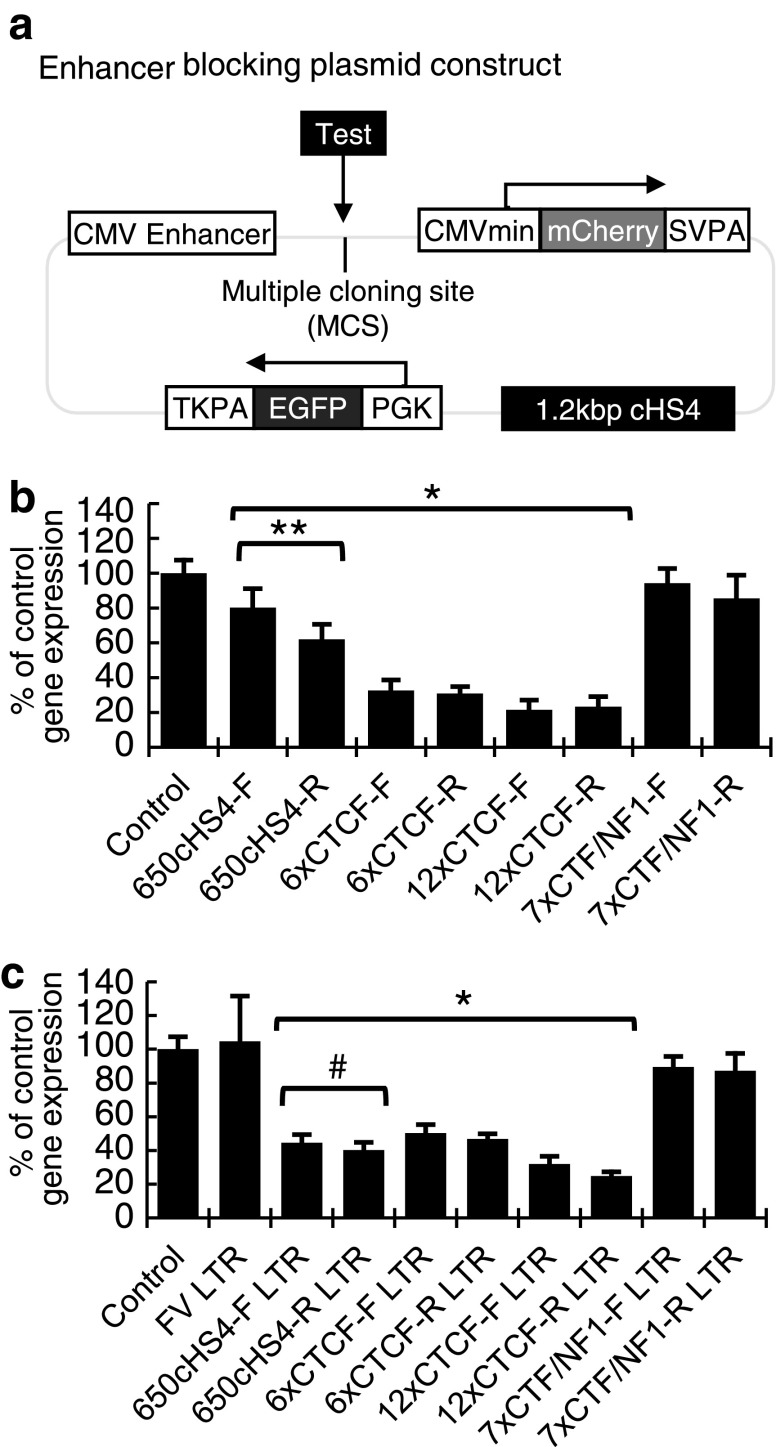
Enhancer-blocking activity of candidate insulators. (a) Enhancer-blocking plasmid construct. Insulators or an FV vector LTR containing an insulator to be tested were placed in the multiple cloning site between the CMV enhancer and the CMV minimal promoter controlling the expression of mCherry. The ratio of mCherry expression to EGFP expression was then determined. SVPA, simian virus 40 (SV40) polyadenylation site; TKPA, thymidine kinase polyadenylation site. (b) Insulator activity. Enhancer-blocking plasmid with no insulator (Control) or with the indicated insulators was transfected into HEK293T cells and the effect of insulators on enhancers, determined by intensity of fluorescence, was evaluated by flow cytometry 40–45 hr posttransfection. Columns represent the percentage of normalized mCherry expression as compared with the uninsulated control. (c) Enhancer-blocking capacity of insulators in the context of the FV LTR. *p < 0.05 compared with control; **p < 0.05 between samples; #p < 0.05 compared with insulator alone.
<b>Figure 3.</b>
Figure 3.
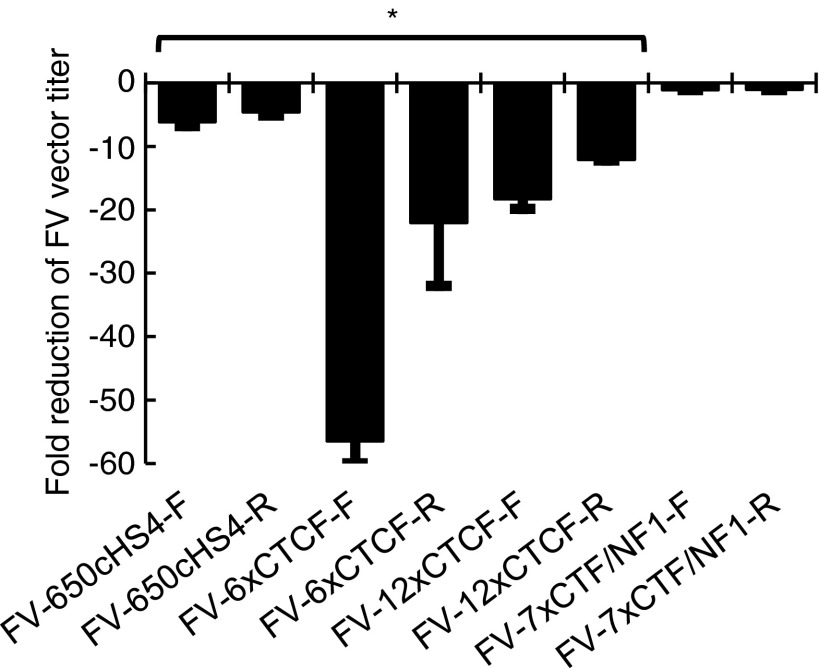
Titers of insulated FV vectors. HT1080 fibroblasts were transduced with FV vector preparations with the indicated insulators, and titers were determined by flow cytometry for EGFP expression. Columns represent the fold reduction in titer as compared with an uninsulated FV vector control. *p < 0.05 compared with control.
<b>Figure 4.</b>
Figure 4.
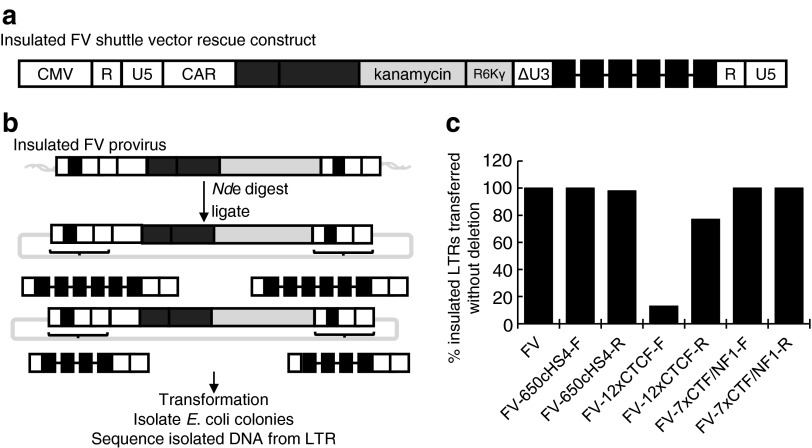
Shuttle vector rescue for analysis of insulator fidelity. A shuttle vector rescue strategy was used to isolate whole integrated vector proviruses and evaluate the presence of insulators from both the 5′ and 3′ LTRs. (a) Schematic of the shuttle vector rescue insulated FV vector construct with an R6Kγ bacterial origin of replication and kanamycin resistance cassette between the EGFP gene cassette and the 3′ LTR. (b) Shuttle vector rescue process to rescue whole integrated proviruses from transduced HT1080 genomic DNA. Genomic DNA is isolated from transduced cells and then digested with the restriction enzyme NdeI, which does not cut within the provirus, to produce DNA fragments with an intact vector provirus. Digested DNA is then ligated and transformed into electrocompetent Escherichia coli. Plasmid DNA from transformed kanamycin-resistant colonies containing proviruses is isolated and both the 3′ and 5′ LTRs are sequenced to determine the fidelity of transfer of the insulators to each LTR. In the example, two rescued proviruses are shown; the top one has an intact 6X element, whereas the bottom one has deleted two elements in both the 5′ and 3′ LTRs. (c) Percentage of intact insulated LTRs rescued after shuttle vector rescue.
<b>Figure 5.</b>
Figure 5.
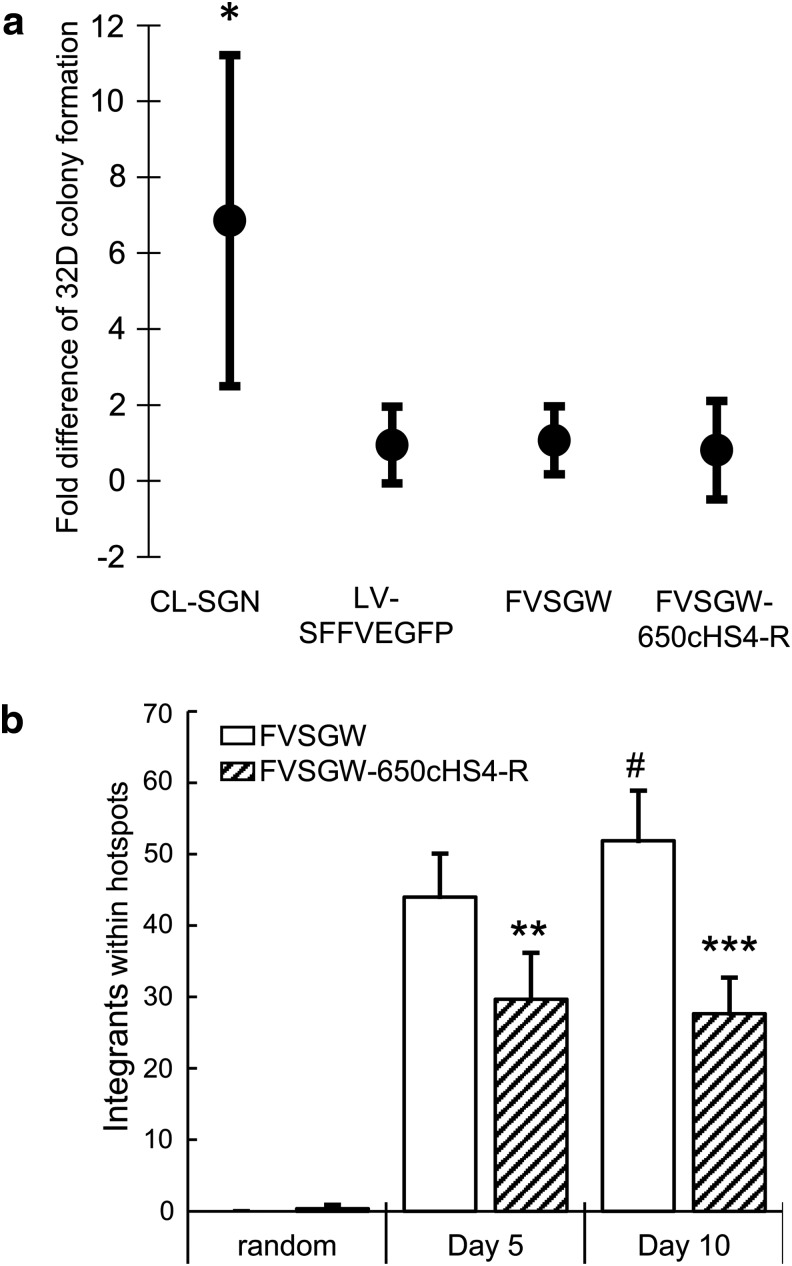
In vitro assessment of genotoxicity. (a) 32D cells were transduced with the indicated vectors and plated in IL-3-deficient semisolid medium for 4–5 weeks to allow for colony development. Shown is the mean fold difference with standard deviation as compared with untransduced control cells per 5 × 105 plated cells. CL-SGN, n = 4; LV-SFFVEGFP, n = 34; FVSGW, n = 45; FVSGW-650cHS4-R, n = 43. (b) CD34+ stem cells from cord blood were transduced with either FVSGW or FVSGW-650cHS4-R and cultured in vitro for 5 or 10 days before genomic DNA extraction for modified genomic sequencing-polymerase chain reaction (MGS-PCR). Captured integrations were ordered by position in the genome, and the distances between nearest integration sites were evaluated. Columns represent the percentage of total integrations within 50 kbp of two other integration sites. Each average is based on at least three randomly chosen nonoverlapping unique sets of 1588 integrations from the available MGS-PCR sequencing data. *p < 0.001 compared with LV-SFFVEGFP, FVSGW, and FVSGW-650cHS4-R; **p < 0.05 compared with FVSGW; ***p < 0.01 compared with FVSGW; #p < 0.05 compared with day 5.

References

    1. Bordignon C, Notarangelo LD, Nobili N, et al. . Gene therapy in peripheral blood lymphocytes and bone marrow for ADA-immunodeficient patients. Science 1995;270:470–475 - PubMed
    1. Hacein-Bey-Abina S, Le Deist F, Carlier F, et al. . Sustained correction of X-linked severe combined immunodeficiency by ex vivo gene therapy. N Engl J Med 2002;346:1185–1193 - PubMed
    1. Wang GP, Berry CC, Malani N, et al. . Dynamics of gene-modified progenitor cells analyzed by tracking retroviral integration sites in a human SCID-X1 gene therapy trial. Blood 2010;115:4356–4366 - PMC - PubMed
    1. Cavazzana-Calvo M, Payen E, Negre O, et al. . Transfusion independence and HMGA2 activation after gene therapy of human β-thalassaemia. Nature 2010;467:318–322 - PMC - PubMed
    1. Santilli G, Almarza E, Brendel C, et al. . Biochemical correction of X-CGD by a novel chimeric promoter regulating high levels of transgene expression in myeloid cells. Mol Ther 2011;19:122–132 - PMC - PubMed

Publication types