Case Reports
. 2015 Dec 29:15:235.
doi: 10.1186/s12909-015-0522-z.

The understanding of core pharmacological concepts among health care students in their final semester

Affiliations
Case Reports

The understanding of core pharmacological concepts among health care students in their final semester

Patrik Aronsson et al. BMC Med Educ. .

Abstract

Background: The overall aim of the study was to explore health care students´ understanding of core concepts in pharmacology.

Method: An interview study was conducted among twelve students in their final semester of the medical program (n = 4), the nursing program (n = 4), and the specialist nursing program in primary health care (n = 4) from two Swedish universities. The participants were individually presented with two pharmacological clinically relevant written patient cases, which they were to analyze and propose a solution to. Participants were allowed to use the Swedish national drug formulary. Immediately thereafter the students were interviewed about their assessments. The interviews were audio-recorded and transcribed verbatim. A thematic analysis was used to identify units of meaning in each interview. The units were organized into three clusters: pharmacodynamics, pharmacokinetics, and drug interactions. Subsequent procedure consisted of scoring the quality of students´ understanding of core concepts. Non-parametric statistics were employed.

Results: The study participants were in general able to define pharmacological concepts, but showed less ability to discuss the meaning of the concepts in depth and to implement these in a clinical context. The participants found it easier to grasp concepts related to pharmacodynamics than pharmacokinetics and drug interactions.

Conclusion: These results indicate that education aiming to prepare future health care professionals for understanding of more complex pharmacological reasoning and decision-making needs to be more focused and effective.


Figures
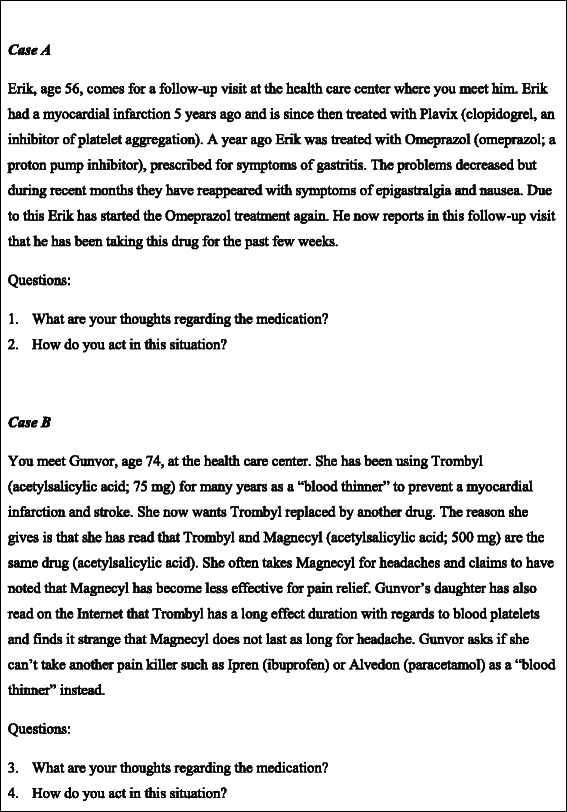
Fig. 1
Fig. 1
The two patient cases that were presented to the interviewees for discussion. Case A The patient is prescribed omeprazole (a proton pump inhibitor) in combination with the prodrug clopidogrel, an inhibitor of platelet aggregation (P2Y12 purinoceptor antagonist). Since clopidogrel is activated by an enzyme (CYP2C19) that is inhibited by omeprazole possible effects of an interaction may appear, which should be considered by the interviewed. Case B The patient is prescribed acetylsalicylic acid (at a low dose) because of cardiovascular events. The patient wants it to be replaced by another non-steroid, anti-inflammatory drug (NSAID) or paracetamol (acetaminophen). The discussion of this case requires the understanding of the mechanism of action of NSAIDs (reversible and irreversible cyclooxygenase binding) and its relevance for the dosage
Fig. 2
Fig. 2
In the analysis of unites of meaning the quality of each unit was awarded a score from 1–10. The figure displays the competences expected on each level
Fig. 3
Fig. 3
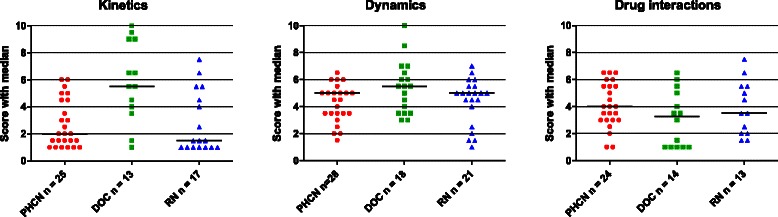
Graphic overview of the results of the quality of units of meaning (score 1–10 and median). Results related to the core concepts of pharmacology; pharmacokinetics, pharmacodynamics and drug interactions, subdivided by groups of future health care professionals, i.e. primary healthcare nurse students (PHCN; ●), medical students (DOC; ■) and nurse students (RN; ▲). n = Number of units of meanings expressed by each category of future professionals. All participants contributed in each case

References

    1. Grönvik L. Pharmaceuticals – statistics for 2012. Swedish: National Board of Health and Welfare, OFFICIAL STATISTICS OF SWEDEN, Statistics – Health and Medical Care. 2012. https://www.socialstyrelsen.se/Lists/Artikelkatalog/Attachments/19023/20....
    1. Ince I, Knibbe CA, Danhof M, de Wildt SN. Developmental changes in the expression and function of cytochrome P450 3A isoforms: evidence from in vitro and in vivo investigations. Clin Pharmacokinet. 2013;52(5):333–45. doi: 10.1007/s40262-013-0041-1. - DOI - PubMed
    1. Boreham NC, Mawer GE, Foster RW. Medical students’ errors in pharmacotherapeutics. Medical Education. 2000;34(3):188–93. doi: 10.1046/j.1365-2923.2000.00510.x. - DOI - PubMed
    1. Duconge J. Applying organ clearance concepts in a clinical setting. American Journal of Pharmaceutical Education. 2008;72(5):121. doi: 10.5688/aj7205121. - DOI - PMC - PubMed
    1. Westerlund T, Gelin U, Pettersson E, Skarlund F, Wagstrom K, Ringbom C. A retrospective analysis of drug-related problems documented in a national database. International Journal of Clinical Pharmacy. 2013;35(2):202–9. doi: 10.1007/s11096-012-9724-1. - DOI - PubMed

Publication types