


High Risk of Depressive Disorders in Patients With Gout: A Nationwide Population-Based Cohort Study
- PMID: 26717394
- PMCID: PMC5291635
- DOI: 10.1097/MD.0000000000002401
High Risk of Depressive Disorders in Patients With Gout: A Nationwide Population-Based Cohort Study
Erratum in
-
Erratum: High Risk of Depressive Disorders in Patients With Gout: A Nationwide Population-Based Cohort Study: Erratum.Medicine (Baltimore). 2016 May 13;95(19):e8052. doi: 10.1097/01.md.0000484180.59880.52. eCollection 2016 May. Medicine (Baltimore). 2016. PMID: 31265572 Free PMC article.
Abstract
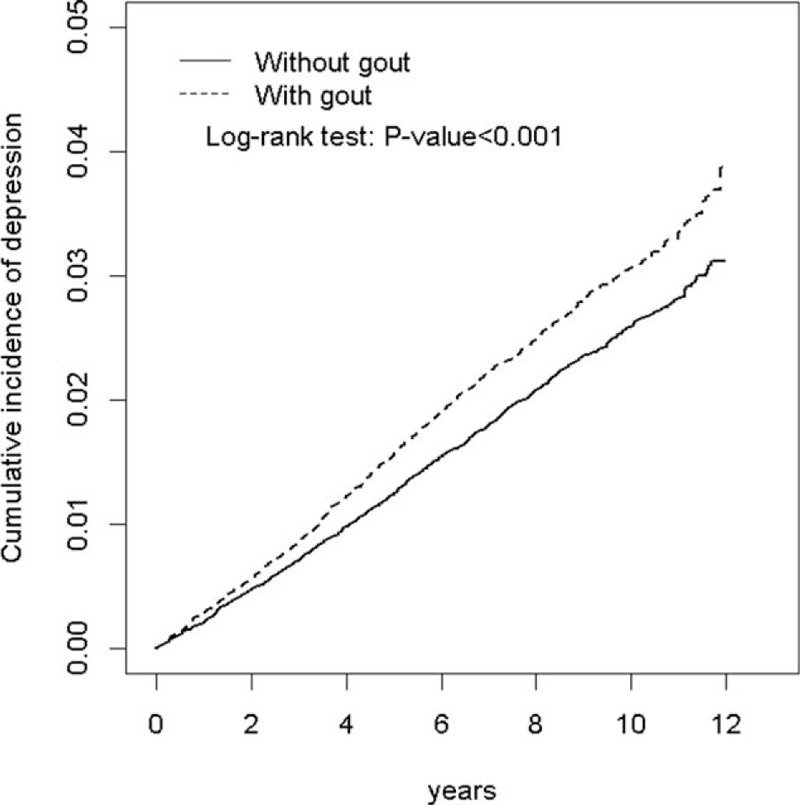
Metabolic abnormalities are common in patients with depressive disorders. However, the relationship between gout and depression is unclear. We explored the causal relationship among gout, antigout medication, and the associated risk of incidental depressive disorders.In this nationwide cohort study, we sampled data from the National Health Insurance Research Database to recruit 34,050 patients with gout as the gout cohort and 68,100 controls (without gout) as the nongout cohort. Our primary endpoint was the diagnosis of depressive disorders during follow-up. The overall study population was followed up until depression diagnosis, withdrawal from the NHI program, or the end of the study. The differences in demographic and clinical characteristics between both cohorts were determined using the Chi-square test for categorical variables and the t-test for continuous variables. Cox proportional hazard regression models were used to examine the effect of gout on the risk of depression, represented using the hazard ratio with the 95% confidence interval.Patients with gout exhibited a higher risk of depressive disorders than controls did. The risk of depressive disorders increased with age and was higher in female patients and those with hypertension, stroke, and coronary artery disease. Nonsteroidal antiinflammatory drug and prednisolone use was associated with a reduced risk of depression. Patients with gout who had received antigout medication exhibited a reduced risk of depressive disorders compared with nongout patients.Our findings support that gout increases the risk of depressive disorders, and that antigout medication use reduces the risk.
Conflict of interest statement
All authors have no conflicts of interest to disclose.
Figures
References
-
- Chuang CS, Yang TY, Muo CH, et al. Hyperlipidemia, statin use and the risk of developing depression: a nationwide retrospective cohort study. Gen Hosp Psychiatry 2014; 36:497–501. - PubMed
-
- Detka J, Kurek A, Basta-Kaim A, et al. Neuroendocrine link between stress, depression and diabetes. Pharmacol Rep 2013; 65:1591–1600. - PubMed
-
- Henderson DC, Vincenzi B, Andrea NV, et al. Pathophysiological mechanisms of increased cardiometabolic risk in people with schizophrenia and other severe mental illnesses. Lancet Psychiatry 2015; 2:452–464. - PubMed
-
- Huang CJ, Lin CH, Lee MH, et al. Prevalence and incidence of diagnosed depression disorders in patients with diabetes: a national population-based cohort study. Gen Hosp Psychiatry 2012; 34:242–248. - PubMed
-
- McElroy SL, Kotwal R, Malhotra S, et al. Are mood disorders and obesity related? A review for the mental health professional. J Clin Psychiatry 2004; 65:634–651.quiz 730. - PubMed
Publication types
MeSH terms
Substances
LinkOut - more resources
Full Text Sources
Medical
