


Prevalence and Risk Factors of Sleep Disordered Breathing in Fabry disease: A Prospective Cohort Study
- PMID: 26717401
- PMCID: PMC5291642
- DOI: 10.1097/MD.0000000000002413
Prevalence and Risk Factors of Sleep Disordered Breathing in Fabry disease: A Prospective Cohort Study
Abstract
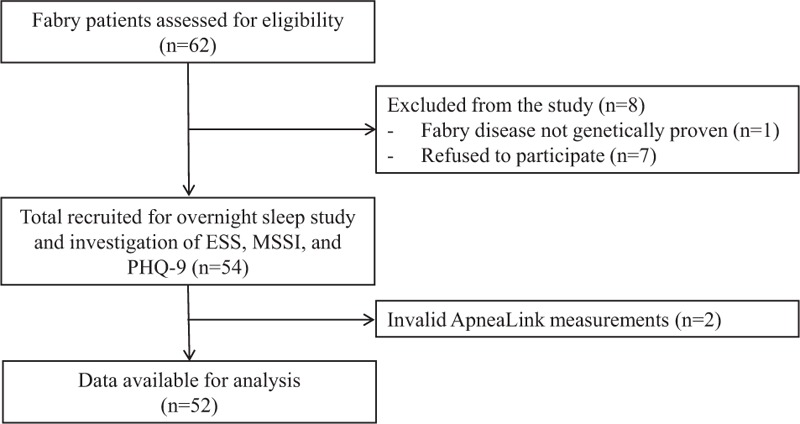
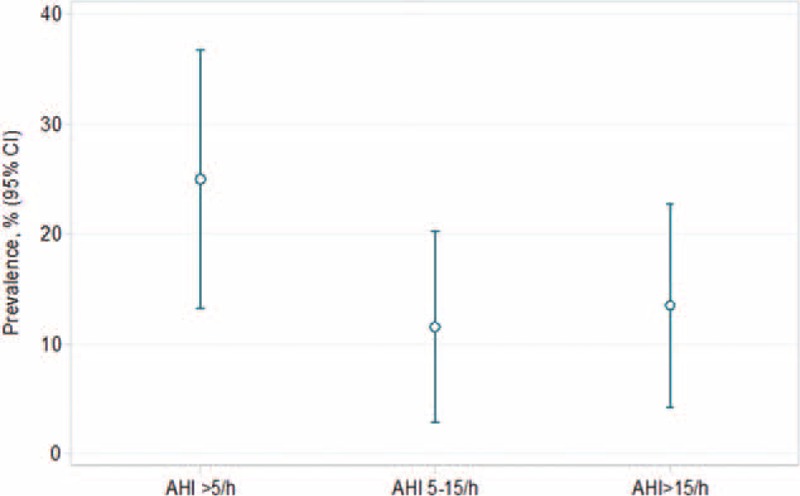
Excessive daytime sleepiness (EDS) is a frequently reported and not well-understood symptom in patients with Fabry disease (FD). Sleep-disordered breathing (SDB) is a possible factor. As deposition of glycosphingolipids in the upper airway muscles is likely, we hypothesized that obstructive sleep apnoea (OSA) is highly prevalent in FD and positively associated with its severity.All patients with FD who are followed in the Fabry cohort of the University Hospital Zurich (n = 62) were asked to participate in this prospective cohort study. Eligible patients were prospectively investigated by assessing their daytime sleepiness using the Epworth Sleepiness Scale (ESS), the severity of FD using the Mainz Severity Score Index (MSSI), and by an ambulatory overnight respiratory polygraphy between November 1, 2013, and January 31, 2015. SDB was defined as an apnea/hypopnea index (AHI) of > 5/h.Fifty-two patients (mean ± SD age 42.8 ± 14.7 years, 33% men, mean ± SD BMI 23.4 ± 3.6 kg/m) with a median (IQR) MSSI of 12 (5-19) were included. Median (IQR) ESS was 6 (2-10) and 7 patients (14%) had an ESS > 10. Thirteen patients (25%) had SDB (78% obstructive sleep apnea, 22% central sleep apnea). In the multivariable analysis, the age was the only statistically significant predictor of SDB (OR 1.11, 95% CI 1.04-1.18, P = 0.001). ESS was associated with depression (P < 0.001) but not AHI nor age.This study shows that SDB, especially obstructive sleep apnea is highly prevalent in patients with Fabry disease. However, EDS in FD seems to be related with depression rather than SDB.ClinicalTrials.gov (identifier: NCT01947634).
Conflict of interest statement
The authors have no conflicts of interest to disclose.
Figures
References
-
- Zarate YA, Hopkin RJ. Fabry's disease. Lancet 2008; 372:1427–1435. - PubMed
-
- Pallesen S, Nordhus IH, Omvik S, et al. Prevalence and risk factors of subjective sleepiness in the general adult population. Sleep 2007; 30:619–624. - PubMed
-
- Desnick RJ, Brady R, Barranger J, et al. Fabry disease, an under-recognized multisystemic disorder: expert recommendations for diagnosis, management, and enzyme replacement therapy. Ann Intern Med 2003; 138:338–346. - PubMed
-
- Berry RB, Budhiraja R, Gottlieb DJ, et al. Rules for scoring respiratory events in sleep: update of the 2007 AASM Manual for the Scoring of Sleep and Associated Events. Deliberations of the Sleep Apnea Definitions Task Force of the American Academy of Sleep Medicine. J Clin Sleep Med 2012; 8:597–619. - PMC - PubMed
