. 2016 Feb;39(4):676-81.
doi: 10.1002/jssc.201500989. Epub 2016 Jan 28.

Two-step ion-exchange chromatographic purification combined with reversed-phase chromatography to isolate C-peptide for mass spectrometric analysis

Affiliations

Two-step ion-exchange chromatographic purification combined with reversed-phase chromatography to isolate C-peptide for mass spectrometric analysis

Kuanysh Kabytaev et al. J Sep Sci. 2016 Feb.

Abstract

A liquid chromatography with mass spectrometry on-line platform that includes the orthogonal techniques of ion exchange and reversed phase chromatography is applied for C-peptide analysis. Additional improvement is achieved by the subsequent application of cation- and anion-exchange purification steps that allow for isolating components that have their isoelectric points in a narrow pH range before final reversed-phase mass spectrometry analysis. The utility of this approach for isolating fractions in the desired "pI window" for profiling complex mixtures is discussed.

Keywords: C-peptide; Ion exchange chromatography; Isotope dilution assay; Orthogonal separations; Peptide purification.


Figures

Figure 1
Figure 1
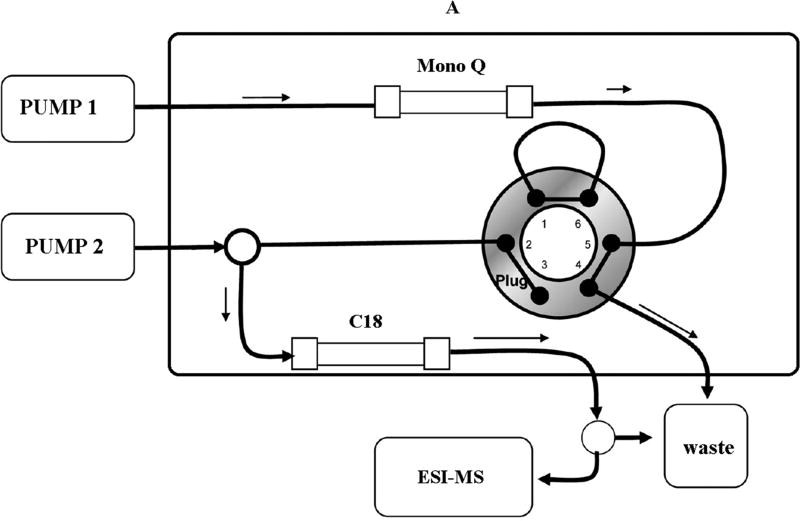
The diagram illustrating LC–MS process and most important sample preparation steps. The two on-line chromatographic separations are performed sequentially, anion exchange chromatographic step is followed by RP and, further, by ESI-MS. A combination of cation exchange, which is a part of off-line purification, and anion exchange steps (on-line) allows for reducing the number of ballast components (only species with pI values in the selected window are collected (see Fig. 2 for details)).
Figure 2
Figure 2
A two-step ion exchange chromatographic procedure (in this example a cation exchange precedes anion exchange) that isolates mixture components with pIs that belong selected pH interval. Multi-component system ampholytes (proteins or peptides) interacting with cation and anion exchangers. At any given pH1, the analytes with their pI values located to the right (pI>pH1) will be charged positively and thus will be retained by a cation exchanger. Similarly, for anion exchangers, the interaction takes place for the species having their pI below the selected pH value (pH2). In this illustration, a sample is applied initially to a cation exchanger followed by an anion exchanger, so pH1>pH2. In this picture, the same form curves (titration curves), uniformly dispersed across whole pH range, represent all different compounds in the sample solution.
Figure 3
Figure 3
Potential application of a narrow pH window method for complex mixture profiling. As a result of sequential application of a pair ion-exchange separations, a fraction of initial sample is obtained that contained species with pI values belonging to the selected pH window. By repeating the above procedure, all necessary pH intervals can be covered. The collected fractions can be subjected to a second dimension analysis, as shown. With some limitations, the method can be considered as alternative for IEF.
Figure 4
Figure 4
2D hardware design and valve positions. At position A, the flow from the IEx column is directed to waste.
Figure 5
Figure 5
Valve position B. The flow from the IEx column is transferred to second column, C18.
Figure 6
Figure 6
2D chromatography separation method. Concentration gradient profiles for each column are shown. Dotted line represents Pump 1 gradient profile: a sharp increase of B solution concentration is used for a sharp pH decrease to provide fast C-peptide elution and then the column is re-equilibrated to the pH of sample loading (pH 5). A solid line shows Pump 2 gradient (acetonitrile concentration). C-peptide elution occurs at 40%, approx. and two more washing cycles are added to provide reliable C18 column cleaning.
Figure 7
Figure 7
Selected ion monitoring (SIM) for C-peptide plasma sample. 2D LC method: anion exchange purification on MonoQ followed by RP (C18). Retention time for C-peptide is 27.96 min. The isotopically labeled standards (m/z=1017.7 and 1013.0) are co-eluted with the native C-peptide (m/z =1007.7). The insert shows the same full length 1 h SIM data.

References

    1. Wagner K, Miliotis T, Marko-Varga G, Bischoff R, Unger KK. Anal. Chem. 2002;74:809–820. - PubMed
    1. Henry R. Principles of multidimensional HPLC and advantages for protein and peptide analysis; Lecture L-5 at 23rd International Symposium on the Separation of Proteins, Peptides and Polynucleotides (ICPPP); November 2003; Delray Beach, FL, USA.
    1. Stoyanov A. Electrophoresis. 2012;33:3281–3290. - PubMed
    1. Kuzuya H, Blix PM, Horwitz DL, Rubinstein AH, Steiner DF, Binder C, Faber OK. Diabetes. 1978;27:184–191. - PubMed
    1. Steiner DF. N. Engl. J. Med. 1969;280:1106–1113. - PubMed

LinkOut - more resources