. 2015 Dec 31;11(12):e1005671.
doi: 10.1371/journal.pgen.1005671. eCollection 2015 Dec.

RNA Polymerase III Output Is Functionally Linked to tRNA Dimethyl-G26 Modification

Affiliations

RNA Polymerase III Output Is Functionally Linked to tRNA Dimethyl-G26 Modification

Aneeshkumar G Arimbasseri et al. PLoS Genet. .

Abstract

Control of the differential abundance or activity of tRNAs can be important determinants of gene regulation. RNA polymerase (RNAP) III synthesizes all tRNAs in eukaryotes and it derepression is associated with cancer. Maf1 is a conserved general repressor of RNAP III under the control of the target of rapamycin (TOR) that acts to integrate transcriptional output and protein synthetic demand toward metabolic economy. Studies in budding yeast have indicated that the global tRNA gene activation that occurs with derepression of RNAP III via maf1-deletion is accompanied by a paradoxical loss of tRNA-mediated nonsense suppressor activity, manifested as an antisuppression phenotype, by an unknown mechanism. We show that maf1-antisuppression also occurs in the fission yeast S. pombe amidst general activation of RNAP III. We used tRNA-HydroSeq to document that little changes occurred in the relative levels of different tRNAs in maf1Δ cells. By contrast, the efficiency of N2,N2-dimethyl G26 (m(2)2G26) modification on certain tRNAs was decreased in response to maf1-deletion and associated with antisuppression, and was validated by other methods. Over-expression of Trm1, which produces m(2)2G26, reversed maf1-antisuppression. A model that emerges is that competition by increased tRNA levels in maf1Δ cells leads to m(2)2G26 hypomodification due to limiting Trm1, reducing the activity of suppressor-tRNASerUCA and accounting for antisuppression. Consistent with this, we show that RNAP III mutations associated with hypomyelinating leukodystrophy decrease tRNA transcription, increase m(2)2G26 efficiency and reverse antisuppression. Extending this more broadly, we show that a decrease in tRNA synthesis by treatment with rapamycin leads to increased m(2)2G26 modification and that this response is conserved among highly divergent yeasts and human cells.


Conflict of interest statement

The authors have declared that no competing interests exist.

Figures
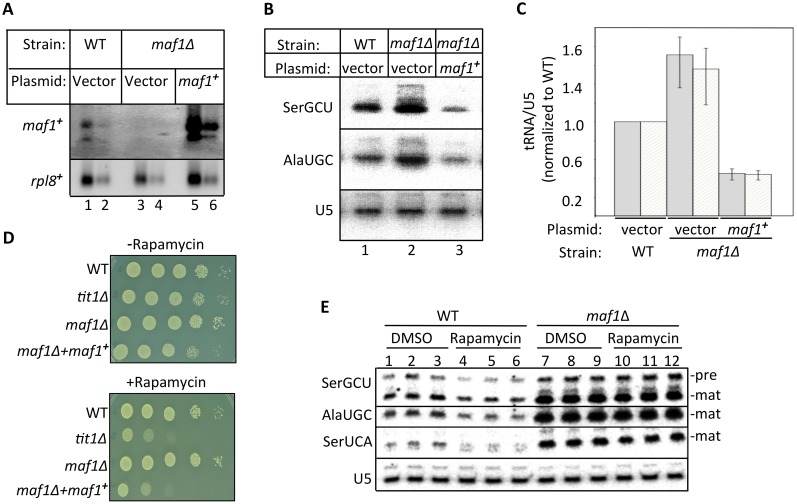
Fig 1
Fig 1. Maf1 is a rapamycin-sensitive regulator of RNAP III-mediated tRNA transcription in S. pombe.
A) Northern blot probed for maf1 + mRNA in parent wild type (WT) strain, maf1Δ strain and maf1Δ in which maf1 + is over expressed from a multicopy plasmid. The rpl8 + mRNA serves as a loading control. Each sample was loaded in duplicate at 2X and 1X. B) Northern blot analysis of tRNASerGCU, tRNAAlaUGC and U5 snRNA loading control on the same blot from the three strains indicated above the lanes. C) Quantitation of the tRNAAlaUGC (white bar) and tRNASerGCU (grey) transcripts from three northern blots, including from panel B, using U5 snRNA on the same blots for calibration. Error bars indicate standard deviations of three experiments. D) Spot assay showing growth of S. pombe strains in minimal media (EMM) with or without rapamycin at 100 ng/ml. E) Northern blot comparing the tRNA transcripts indicated in WT and maf1Δ cells one hour after the addition of rapamycin or DMSO carrier alone to the liquid culture media.
Fig 2
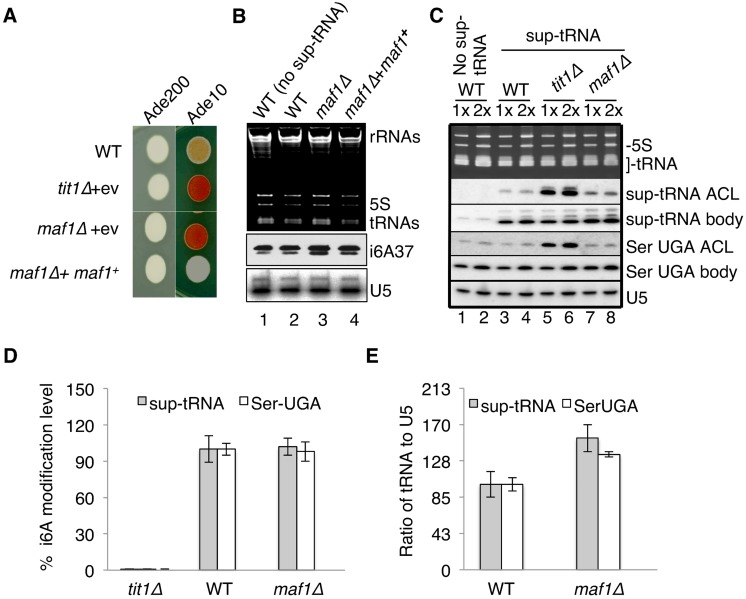
Fig 2. Lack of i6A37 is not responsible for maf1-antisuppression phenotype.
A) tRNA mediated suppression (TMS) in WT (wild-type, i.e., maf1 +), tit1Δ (lacking the tRNA A37-isopentenyltransferase-1 gene, tit1 +, see text) and maf1Δ cells in excess or limiting adenine (Ade200 vs. Ade10; 200 vs. 10 mg/L, respectively); transformed with empty vector (+ev) or expression vector for maf1 +. B) Midwestern blotting of RNA from maf1 + and maf1Δ cells using anti-i6A antibody, and subsequent probing for U5 snRNA as loading control. C) Monitoring in vivo i6A37 level by PHA6 (positive hybridization in the absence of i6A modification, see text) assay in sup-tRNASerUCA (sup-tRNA) and other RNA as indicated. 1X, 2X = 5, 10 ug total RNA. D) Graphic plot of quantification efficiencies in the three S. pombe strains: % modification = [1− (ACLtit1 +/BPtit1 +)/(ACLtit1Δ/BPtit1Δ)] X 100. ACL, anticodon loop probe; BP, body probe. E) Quantification of steady state levels of the sup-tRNASerUCA and tRNASerUGA examined in panel C. D & E: Error bars reflect standard deviations for three experiments.
Fig 3
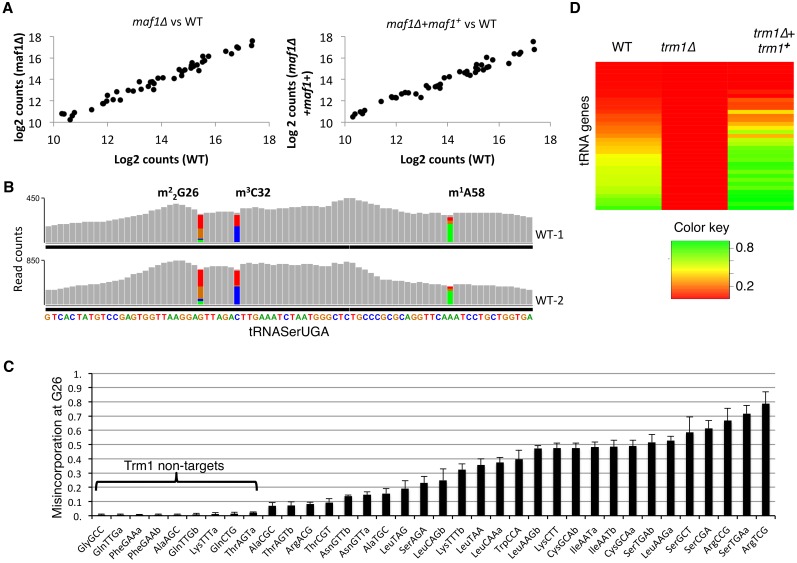
Fig 3. tRNA-HydroSeq identifies some tRNA modifications as misincorporations.
A) Scatter plots showing normalized counts of maf1Δ vs. WT (left), and maf1Δ+maf1 + vs. WT (right) cells. B) The tRNASerUGA track profiles from IGV display software for two WT strain replicates (WT-1 and WT-2) showing misincorporations as colored bars. IGV introduced color if ≥15% mismatch is detected relative to the reference gene sequence. Color key: green = A, red = T, orange = G, blue = C. Sequence read counts are indicated on the Y-axis. C) G26 misincorporations for the 36 S. pombe tRNAs that have G at position 26, arranged left to right according to misincorporation level. Error bars indicate standard deviation of 4 samples. D) Heatmap illustrating misincorporation levels in WT, trm1Δ, and trm1Δ+trm1 + over-expression cells.
Fig 4
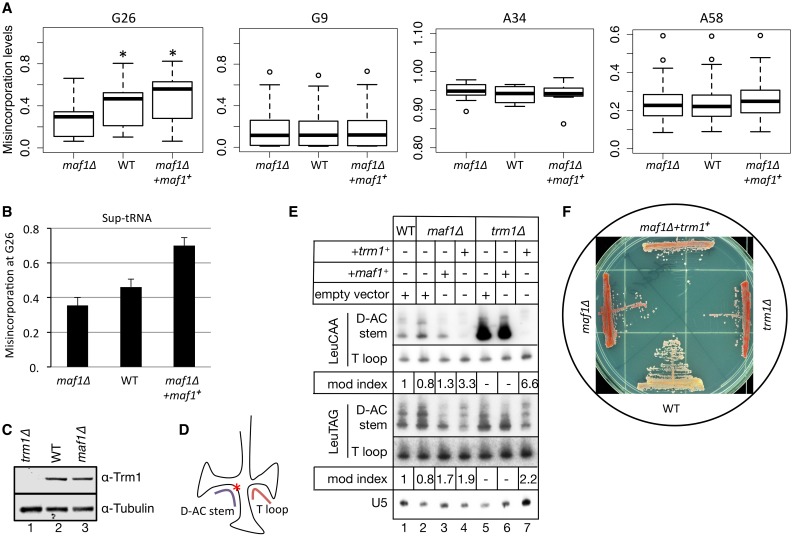
Fig 4. M2 2G26 hypomodification is responsible for the maf1-antisuppression paradox.
A) Box plots showing misincorporations in maf1Δ, WT and maf1Δ+maf1 + strains; G26 box shows misincorporations for 36 tRNAs with G at position 26 (*paired student t test p value <0.001); the G9, A34 and A58 box plots show misincorporations for the tRNA subsets with the corresponding nucleotide identities. B) G26 misincorporations for unique reads mapping to sup-tRNASerUCA in maf1Δ, WT and maf1Δ+maf1 + strains. C) Western blot analysis of Trm1 levels in the strains indicated above the lanes; tubulin served as a loading control. D) Cartoon showing G26 as red asterisk and the two probes used for PHA26 (positive hybridization in the absence of G26 modification) assay. E) PHA26 northern blot assay showing sequential probings with oligos to the two different tRNAsLeu indicated to the left; strains are indicated above the lanes and over-expression plasmids are indicated as +trm1 + +maf1 + or the control, empty vector. Quantification of T-loop/D-AC stem probe signal is expressed as a modification index where the value of the control, in this case lane 1, set to a value of 1.0, is shown below the lanes of each tRNA panel. F) tRNA-mediated suppression (TMS) for WT, maf1Δ, trm1Δ, and maf1Δ+trm1 + cells.
Fig 5
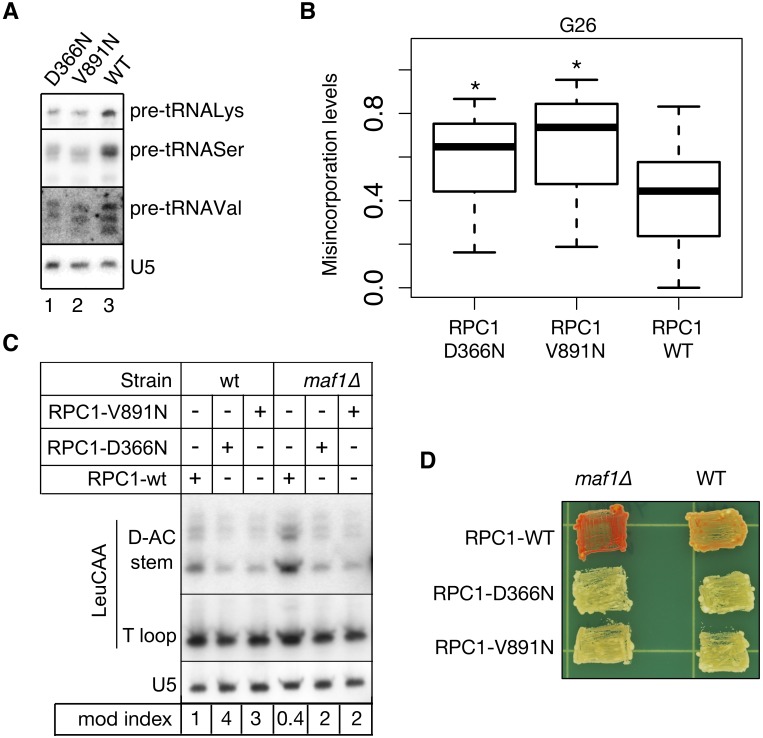
Fig 5. HLD mutations in RNAP III catalytic subunits reduce transcription and increase tRNA m2 2G26 modification efficiency.
A) Northern blot using probes specific for three precursor-tRNAs indicated to the right of each panel; probe for U5 was used as loading control. B) Box plot showing total G26 misincorporation rates for the 27 Trm1 target tRNAs (*paired student t test p value <0.001). C) PHA26 northern blot assay for m2 2G26 modification. D) TMS assay for maf1Δ and WT cells over expressing the HLD Rpc1 mutations and the Rpc-WT control.
Fig 6
Fig 6. M2 2G26 is regulated by nutrient/growth conditions.
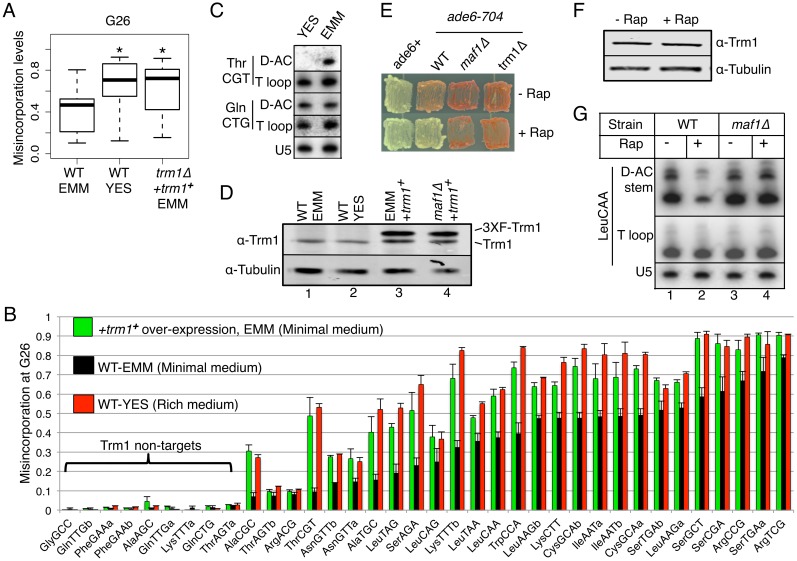
A) Box plot showing G26 misincorporation levels in WT cells grown in minimal (EMM), rich (YES) media, and trm1 + over-expression (trm1Δ+trm1 +) in EMM as indicated (*paired student t test p value <0.001 relative to WT-EMM). B) Bar graph showing G26 misincorporation levels in WT cells in minimal (EMM) and rich (YES) media and +trm1 + over-expression in EMM. C) PHA26 assay for tRNAThrCGT in minimal (EMM) and rich (YES) media. D) Western blot analysis for Trm1 in WT cells in minimal (EMM) and rich (YES) media (lanes 1, 2), and +trm1 + over-expression in EMM (lane 3), as well as maf11Δ+trm1 + in EMM (lane 4); tubulin serves as a loading control. E) TMS assay for various strains in +/- rapamycin as indicated to the right. F) Western blot analysis for Trm1 in +/- rapamycin as indicated above the lanes; tubulin serves as a loading control. G) PHA26 assay on various strains in +/- rapamycin as indicated above the lanes.
Fig 7
Fig 7. The m2 2G26 modification efficiency response is conserved in S. cerevisiae and human cells.
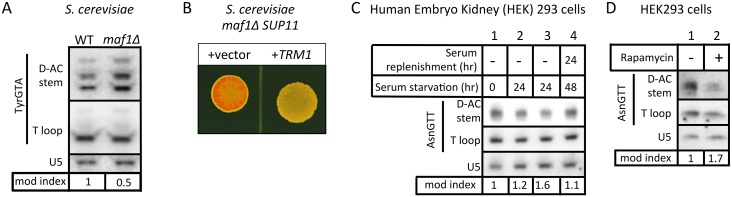
A) PHA26 assay of S. cerevisiae maf1Δ and WT (MAF1) cells. B) TMS assay shows that over-expression of TRM1 reverses antisuppression phenotype of S. cerevisiae maf1Δ cells. C) PHA26 assay of human embryonic kidney (HEK) 293 cells grown for a period of serum starvation or after serum replenishment as indicated above the lanes. D) PHA26 assay of HEK293 cells in the presence or absence of rapamycin. Quantitative modification indices are shown for panels A, C and D, described as for Fig 4D.

Comment in

References

    1. Gingold H, Tehler D, Christoffersen NR, Nielsen MM, Asmar F, et al. (2014) A dual program for translation regulation in cellular proliferation and differentiation. Cell 158: 1281–1292. 10.1016/j.cell.2014.08.011 - DOI - PubMed
    1. Gu C, Begley TJ, Dedon PC (2014) tRNA modifications regulate translation during cellular stress. FEBS Lett 588: 4287–4296. 10.1016/j.febslet.2014.09.038 - DOI - PMC - PubMed
    1. Hinnebusch AG, Natarajan K (2002) Gcn4p, master regulator of gene expression, is controlled at multiple levels by diverse signals of starvation and stress. Eukaryot Cell 1:22–32. - PMC - PubMed
    1. Johnson DL, Johnson SA (2008) Cell biology. RNA metabolism and oncogenesis. Science 320: 461–462. 10.1126/science.1158680 - DOI - PubMed
    1. Pavon-Eternod M, Gomes S, Geslain R, Dai Q, Rosner MR, et al. (2009) tRNA over-expression in breast cancer and functional consequences. Nucleic Acids Res 37: 7268–7280. 10.1093/nar/gkp787 - DOI - PMC - PubMed

Publication types

MeSH terms