


Morphology and Function over a One-Year Follow Up Period after Intravitreal Dexamethasone Implant (Ozurdex) in Patients with Diabetic Macular Edema
- PMID: 26720268
- PMCID: PMC4697855
- DOI: 10.1371/journal.pone.0145663
Morphology and Function over a One-Year Follow Up Period after Intravitreal Dexamethasone Implant (Ozurdex) in Patients with Diabetic Macular Edema
Abstract
Background: To investigate changes in macular morphology and function after an intravitreal dexamethasone implant for diabetic macular edema (DME).
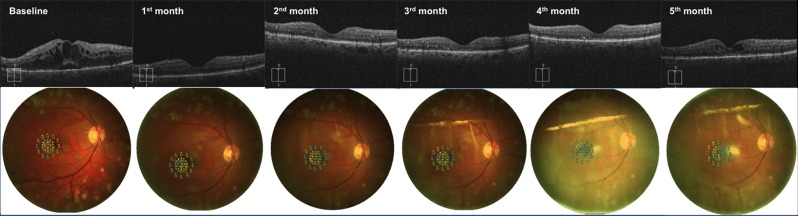
Methods: Twenty-seven eyes in 27 treatment-naive patients affected by DME were treated with intravitreal Ozurdex® injections (IVOI) and followed up 12 months to evaluate morphological and functional changes by means of best-corrected visual acuity (BCVA), microperimetry (MP1), multifocal electroretinography (mfERG), pattern electroretinography (PERG) and spectral domain optical coherence tomography (SD-OCT).
Results: Both BCVA and retinal sensitivity improved significantly at one month after the IVOI (p = 0.031 and p<0.0001, respectively). After five months, the improvement of BCVA remained statistically significant compared with baseline values (p = 0.022); retinal sensitivity improvement was statistically significant for up to four months after the IVOI (p = 0.059). Moreover, central macular thickness significantly decreased for up to four months. Interestingly, PERG and mfERG values did not change significantly for up to four months post-IVOI, but then began to worsen.
Conclusions: In eyes with DME, intravitreal dexamethasone implant determined morphological and functional improvement as soon as one month and for up to four months after the treatment.
Conflict of interest statement
Figures
References
-
- Zitkus BS. Update on the American Diabetes Association Standards of Medical Care. Nurse Pract 2014;39:22–32. - PubMed
Publication types
MeSH terms
Substances
LinkOut - more resources
Full Text Sources
Other Literature Sources
Medical
