doi: 10.1001/jamapediatrics.2015.3235.
Outcomes of Respiratory Syncytial Virus Immunoprophylaxis in Infants Using an Abbreviated Dosing Regimen of Palivizumab
Affiliations
- PMID: 26720836
- PMCID: PMC5647159
- DOI: 10.1001/jamapediatrics.2015.3235
Item in Clipboard
Outcomes of Respiratory Syncytial Virus Immunoprophylaxis in Infants Using an Abbreviated Dosing Regimen of Palivizumab
JAMA Pediatr.
2016 Feb.
No abstract available
Conflict of interest statement
Figures
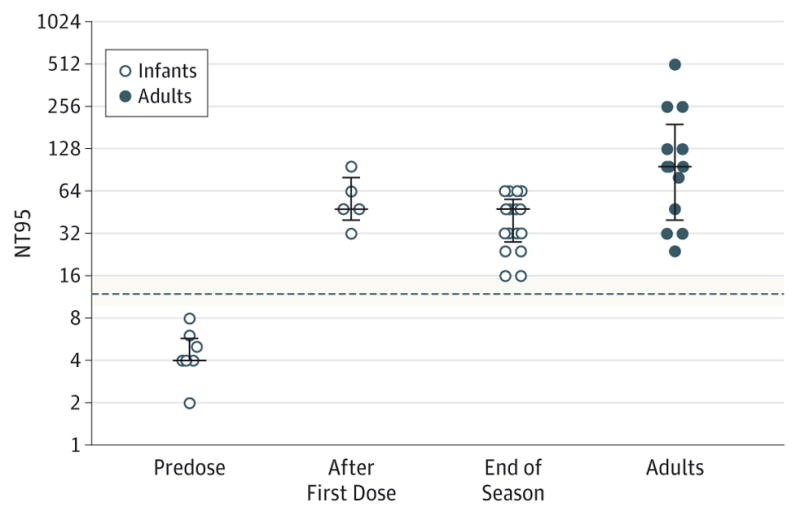
A subset of infants approved to receive either 3 or 4 doses of palivizumab were tested before any palivizumab dose, between 1 and 5 days after a first dose of palivizumab, and at the end of the RSV season (at least 30 days after the last palivizumab dose or after April 15, whichever came last). The RSV neutralizing antibody titers were also determined in season-matched healthy adults. The RSV neutralizing serum antibody titer equivalents (NT95) are based on the ability of a serum dilution (expressed as 1/titer) to inhibit 95%or more of viral infection. In this assay, we determined that palivizumab serum concentrations of 40 μg/mL correspond to a median neutralizing antibody titer of 1:12 (dotted line with minimum and maximum values [shaded area from 3 independent experiments performed in duplicate]). Detection limit was NT95 of approximately 4 (or 1/4), equivalent to a serum concentration of palivizumab of approximately 6.25 μg/mL except for predose serum samples for which the detection limit of the assay was NT95 of approximately 2. Error bars represent median with interquartile range.
References
-
- Johnson S, Oliver C, Prince GA, et al. Development of a humanized monoclonal antibody (MEDI-493) with potent in vitro and in vivo activity against respiratory syncytial virus. J Infect Dis. 1997;176(5):1215–1224. - PubMed
-
- Brady MT American Academy of Pediatrics Committee on Infectious Diseases; American Academy of Pediatrics Bronchiolitis Guidelines Committee. Updated guidance for palivizumab prophylaxis among infants and young children at increased risk of hospitalization for respiratory syncytial virus infection. Pediatrics. 2014;134(2):415–420. - PubMed
-
- Mitchell I, Paes BA, Li A, Lanctôt KL CARESS investigators. CARESS: the Canadian Registry of Palivizumab. Pediatr Infect Dis J. 2011;30(8):651–655. - PubMed
Publication types
MeSH terms
Substances
Grants and funding
LinkOut - more resources
Full Text Sources
Other Literature Sources
Medical