


HIV Drug Resistance Among Children Initiating First-Line Antiretroviral Treatment in Uganda
- PMID: 26723018
- PMCID: PMC4931746
- DOI: 10.1089/AID.2015.0215
HIV Drug Resistance Among Children Initiating First-Line Antiretroviral Treatment in Uganda
Abstract
Background: There are limited data on primary human immunodeficiency virus drug resistance (HIVDR) in pediatric populations. This study aimed to assess the prevalence of primary HIVDR and associated risk factors among children initiating first-line antiretroviral therapy (ART) in Uganda.
Methods: At three Ugandan clinics, children (age <12 years) requiring ART were recruited between January 2010 and August 2011. Before starting ART, blood was collected for viral load and pol gene sequencing. Drug resistance mutations were determined using the 2010 International AIDS Society-USA mutation list. Risk factors for HIVDR were assessed with multivariate regression analysis.
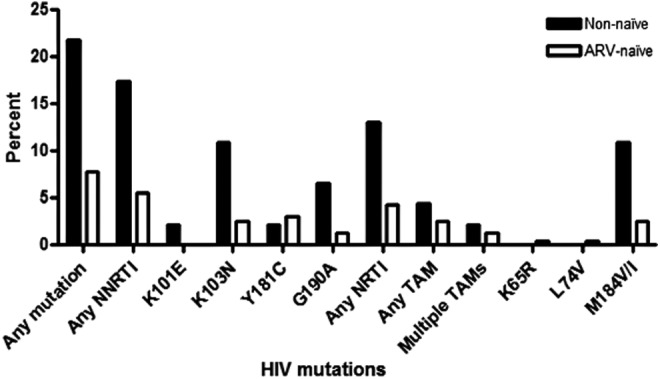
Results: Three hundred nineteen HIV-infected children with a median age of 4.9 years were enrolled. Sequencing was successful in 279 children (87.5%). HIVDR was present in 10% of all children and 15.2% of children <3 years. Nucleoside reverse transcriptase inhibitors (NRTIs), non-NRTI (NNRTI), and dual-class resistance was present in 5.7%, 7.5%, and 3.2%, respectively. HIVDR occurred in 35.7% of prevention of mother-to-child transmission (PMTCT)-exposed children, 15.6% in children with unknown PMTCT history, and 7.7% among antiretroviral-naive children. History of PMTCT exposure [adjusted odds ratio (AOR): 2.6, 95% CI: 1.3-5.1] or unknown PMTCT status (AOR: 3.8, 95% CI: 1.1-13.5), low CD4 (AOR: 2.2, 95% CI: 1.3-3.6), current breastfeeding (AOR: 7.4, 95% CI: 2.6-21), and current maternal ART use (AOR: 6.4, 95% CI: 3.4-11.9) emerged as risk factors for primary HIVDR in multivariate analysis.
Conclusion: Pretreatment HIVDR is high, especially in children with PMTCT exposure. Protease inhibitor (PI)-based regimens are advocated by the World Health Organization, but availability in children is limited. Children with (unknown) PMTCT exposure, low CD4 count, current breastfeeding, or maternal ART need to be prioritized to receive PI-based regimens.
Figures

References
-
- Gibb DM, Giaquinto C: Children with HIV infection: Special cases. Lancet 2000;356 Suppl:s34. - PubMed
-
- World Health Organization, Unicef, UNAIDS: Global update on HIV treatment 2013: Results, impact and opportunities. WHO Bull 2013(June):7 ISBN 978 92 4 150573 4
-
- Ton Q, Frenkel L: HIV drug resistance in mothers and infants following use of antiretrovirals to prevent mother-to-child transmission. Curr HIV Res 2013;11:126–136 - PubMed
Publication types
MeSH terms
Substances
LinkOut - more resources
Full Text Sources
Other Literature Sources
Medical
Molecular Biology Databases
Research Materials
Miscellaneous
