


Fundamental constructs in food parenting practices: a content map to guide future research
- PMID: 26724487
- PMCID: PMC4892304
- DOI: 10.1093/nutrit/nuv061
Fundamental constructs in food parenting practices: a content map to guide future research
Abstract
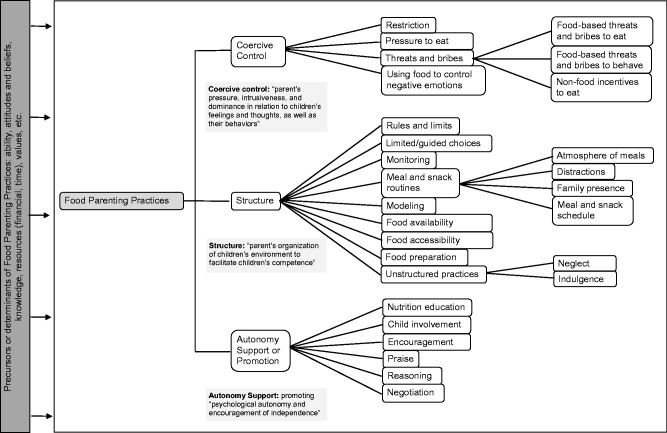
Although research shows that "food parenting practices" can impact children's diet and eating habits, current understanding of the impact of specific practices has been limited by inconsistencies in terminology and definitions. This article represents a critical appraisal of food parenting practices, including clear terminology and definitions, by a working group of content experts. The result of this effort was the development of a content map for future research that presents 3 overarching, higher-order food parenting constructs--coercive control, structure, and autonomy support--as well as specific practice subconstructs. Coercive control includes restriction, pressure to eat, threats and bribes, and using food to control negative emotions. Structure includes rules and limits, limited/guided choices, monitoring, meal- and snacktime routines, modeling, food availability and accessibility, food preparation, and unstructured practices. Autonomy support includes nutrition education, child involvement, encouragement, praise, reasoning, and negotiation. Literature on each construct is reviewed, and directions for future research are offered. Clear terminology and definitions should facilitate cross-study comparisons and minimize conflicting findings resulting from previous discrepancies in construct operationalization.
Keywords: children; eating behaviors; feeding practices; obesity..
© The Author(s) 2016. Published by Oxford University Press on behalf of the International Life Sciences Institute. All rights reserved. For Permissions, please e-mail: journals.permissions@oup.com.
Figures
References
-
- Golley RK, Hendrie GA, McNaughton SA. Scores on the dietary guideline index for children and adolescents are associated with nutrient intake and socio-economic position but not adiposity. J Nutr. 2011;141:1340–1347. - PubMed
-
- Diethelm K, Jankovic N, Moreno LA, et al. Food intake of European adolescents in the light of different food-based dietary guidelines: results of the HELENA (Healthy Lifestyle in Europe by Nutrition in Adolescence) Study. Public Health Nutr. 2012;15:386–398. - PubMed
Publication types
MeSH terms
Grants and funding
LinkOut - more resources
Full Text Sources
Other Literature Sources
Medical
