Review
. 2016 Jul;65(7):797-804.
doi: 10.1007/s00262-015-1783-4. Epub 2016 Jan 2.

PD-L1-specific T cells

Affiliations
Review

PD-L1-specific T cells

Shamaila Munir Ahmad et al. Cancer Immunol Immunother. 2016 Jul.

Abstract

Recently, there has been an increased focus on the immune checkpoint protein PD-1 and its ligand PD-L1 due to the discovery that blocking the PD-1/PD-L1 pathway with monoclonal antibodies elicits striking clinical results in many different malignancies. We have described naturally occurring PD-L1-specific T cells that recognize both PD-L1-expressing immune cells and malignant cells. Thus, PD-L1-specific T cells have the ability to modulate adaptive immune reactions by reacting to regulatory cells. Thus, utilization of PD-L1-derived T cell epitopes may represent an attractive vaccination strategy for targeting the tumor microenvironment and for boosting the clinical effects of additional anticancer immunotherapy. This review summarizes present information about PD-L1 as a T cell antigen, depicts the initial findings about the function of PD-L1-specific T cells in the adjustment of immune responses, and discusses future opportunities.

Keywords: Anti-Tregs; CITIM 2015; Cancer vaccines; PD-L1; PD-L1-specific T cells.


Conflict of interest statement

Mads Hald Andersen is an author of three filed patent applications based on the use of PD-L1 vaccination. The rights of the patent applications have been transferred to Copenhagen University Hospital, Herlev/The Capital Region of Denmark, according to the Danish Law of Public Inventions at Public Research Institutions. All other authors declare no conflict of interest.

Figures
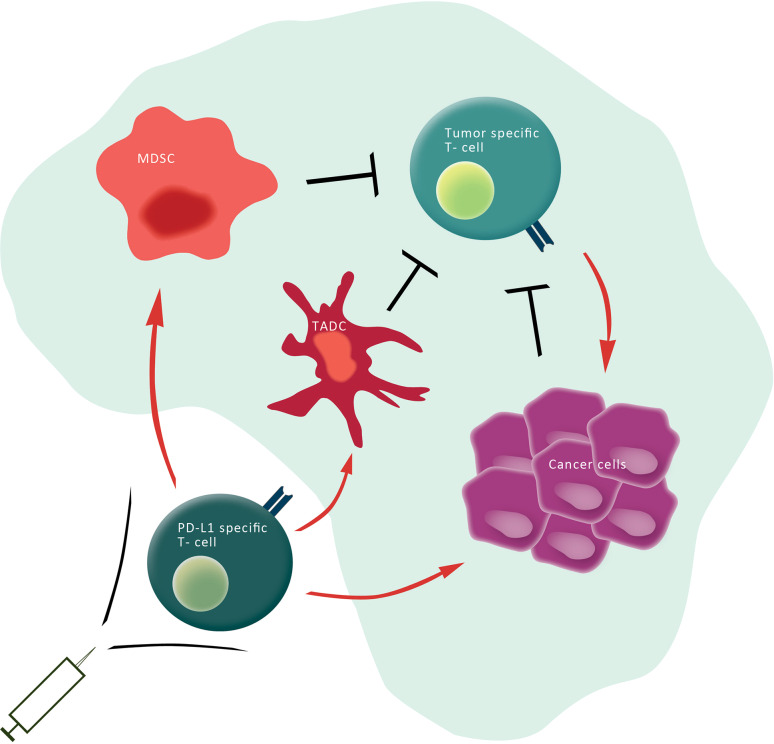
Fig. 1
Fig. 1
PD-L1-specific T cells target immune regulatory cells as well as cancer cells. Cancer cells (purple) as well as other regulatory immune cells [e.g., tumor-associated dendritic cells (TADC) (dark red) and MDSC (light red)] express checkpoint inhibitors (e.g., PD-L1), inhibitory cytokines as well as metabolic enzymes that restrain the antitumor activity of anti-tumor-specific T cells (green) in the tumor microenvironment. Specific T cells recognizing HLA-restricted PD-L1-derived epitopes (yellow), which are generated from intracellular degraded PD-L1, are able to eliminate (red arrows) regulatory immune cells as well as cancer cells. Hence, the activation of PD-L1-specific T cells by vaccination may directly target immune inhibitory pathways in the tumor microenvironment, modulate immune regulation, and potentially alter tolerance to tumor antigens. The addition of PD-L1 epitopes to therapeutic cancer vaccines would thus be a simple and highly synergistic means to increase the outcome
Fig. 2
Fig. 2
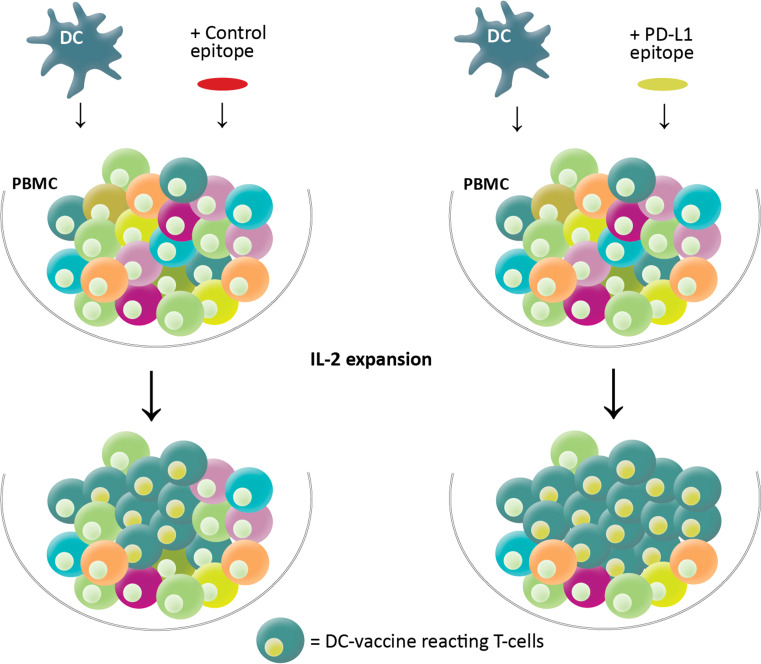
Co-stimulation with PD-L1 epitopes boosts the immunogenicity of a DC-based vaccine. PBMC (numerous colors) was stimulated with an autologous DC-based vaccine (blue) in the presence of IL-2. Subsequently, DC-reactive T cells (green) expand, and this is augmented when PD-L1-specific T cells are activated by co-stimulation with PD-L1-derived epitopes (yellow) assessed in cultures co-stimulated with an HIV control epitope (red)
Fig. 3
Fig. 3
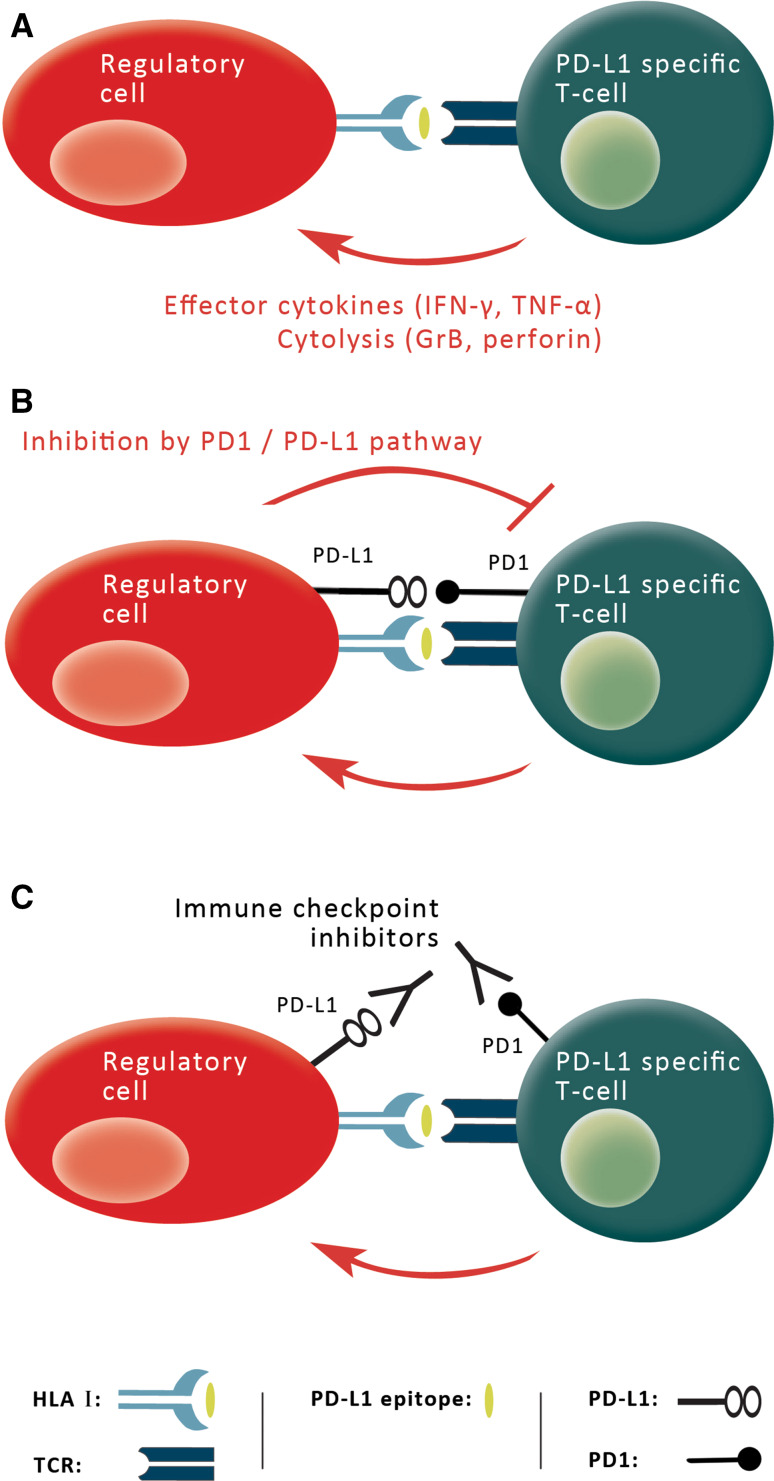
A PD-L1 vaccine and checkpoint inhibitors are complimentary. a PD-L1-expressing regulatory immune cells (red) degrade intracellular PD-L1 into peptides (yellow) that are subsequently processed into peptides and presented on the cell surface by HLA molecules, where they are recognized by PD-L1-specific T cells (green). Hence, PD-L1-specific T cells can promote local immune suppression by the secretion of effector cytokines or by killing regulatory immune cells directly (red arrow), thereby influencing general immune reactions. Similarly, they can eliminate PD-L1-expressing malignant cells, b PD-1-positive, PD-L1-specific T cells are themselves hampered by the suppressive effects of PD-L1 expression on their targets and c PD-L1-specific T cells may thus be further boosted by PD-L1 blockade, since PD-L1 mAbs target the same cells as vaccine-induced T cells; this therapeutic strategy will therefore make cells more vulnerable targets. Thus, a PD-L1-based vaccine should be viewed as complementing rather than competing with checkpoint inhibitors

References

    1. Hornig N, Reinhardt K, Kermer V, Kontermann RE, Muller D. Evaluating combinations of costimulatory antibody-ligand fusion proteins for targeted cancer immunotherapy. Cancer Immunol Immunother. 2013;62:1369–1380. doi: 10.1007/s00262-013-1441-7. - DOI - PMC - PubMed
    1. Hodi FS, O’Day SJ, McDermott DF, Weber RW, Sosman JA, Haanen JB, Gonzalez R, Robert C, Schadendorf D, Hassel JC, Akerley W, van den Eertwegh AJ, Lutzky J, Lorigan P, Vaubel JM, Linette GP, Hogg D, Ottensmeier CH, Lebbe C, Peschel C, Quirt I, Clark JI, Wolchok JD, Weber JS, Tian J, Yellin MJ, Nichol GM, Hoos A, Urba WJ. Improved survival with ipilimumab in patients with metastatic melanoma. N Engl J Med. 2010;363:711–723. doi: 10.1056/NEJMoa1003466. - DOI - PMC - PubMed
    1. Ishida Y, Agata Y, Shibahara K, Honjo T. Induced expression of PD-1, a novel member of the immunoglobulin gene superfamily, upon programmed cell death. EMBO J. 1992;11:3887–3895. - PMC - PubMed
    1. Wherry EJ. T cell exhaustion. Nat Immunol. 2011;12:492–499. doi: 10.1038/ni.2035. - DOI - PubMed
    1. Dong H, Zhu G, Tamada K, Chen L. B7-H1, a third member of the B7 family, co-stimulates T-cell proliferation and interleukin-10 secretion. Nat Med. 1999;5:1365–1369. doi: 10.1038/70932. - DOI - PubMed

Publication types