


Association between treatment-related lymphopenia and overall survival in elderly patients with newly diagnosed glioblastoma
- PMID: 26725885
- PMCID: PMC4783226
- DOI: 10.1007/s11060-015-2037-1
Association between treatment-related lymphopenia and overall survival in elderly patients with newly diagnosed glioblastoma
Abstract
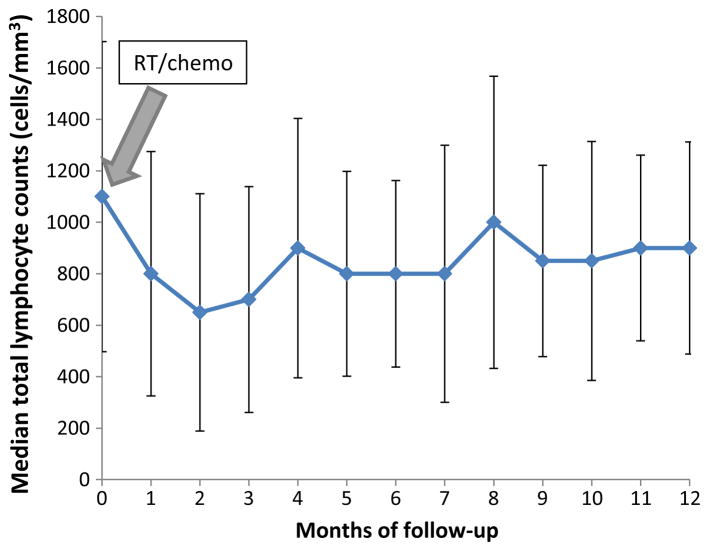
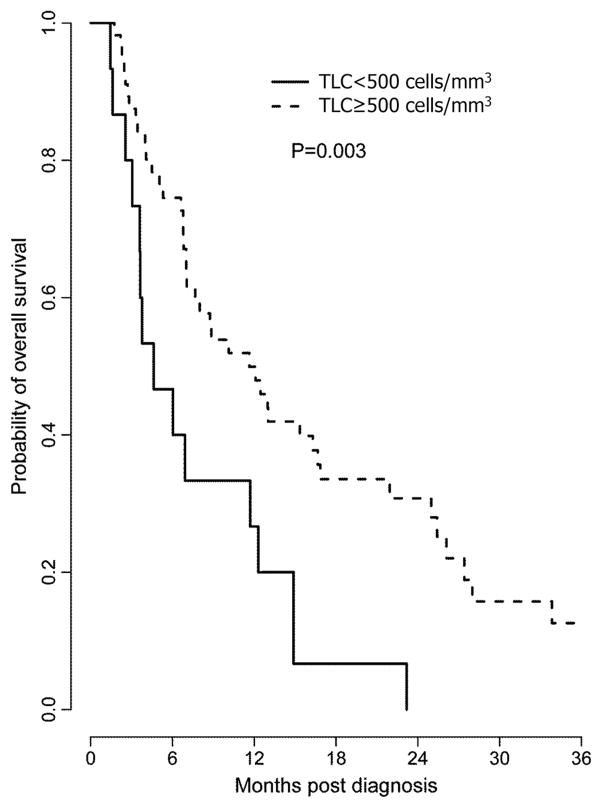
Management of patients with glioblastoma (GBM) often includes radiation (RT) and temozolomide (TMZ). The association between severe treatment-related lymphopenia (TRL) after the standard chemoradiation and reduced survival has been reported in GBM patients with the median age of 57. Similar findings were described in patients with head and neck, non-small cell lung, and pancreatic cancers. This retrospective study is designed to evaluate whether elderly GBM patients (age ≥65) develop similar TRL after RT/TMZ and whether such TRL is associated with decreased survival. Serial total lymphocyte counts (TLC) were retrospectively reviewed in patients (age ≥65) with newly diagnosed GBM undergoing RT/TMZ and associated with treatment outcomes. Seventy-two patients were eligible: median KPS 70, median age 71 years (range 65-86) with 56 % of patients >70 years, 53% female, 31% received RT ≤45 Gy. Baseline median TLC was 1100 cells/mm(3) which fell by 41% to 650 cells/mm(3) 2 months after initiating RT/TMZ (p < 0.0001). Patients with TLC <500 cells/mm(3) at 2 months had a shorter survival than those with higher TLCs with a median overall survival of 4.6 versus 11.6 months, respectively. Multivariate analysis revealed a significant association between TRL and survival (HR 2.76, 95% CI 1.30-5.86, p = 0.008). Treatment-related lymphopenia is frequent, severe, and an independent predictor for survival in elderly patients with GBM. These findings add to the body of evidence that immunosuppression induced by chemoradiation is associated with inferior clinical outcomes. Prospective studies are needed to confirm these findings suggesting that immune preservation is important in this cancer.
Keywords: Chemotherapy; Glioblastoma; Lymphopenia; Radiation; Treatment-related toxicities.
Conflict of interest statement
Figures
References
-
- Kantoff PW, Higano CS, Shore ND, et al. Sipuleucel-T immunotherapy for castration resistant prostate cancer. N Engl J Med. 2010;363:411–422. - PubMed
-
- Lissoni P, Brivio F, Fumagalli L, et al. Efficacy of cancer chemotherapy in relation to the pretreatment number of lymphocytes in patients with metastatic solid tumors. Int J Biol Markers. 2004;19:135–140. - PubMed
Publication types
MeSH terms
Substances
Grants and funding
LinkOut - more resources
Full Text Sources
Other Literature Sources
Medical
