The Effect of In Vitro Cultivation on the Transcriptome of Adult Brugia malayi
- PMID: 26727204
- PMCID: PMC4699822
- DOI: 10.1371/journal.pntd.0004311
The Effect of In Vitro Cultivation on the Transcriptome of Adult Brugia malayi
Abstract
Background: Filarial nematodes cause serious and debilitating infections in human populations of tropical countries, contributing to an entrenched cycle of poverty. Only one human filarial parasite, Brugia malayi, can be maintained in rodents in the laboratory setting. It has been a widely used model organism in experiments that employ culture systems, the impact of which on the worms is unknown.
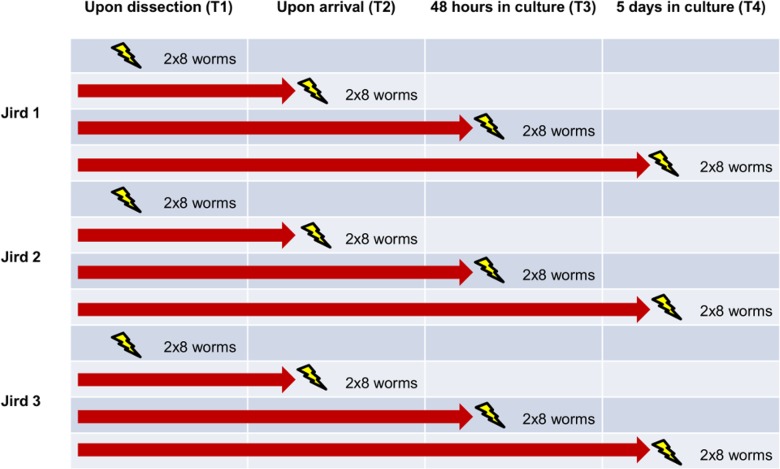
Methodology/principal findings: Using Illumina RNA sequencing, we characterized changes in gene expression upon in vitro maintenance of adult B. malayi female worms at four time points: immediately upon removal from the host, immediately after receipt following shipment, and after 48 h and 5 days in liquid culture media. The dramatic environmental change and the 24 h time lapse between removal from the host and establishment in culture caused a globally dysregulated gene expression profile. We found a maximum of 562 differentially expressed genes based on pairwise comparison between time points. After an initial shock upon removal from the host and shipping, a few stress fingerprints remained after 48 h in culture and until the experiment was stopped. This was best illustrated by a strong and persistent up-regulation of several genes encoding cuticle collagens, as well as serpins.
Conclusions/significance: These findings suggest that B. malayi can be maintained in culture as a valid system for pharmacological and biological studies, at least for several days after removal from the host and adaptation to the new environment. However, genes encoding several stress indicators remained dysregulated until the experiment was stopped.
Conflict of interest statement
The authors have declared that no competing interests exist.
Figures


References
-
- Krishna Kumari A, Harichandrakumar KT, Das LK, Krishnamoorthy K (2005) Physical and psychosocial burden due to lymphatic filariasis as perceived by patients and medical experts. Trop Med Int Health 10: 567–573. - PubMed
-
- Williams SA, Lizotte-Waniewski MR, Foster J, Guiliano D, Daub J, Scott AL, et al. (2000) The filarial genome project: analysis of the nuclear, mitochondrial and endosymbiont genomes of Brugia malayi. Int J Parasitol 30: 411–419. - PubMed
Publication types
MeSH terms
LinkOut - more resources
Full Text Sources
Other Literature Sources
Molecular Biology Databases