


Recognition of a pseudo-symmetric RNA tetranucleotide by Csx3, a new member of the CRISPR associated Rossmann fold superfamily
- PMID: 26727591
- PMCID: PMC4829336
- DOI: 10.1080/15476286.2015.1130209
Recognition of a pseudo-symmetric RNA tetranucleotide by Csx3, a new member of the CRISPR associated Rossmann fold superfamily
Abstract
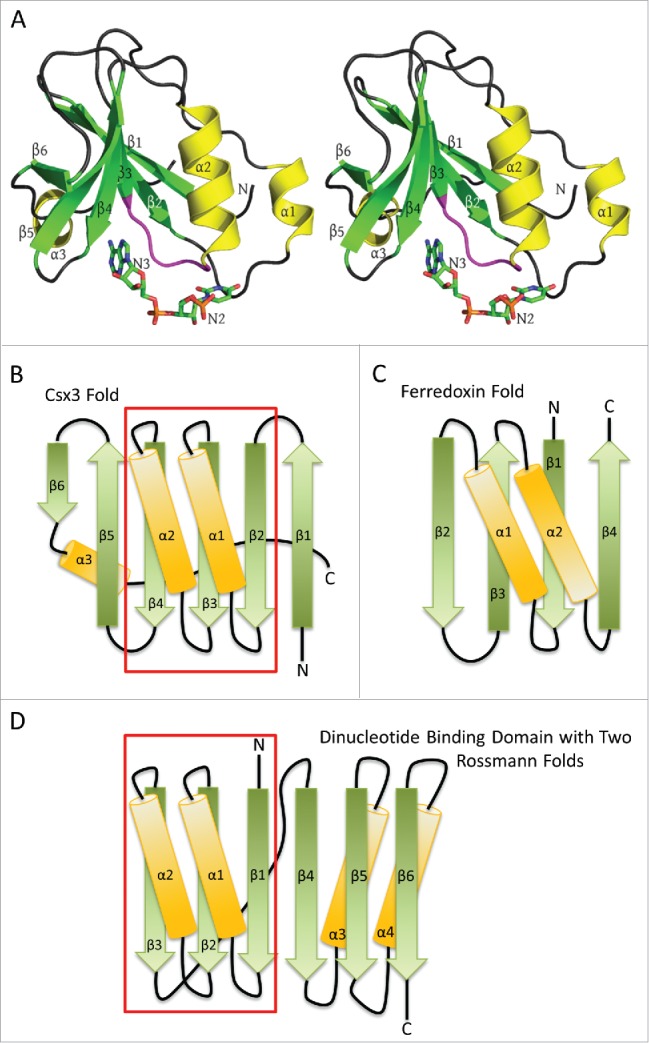
The CRISPR/Cas adaptive immune system shows extreme diversity in the number of CRISPR/Cas types and subtypes, and in the multitude of CRISPR associated protein families of which they are composed. Despite this diversity, the roles of many Cas protein families are now defined with regard to spacer acquisition, crRNA biogenesis, and DNA or RNA surveillance and targeting. However, a number of unclassified CRISPR-Cas proteins remain. Such proteins have traditionally been designated as CRISPR subtype x (Csx). Here we revisit the structural analysis of one such protein, Csx3, and show that this homodimeric protein utilizes a Rossmann fold for the recognition of an RNA tetranucleotide. Tertiary and quaternary structural similarities of Csx3 to CRISPR/Cas proteins Csx1 and Csa3 are identified and suggest Csx3 is a new member of the CRISPR Associated Rossmann Fold (CARF) superfamily. The structure of the Csx3/RNA complex illustrates one way CARF domain proteins may recognize pseudo-symmetric polynucleotides.
Keywords: CARF; CRISPR; CRISPR/Cas; Cas; Csa3; Csm6; Csx1; Csx3.
Figures
Comment on
-
Crystal structures of CRISPR-associated Csx3 reveal a manganese-dependent deadenylation exoribonuclease.RNA Biol. 2015;12(7):749-60. doi: 10.1080/15476286.2015.1051300. RNA Biol. 2015. PMID: 26106927 Free PMC article.
References
-
- Yan X, Guo W, Yuan YA. Crystal structures of CRISPR-associated Csx3 reveal a manganese-dependent deadenylation exoribonuclease. RNA Biol 2015; 12:749-60; PMID:26106927; http://dx.doi.org/ 10.1080/15476286.2015.1051300 - DOI - PMC - PubMed
-
- Reeks J, Naismith JH, White MF. CRISPR interference: a structural perspective. Biochem J 2013; 453:155-66; PMID:23805973; http://dx.doi.org/ 10.1042/BJ20130316 - DOI - PMC - PubMed
-
- Sorek R, Lawrence CM, Wiedenheft B. CRISPR-mediated adaptive immune systems in bacteria and archaea. Annu Rev Biochem 2013; 82:237-66; PMID:23495939; http://dx.doi.org/ 10.1146/annurev-biochem-072911-172315 - DOI - PubMed
-
- Andreeva A, Howorth D, Chandonia JM, Brenner SE, Hubbard TJ, Chothia C, Murzin AG. Data growth and its impact on the SCOP database: new developments. Nucleic Acids Res 2008; 36:D419-25; PMID:18000004; http://dx.doi.org/ 10.1093/nar/gkm993 - DOI - PMC - PubMed
-
- Rao ST, Rossmann MG. Comparison of super-secondary structures in proteins. J Mol Biol 1973; 76:241-56; PMID:4737475; http://dx.doi.org/ 10.1016/0022-2836(73)90388-4 - DOI - PubMed
Publication types
MeSH terms
Substances
LinkOut - more resources
Full Text Sources
Other Literature Sources
