. 2016 Aug;63(2):200-9.
doi: 10.1097/MPG.0000000000001100.

Eosinophilic Esophagitis-Associated Chemical and Mechanical Microenvironment Shapes Esophageal Fibroblast Behavior

Affiliations

Eosinophilic Esophagitis-Associated Chemical and Mechanical Microenvironment Shapes Esophageal Fibroblast Behavior

Amanda B Muir et al. J Pediatr Gastroenterol Nutr. 2016 Aug.

Abstract

Objectives: Eosinophilic esophagitis (EoE) is an immune-mediated allergic disease characterized by progressive esophageal dysmotility and fibrotic stricture associated with chronic esophageal fibroblast activation. It remains unknown how esophageal fibroblasts respond to EoE-relevant matrix stiffness or inflammatory cytokines.

Methods: Immunofluorescence was used to evaluate α-smooth muscle actin (α-SMA) expression in endoscopic esophageal biopsies. Primary esophageal fibroblasts from adult and pediatric patients with or without EoE were exposed to transforming growth factor (TGF)β to determine gene expression, collagen-matrix contractility, and cytoskeletal organization. The influence of matrix stiffness upon fibroblast behavior was assessed on the engineered surface of polyacrylamide gels with varying stiffness. Fibroblast traction forces were measured using microfabricated-post-array-detectors.

Results: EoE esophageal fibroblasts had enhanced α-SMA expression. TGFβ not only stimulated enhanced fibroblast-specific gene expression but also promoted fibroblast-mediated collagen-matrix contraction, despite disease state or age of patients as the origin of cells. Unlike conventional monolayer cell, culture conditions using plastic surface (1 GPa) that activates fibroblasts constitutively, our engineered platforms recapitulating physiologically relevant stiffness (1-20 kPa) revealed that matrix stiffness defines the extent of α-SMA expression, intracellular collagen fibril organization, SMAD3 phosphorylation, and fibroblast traction force.

Conclusions: Matrix stiffness may critically influence TGFβ-mediated gene expression and functions of esophageal fibroblasts ex vivo independent of age and disease conditions. These findings provide a novel insight into the pathogenesis of fibrostenotic disease in EoE.


Figures
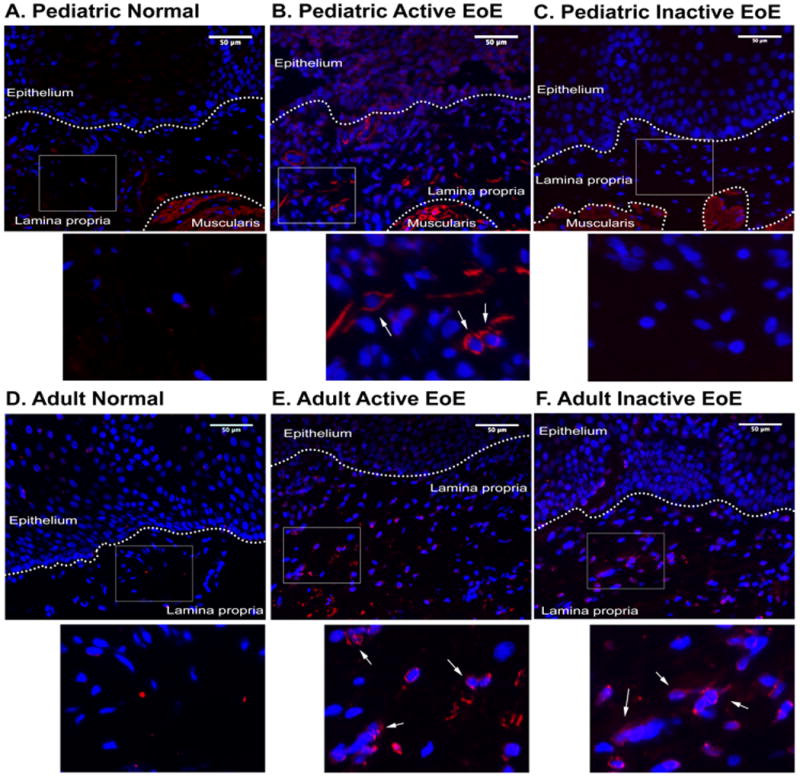
Figure 1
Figure 1. Subepithelial activation of fibroblasts in EoE
Immunofluorescent staining of human esophageal biopsies from pediatric control (A), active EoE (B), and inactive EoE patients (C). Adult biopsies of control (D), active EoE (E), and inactive EoE patients (F) (N=2 for each group). Biopsy specimens are counterstained with DAPI (blue). α-SMA-positive fibroblasts indicated in insert with white arrows. α-SMA-expressing smooth muscle cells provide a positive control. Scale bar is 50μm. Histogram representing relative intensity per area of lamina propria (G).
Figure 2
Figure 2. TGFβ enhances expression of relevant markers of fibroblast activation
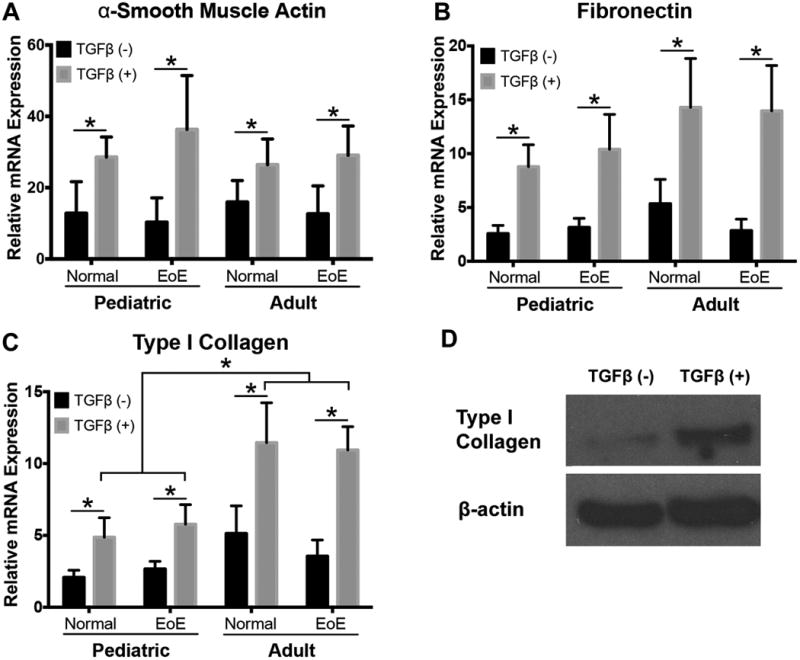
PCR was performed to evaluate markers of fibroblast activation in human esophageal fibroblast cultures. Constitutive expression of α-SMA is similar across phenotypes and increases upon stimulation with TGFβ (A)(N=5, 7, 3, 7 cell cultures respectively) (main effect of TGFβ p=0.0254). Fibronectin expression does not vary at baseline, but is significantly increased with TGFβ stimulation (B) (N=5, 7, 3, 7)(main effect of TGFβ p=0.0001). Constitutive expression of collagen is similar across all phenotypes and TGFβ enhances expression of type 1 collagen in all cell cultures (main effect of TGFβ p<0.0001). Adult derived cell cultures (both EoE and control cell lines) have enhanced response to TGFβ stimulation compared to cells from pediatric patients (C) (n=6, 7, 4, 7) (p<0.05). Increased expression of type I collagen confirmed by Western blot (D), representative picture from normal pediatric primary culture out of total n=4 performed. * p<0.05.
Figure 3
Figure 3. TGFβ enhances fibroblast contractility in a soft matrix
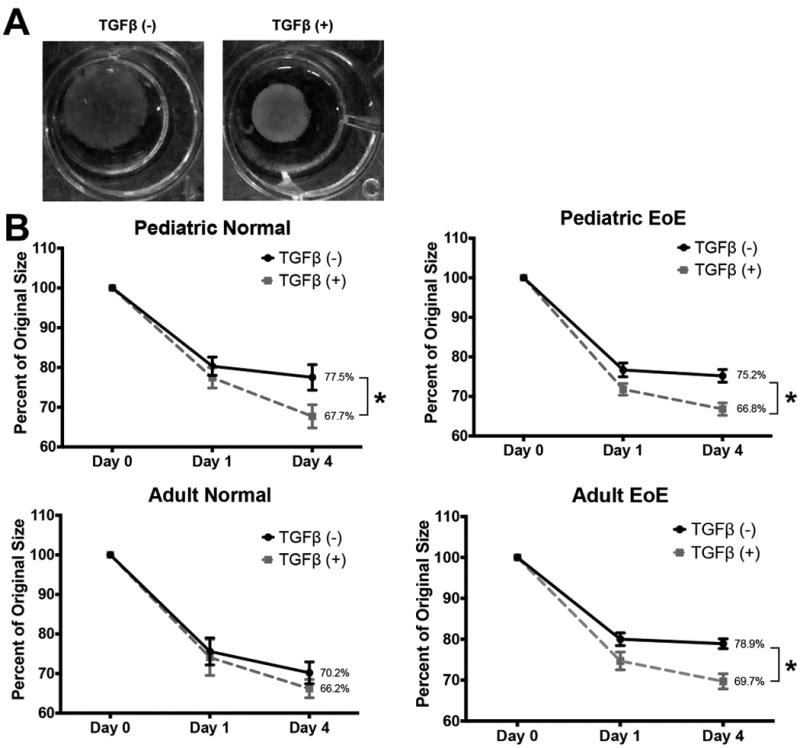
Fibroblasts were embedded into collagen gel matrices and allowed to contract for 4 days. (A) Images of representative gel matrices from Day 0 and Day 4 are shown in panel. (B) Average percent contraction of gels after 4 days of contraction with and without TGFβ in all four patient phenotypes showed significant increases in contraction with TGFβ stimulation of pediatric normal (p=0.01), pediatric EoE (p=0.0015), and adult EoE (p=0.0003) but not adult normal fibroblasts. n=5,7,11, and 4, respectively. *p<0.05 compared to TGFβ(-).
Figure 4
Figure 4. Fibroblasts respond to increasing matrix stiffness and TGFβ stimulation
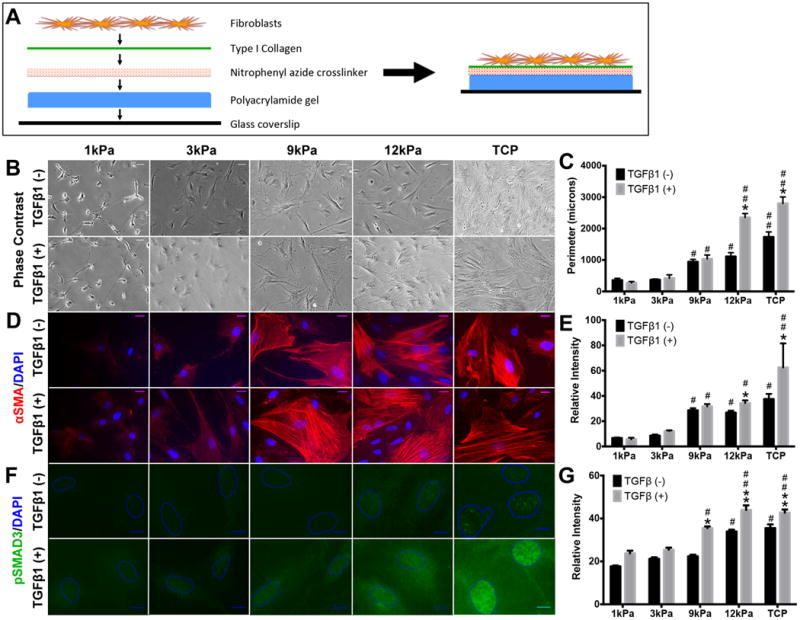
Schematic of experimental design: Fibroblasts were seeded on collagen-coated polyacrylamide gels of varying stiffness (A). Cell morphology differences were observed, with enhanced spindle morphology on stiff matrices (B). Perimeter measurements performed to account for filopodia and cell spreading (C) (significant trend for increasing perimeter from 1kPa to TCP adjusted for TFGβ exposure: p<0.001, with subanalyses demonstrating significant trends for both TGFβ(-) and TGFβ(+) conditions: p<0.001). Immunofluorescent localization (D) and quantification (E) of αSMA (significant trend for increasing relative intensity from 1kPa to TCP adjusted for TFGβ exposure: p<0.001, with subanalyses demonstrating significant trends for both TGFβ(-) and TGFβ(+) conditions: p<0.001 and p=0.001, respectively). Effect of stiffness and TGFβ stimulation upon nuclear co-localization of pSMAD3 (F,G)(significant trend for increasing relative intensity from 1kPa to TCP adjusted for TFGβ exposure: p<0.001, with subanalyses demonstrating significant trends for both TGFβ(-) and TGFβ(+) conditions: p<0.001). * p<0.05 compared to TGFβ(-). # p<0.05 compared to low stiffness (1 and 3kPa(C,E) or 1, 3, and 9kPa (G)). ## p<0.05 compared to 1, 3, and 9kPa (C,G) or 1, 3, 9, and 12kPa (E).
Figure 5
Figure 5. Fibroblast traction force increases with matrix stiffness
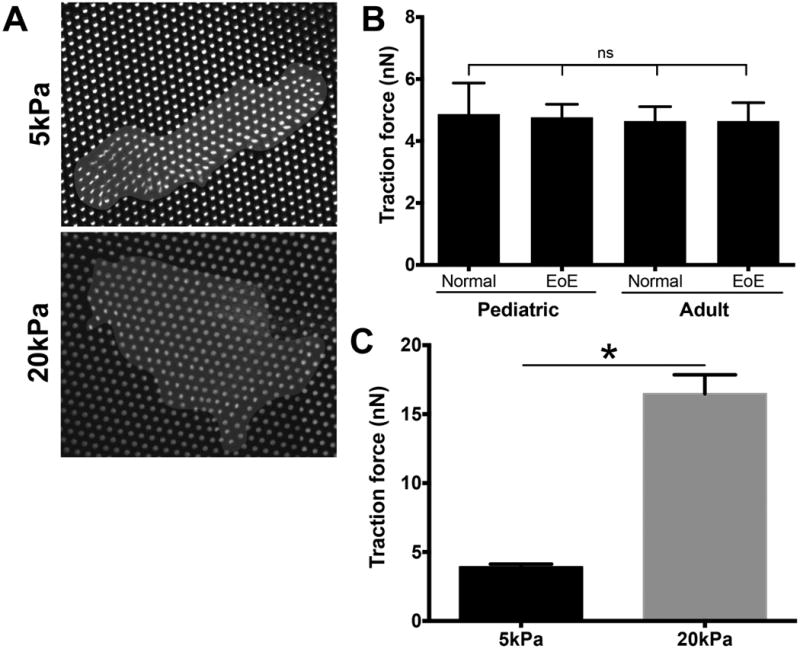
Fibroblasts were seeded on micropost arrays (post diameter = 1.83 μm) with varying post height, thereby varying the spring constant of the post and stiffness of the matrix. Representative images of fibroblasts seeded on 5kPa and 20kPa mPADs (A). Fibroblasts from all phenotypes exerted similar tensile force of engaged microposts of the same stiffness (NS) (B). Traction forces generated by fibroblasts on soft (5kPa) and stiff (20kPa) posts (C). * p<0.0001
Figure 6
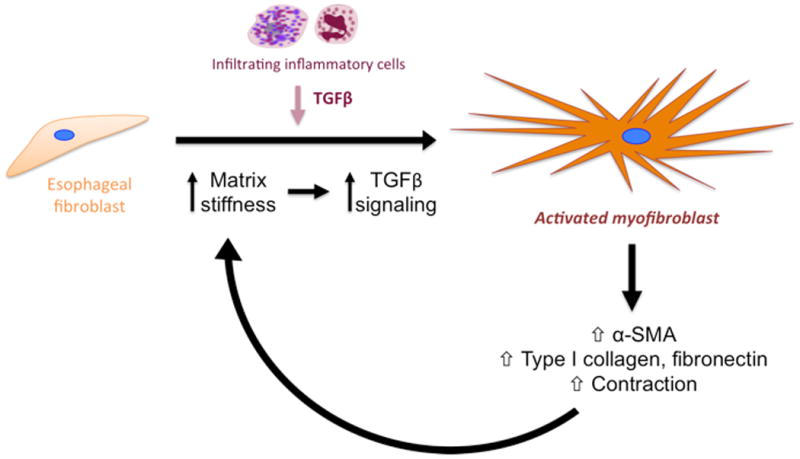
Figure 6. Proposed mechanism of fibroblast activation in EoE
Together, our model suggests that esophageal fibroblasts are stimulated by the EoE inflammatory milieu to produce extracellular matrix proteins and begin remodeling the ECM. This increases stiffness of the environment, leading to enhanced TGFβ signaling in fibroblasts. The increasing stiffness and cytokine response fully activates fibroblasts, which continue to produce α-SMA and extracellular matrix components, such as collagen and fibronectin, and contract their environment to further increase stiffness, giving rise to a positive feedback loop of fibroblast stimulation and activation.

Comment in

References

    1. Aceves SS, Chen D, Newbury RO, et al. Mast cells infiltrate the esophageal smooth muscle in patients with eosinophilic esophagitis, express TGF-β1, and increase esophageal smooth muscle contraction. J Allergy Clin Immunol. 2010;126:1198–204. e4. - PubMed
    1. Noti M, Wojno EDT, Kim BS, et al. Thymic stromal lymphopoietin–elicited basophil responses promote eosinophilic esophagitis. Nature Medicine. 2013;19:1005–1013. - PMC - PubMed
    1. Alain M, Schoepfer MD, Ekaterina Safroneeva P, Christian Bussmann MD, et al. Accepted Manuscript. YGAST. 2013:1–31.
    1. Falk GW. Clinical presentation of eosinophilic esophagitis in adults. Gastroenterol. Clin. North Am. 2014;43:231–242. - PubMed
    1. Rieder F, Nonevski I, Ma J, et al. T-Helper 2 Cytokines, Transforming Growth Factor β1, and Eosinophil Products Induce Fibrogenesis and Alter Muscle Motility in Patients With Eosinophilic Esophagitis. Gastroenterology. 2014 - PMC - PubMed

Publication types

MeSH terms