Review
. 2016 Jan 5:15:1.
doi: 10.1186/s12937-015-0115-z.

Benefits of antioxidant supplements for knee osteoarthritis: rationale and reality

Affiliations
Review

Benefits of antioxidant supplements for knee osteoarthritis: rationale and reality

Ashok Kumar Grover et al. Nutr J. .

Abstract

Arthritis causes disability due to pain and inflammation in joints. There are many forms of arthritis, one of which is osteoarthritis whose prevalence increases with age. It occurs in various joints including hip, knee and hand with knee osteoarthritis being more prevalent. There is no cure for it. The management strategies include exercise, glucosamine plus chondroitin sulfate and NSAIDs. In vitro and animal studies provide a rationale for the use of antioxidant supplements for its management. This review assesses the reality of the benefits of antioxidant supplements in the management of knee osteoarthritis. Several difficulties were encountered in examining this issue: poorly conducted studies, a lack of uniformity in disease definition and diagnosis, and muddling of conclusions from attempts to isolate the efficacious molecules. The antioxidant supplements with most evidence for benefit for pain relief and function in knee osteoarthritis were based on curcumin and avocado-soya bean unsaponifiables. Boswellia and some herbs used in Ayurvedic and Chinese medicine may also be useful. The benefits of cuisines with the appropriate antioxidants should be assessed because they may be more economical and easier to incorporate into the lifestyle.


Figures
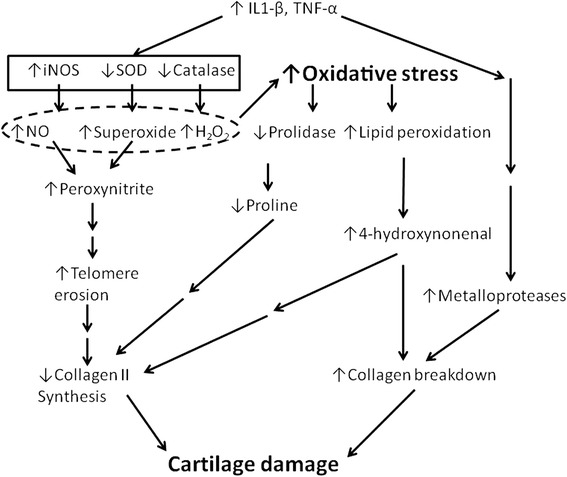
Fig. 1
Fig. 1
Role of oxidative stress in cartilage damage during OA. OA is hypothesised as a chronic inflammation disease that occurs with gradual changes in the immune system (see Pathophysiology of knee OA). IL-1β and TNF-α and other inflammatory factors increase in OA. This pathway leads to induction of NO synthase, production of larger amounts of NO and a deficiency in SOD and catalase (see Role of ROS in OA). The deficiency in SOD leads to higher levels of superoxide which combines with NO to produce peroxynitrite which can cause telomere erosion by targeting guanine repeats in their DNA telomeres. The net result is a decrease in the synthesis of collagen II. The decrease in catalase results in accumulation of peroxide to increase lipid peroxidation which produces 4-hydroxynonenal. The 4-hydroxynonenal increases factors which breakdown collagen II and also inhibits the expression of collagen II. The net result is the cartilage damage that occurs in OA. Note that the scheme shown here is only a summary

References

    1. Alexander CJ. Utilisation of joint movement range in arboreal primates compared with human subjects: an evolutionary frame for primary osteoarthritis. Ann Rheum Dis. 1994;53:720–725. doi: 10.1136/ard.53.11.720. - DOI - PMC - PubMed
    1. Wade GJ. Rethinking the model of osteoarthritis: a clinical viewpoint. J Am Osteopath Assoc. 2011;111:631–637. - PubMed
    1. Yuan XL, Meng HY, Wang YC, Peng J, Guo QY, Wang AY, et al. Bone-cartilage interface crosstalk in osteoarthritis: potential pathways and future therapeutic strategies. Osteoarthr Cartil. 2014;22:1077–1089. doi: 10.1016/j.joca.2014.05.023. - DOI - PubMed
    1. Ashford S, Williard J. Osteoarthritis: a review. Nurse Pract. 2014;39:1–8. doi: 10.1097/01.NPR.0000445886.71205.c4. - DOI - PubMed
    1. Wojdasiewicz P, Poniatowski LA, Szukiewicz D. The role of inflammatory and anti-inflammatory cytokines in the pathogenesis of osteoarthritis. Mediators Inflamm. 2014;2014:561459. doi: 10.1155/2014/561459. - DOI - PMC - PubMed

Publication types

MeSH terms

Substances
