. 2016 Jan 5:17:19.
doi: 10.1186/s12864-015-2347-x.

Genome sequencing and secondary metabolism of the postharvest pathogen Penicillium griseofulvum

Affiliations

Genome sequencing and secondary metabolism of the postharvest pathogen Penicillium griseofulvum

Houda Banani et al. BMC Genomics. .

Abstract

Background: Penicillium griseofulvum is associated in stored apples with blue mould, the most important postharvest disease of pome fruit. This pathogen can simultaneously produce both detrimental and beneficial secondary metabolites (SM). In order to gain insight into SM synthesis in P. griseofulvum in vitro and during disease development on apple, we sequenced the genome of P. griseofulvum strain PG3 and analysed important SM clusters.

Results: PG3 genome sequence (29.3 Mb) shows that P. griseofulvum branched off after the divergence of P. oxalicum but before the divergence of P. chrysogenum. Genome-wide analysis of P. griseofulvum revealed putative gene clusters for patulin, griseofulvin and roquefortine C biosynthesis. Furthermore, we quantified the SM production in vitro and on apples during the course of infection. The expression kinetics of key genes of SM produced in infected apple were examined. We found additional SM clusters, including those potentially responsible for the synthesis of penicillin, yanuthone D, cyclopiazonic acid and we predicted a cluster putatively responsible for the synthesis of chanoclavine I.

Conclusions: These findings provide relevant information to understand the molecular basis of SM biosynthesis in P. griseofulvum, to allow further research directed to the overexpression or blocking the synthesis of specific SM.


Figures
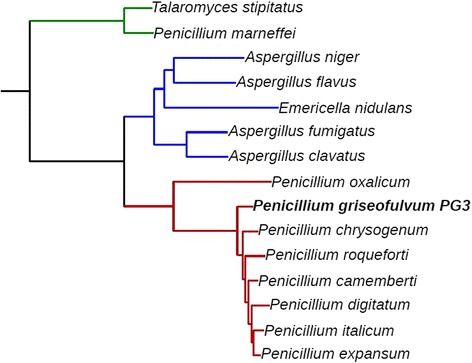
Fig. 1
Fig. 1
Maximum likelihood species tree of PG3 and the other fourteen studied species. The species tree is derived from gene concatenation of 2,134 single-copy genes present in the newly sequenced genome PG3, in the other sequenced Penicillium genomes (P. chrysogenum, P. oxalicum, P. roqueforti, P. camemberti, P. expansum, P. digitatum and P. italicum), and in members of the Aspergillus and Talaromyces clades
Fig. 2
Fig. 2
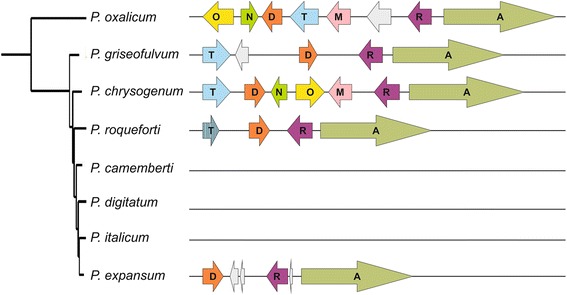
Comparison of patulin gene cluster in PG3 and in phylogenetically close patulin producing species. The species used for comparison are P. expansum and A. clavatus which have a complete patulin gene cluster [19, 20, 22, 23]. Each gene is indicated by an arrow and named according to its position in the original cluster described in A. clavatus [22]
Fig. 3
Fig. 3
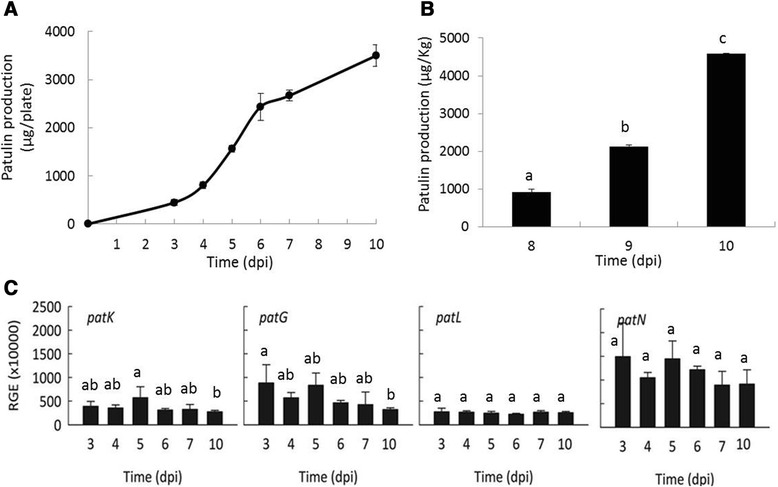
Patulin production and relative expression of key patulin genes in P. griseofulvum PG3. a Patulin production in vitro. b Patulin production in apple. c. Relative gene expression (RGE) of patK, patG, patL and patN in PG3. The gene expression is relative to the geometric mean of the four P. griseofulvum reference genes: the ribosomal 28S RNA, the 37S ribosomal protein (PGRI_092740), the beta-tubulin (PGRI_052690) and the histone H3 (PGRI_044770). Spore suspensions of strains were inoculated on the centre of 55 mm PDA plates and incubated at 24 °C in the dark for up to 10 days post inoculation (dpi). Error bars indicate standard deviations of three biological replicates. Different letters above the columns indicate a significant difference determined by Tukey's Multiple Comparison Test (p < 0.05)
Fig. 4
Fig. 4
Comparison of the roquefortine C cluster genes in PG3 and in other Penicillium species. The species in which the roquefortine C cluster has been described are P. chrysogenum and P. roqueforti [–29]. Each gene is named according to its position in the original cluster described in P. chrysogenum [27, 28]. Additional genes within the cluster are marked with a grey arrow, and stripped arrow represents a pseudogene
Fig. 5
Fig. 5
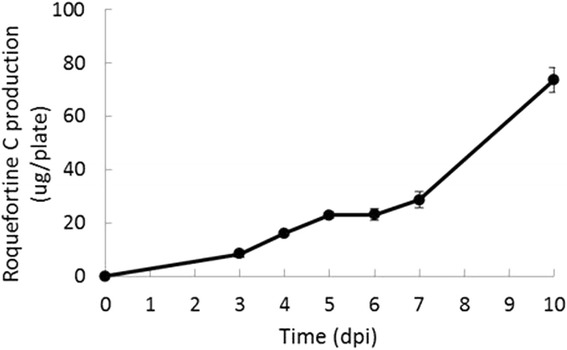
Roquefortine C production by P. griseofulvum PG3 in vitro
Fig. 6
Fig. 6
Schematic representation of the griseofulvin gene cluster in P. aethiopicum and PG3. Each gene is named according to its position in the original cluster described in P. aethiopicum [–42]
Fig. 7
Fig. 7
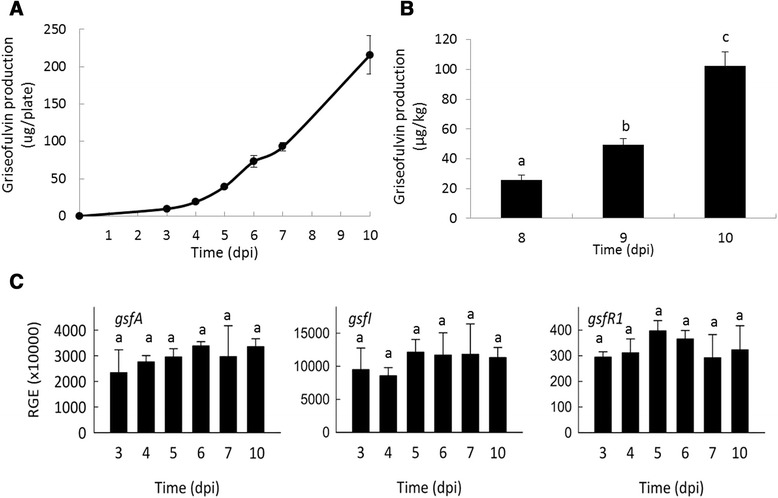
Griseofulvin production and relative expression of key griseofulvin genes in P. griseofulvum PG3. a Griseofulvin production in vitro. b Griseofulvin production in apple. c Relative gene expression of gsfA, gsfI and gsfR1 in P. griseofulvum PG3. The gene expression is relative to the geometric mean of the three P. griseofulvum reference genes: the ribosomal 28S RNA, the 37S ribosomal protein (PGRI_092740), the tubulin (PGRI_052690) and the histone H3 (PGRI_044770). Error bars indicate standard deviations of three biological replicates. Different letters above the columns indicate a significant difference determined by Tukey's Multiple Comparison Test (p < 0.05)
Fig. 8
Fig. 8
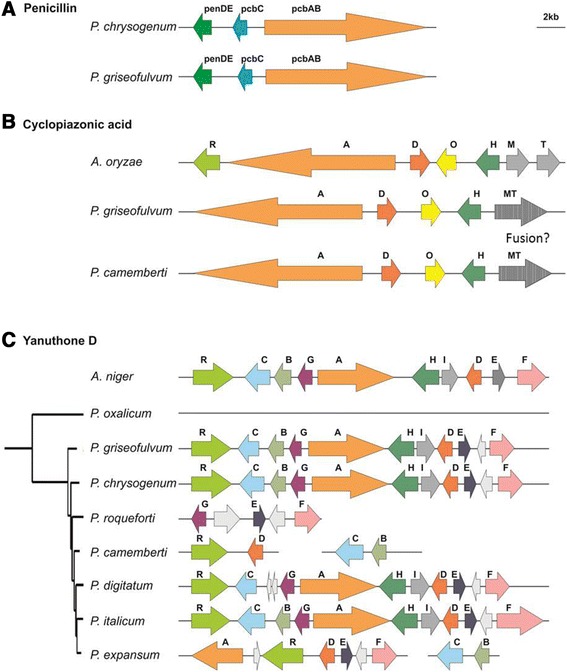
Schematic representation of additional gene clusters in P. griseofulvum PG3. (A): penicillin, (B): cyclopiazonic acid, (C): yanuthone D. Each gene is named according to its position in the original cluster described in literature.

References

    1. Spadaro D, Ciavorella A, Dianpeng Z, Garibaldi A, Gullino ML. Effect of culture media and pH on the biomass production and biocontrol efficacy of a Metschnikowia pulcherrima strain to be used as a biofungicide for postharvest disease control. Can J Microbiol. 2010;56:128–137. doi: 10.1139/W09-117. - DOI - PubMed
    1. Pitt JI, Spotts RA, Holmes RJ, Cruickshank RH. Penicillium solitum revived, and its role as a pathogen of pomaceous fruit. Phytopathology. 1991;81:1108–1112. doi: 10.1094/Phyto-81-1108. - DOI
    1. Sanderson PG, Spotts RA. Postharvest decay of winter pear and apple fruit caused by species of Penicillium. Phytopathology. 1995;1995:103–110. doi: 10.1094/Phyto-85-103. - DOI
    1. Sanzani SM, Montemurro C, Di Rienzo V, Solfrizzo M, Ippolito A. Genetic structure and natural variation associated with host of origin in Penicillium expansum strains causing blue mould. Int J Food Microbiol. 2013;165:111–120. doi: 10.1016/j.ijfoodmicro.2013.04.024. - DOI - PubMed
    1. Welke JE, Hoeltz M, Dottori HA, Noll IB. Patulin accumulation in apples during storage by Penicillium expansum and Penicillium griseofulvum strains. Brazilian J Microbiol. 2011;42:172–180. doi: 10.1590/S1517-83822010005000006. - DOI - PMC - PubMed

Publication types