


A G-protein Subunit-α11 Loss-of-Function Mutation, Thr54Met, Causes Familial Hypocalciuric Hypercalcemia Type 2 (FHH2)
- PMID: 26729423
- PMCID: PMC4949650
- DOI: 10.1002/jbmr.2778
A G-protein Subunit-α11 Loss-of-Function Mutation, Thr54Met, Causes Familial Hypocalciuric Hypercalcemia Type 2 (FHH2)
Abstract
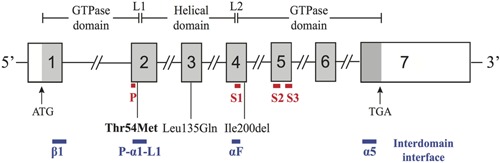
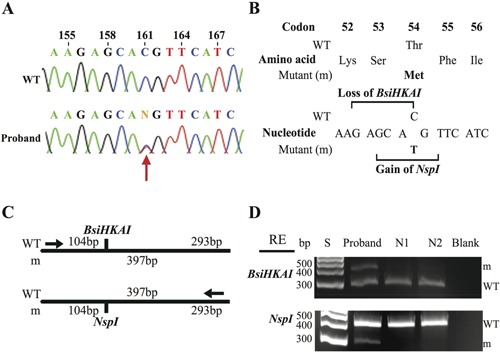
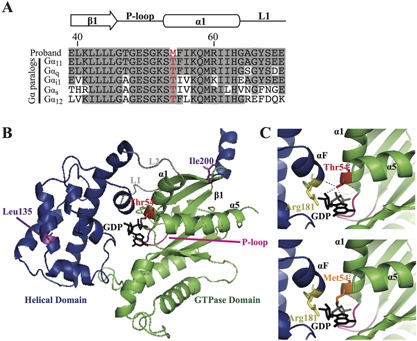
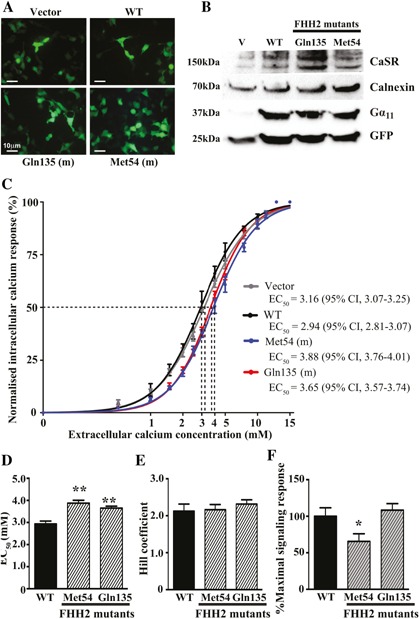
Familial hypocalciuric hypercalcemia (FHH) is a genetically heterogeneous disorder with three variants, FHH1 to FHH3. FHH1 is caused by loss-of-function mutations of the calcium-sensing receptor (CaSR), a G-protein coupled receptor that predominantly signals via G-protein subunit alpha-11 (Gα11 ) to regulate calcium homeostasis. FHH2 is the result of loss-of-function mutations in Gα11 , encoded by GNA11, and to date only two FHH2-associated Gα11 missense mutations (Leu135Gln and Ile200del) have been reported. FHH3 is the result of loss-of-function mutations of the adaptor protein-2 σ-subunit (AP2σ), which plays a pivotal role in clathrin-mediated endocytosis. We describe a 65-year-old woman who had hypercalcemia with normal circulating parathyroid hormone concentrations and hypocalciuria, features consistent with FHH, but she did not have CaSR and AP2σ mutations. Mutational analysis of the GNA11 gene was therefore undertaken, using leucocyte DNA, and this identified a novel heterozygous GNA11 mutation (c.161C>T; p.Thr54Met). The effect of the Gα11 variant was assessed by homology modeling of the related Gαq protein and by measuring the CaSR-mediated intracellular calcium (Ca(2+) i ) responses of HEK293 cells, stably expressing CaSR, to alterations in extracellular calcium (Ca(2+) o ) using flow cytometry. Three-dimensional modeling revealed the Thr54Met mutation to be located at the interface between the Gα11 helical and GTPase domains, and to likely impair GDP binding and interdomain interactions. Expression of wild-type and the mutant Gα11 in HEK293 cells stably expressing CaSR demonstrate that the Ca(2+) i responses after stimulation with Ca(2+) o of the mutant Met54 Gα11 led to a rightward shift of the concentration-response curve with a significantly (p < 0.01) increased mean half-maximal concentration (EC50 ) value of 3.88 mM (95% confidence interval [CI] 3.76-4.01 mM), when compared with the wild-type EC50 of 2.94 mM (95% CI 2.81-3.07 mM) consistent with a loss-of-function. Thus, our studies have identified a third Gα11 mutation (Thr54Met) causing FHH2 and reveal a critical role for the Gα11 interdomain interface in CaSR signaling and Ca(2+) o homeostasis. © 2016 American Society for Bone and Mineral Research.
Keywords: CELL/TISSUE SIGNALING - ENDOCRINE PATHWAYS; DISORDERS OF CALCIUM/PHOSPHATE METABOLISM; PARATHYROID-RELATED DISORDERS; PTH/VIT D/FGF23.
© 2016 American Society for Bone and Mineral Research.
Figures
References
-
- Hannan FM, Thakker RV. Calcium‐sensing receptor (CaSR) mutations and disorders of calcium, electrolyte and water metabolism. Best Pract Res Clin Endocrinol Metab. 2013; 27(3):359–71. - PubMed
-
- Eastell R, Brandi ML, Costa AG, D'Amour P, Shoback DM, Thakker RV. Diagnosis of asymptomatic primary hyperparathyroidism: proceedings of the Fourth International Workshop. J Clin Endocrinol Metab. 2014; 99(10):3570–9. - PubMed
-
- Hannan FM, Nesbit MA, Zhang C, et al. Identification of 70 calcium‐sensing receptor mutations in hyper‐ and hypo‐calcaemic patients: evidence for clustering of extracellular domain mutations at calcium‐binding sites. Hum Mol Genet. 2012; 21(12):2768–78. - PubMed
-
- Wu DQ, Lee CH, Rhee SG, Simon MI. Activation of phospholipase C by the alpha subunits of the Gq and G11 proteins in transfected Cos‐7 cells. J Biol Chem. 1992; 267(3):1811–7. - PubMed
-
- Hofer AM, Brown EM. Extracellular calcium sensing and signalling. Nat Rev Mol Cell Biol. 2003; 4(7):530–8. - PubMed
Publication types
MeSH terms
Substances
Supplementary concepts
Grants and funding
LinkOut - more resources
Full Text Sources
Other Literature Sources
Molecular Biology Databases
Miscellaneous
