


Chromosomally and Extrachromosomally Mediated High-Level Gentamicin Resistance in Streptococcus agalactiae
- PMID: 26729498
- PMCID: PMC4775929
- DOI: 10.1128/AAC.01933-15
Chromosomally and Extrachromosomally Mediated High-Level Gentamicin Resistance in Streptococcus agalactiae
Abstract
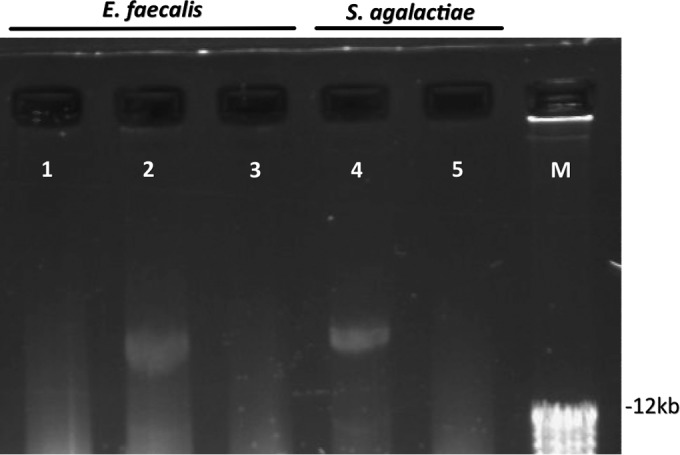
Streptococcus agalactiae (group B Streptococcus [GBS]) is a leading cause of sepsis in neonates. The rate of invasive GBS disease in nonpregnant adults also continues to climb. Aminoglycosides alone have little or no effect on GBS, but synergistic killing with penicillin has been shown in vitro. High-level gentamicin resistance (HLGR) in GBS isolates, however, leads to the loss of a synergistic effect. We therefore performed a multicenter study to determine the frequency of HLGR GBS isolates and to elucidate the molecular mechanisms leading to gentamicin resistance. From eight centers in four countries, 1,128 invasive and colonizing GBS isolates were pooled and investigated for the presence of HLGR. We identified two strains that displayed HLGR (BSU1203 and BSU452), both of which carried the aacA-aphD gene, typically conferring HLGR. However, only one strain (BSU1203) also carried the previously described chromosomal gentamicin resistance transposon designated Tn3706. For the other strain (BSU452), plasmid purification and subsequent DNA sequencing resulted in the detection of plasmid pIP501 carrying a remnant of a Tn3 family transposon. Its ability to confer HLGR was proven by transfer into an Enterococcus faecalis isolate. Conversely, loss of HLGR was documented after curing both GBS BSU452 and the transformed E. faecalis strain from the plasmid. This is the first report showing plasmid-mediated HLGR in GBS. Thus, in our clinical GBS isolates, HLGR is mediated both chromosomally and extrachromosomally.
Copyright © 2016, American Society for Microbiology. All Rights Reserved.
Figures
References
-
- Schrag SJ, Zell ER, Lynfield R, Roome A, Arnold KE, Craig AS, Harrison LH, Reingold A, Stefonek K, Smith G, Gamble M, Schuchat A. 2002. A population-based comparison of strategies to prevent early-onset group B streptococcal disease in neonates. N Engl J Med 347:233–239. doi: 10.1056/NEJMoa020205. - DOI - PubMed
-
- Phares CR, Lynfield R, Farley MM, Mohle-Boetani J, Harrison LH, Petit S, Craig AS, Schaffner W, Zansky SM, Gershman K, Stefonek KR, Albanese BA, Zell ER, Schuchat A, Schrag SJ. 2008. Epidemiology of invasive group B streptococcal disease in the United States, 1999–2005. JAMA 299:2056–2065. doi: 10.1001/jama.299.17.2056. - DOI - PubMed
-
- Skoff TH, Farley MM, Petit S, Craig AS, Schaffner W, Gershman K, Harrison LH, Lynfield R, Mohle-Boetani J, Zansky S, Albanese BA, Stefonek K, Zell ER, Jackson D, Thompson T, Schrag SJ. 2009. Increasing burden of invasive group B streptococcal disease in nonpregnant adults, 1990–2007. Clin Infect Dis 49:85–92. doi: 10.1086/599369. - DOI - PubMed
-
- Westling K, Aufwerber E, Ekdahl C, Friman G, Gardlund B, Julander I, Olaison L, Olesund C, Rundstrom H, Snygg-Martin U, Thalme A, Werner M, Hogevik H. 2007. Swedish guidelines for diagnosis and treatment of infective endocarditis. Scand J Infect Dis 39:929–946. doi: 10.1080/00365540701534517. - DOI - PubMed
Publication types
MeSH terms
Substances
LinkOut - more resources
Full Text Sources
Other Literature Sources
Medical
