Randomized Controlled Trial
. 2016 Jan 5:6:18763.
doi: 10.1038/srep18763.

Evaluation of Post Cessation Weight Gain in a 1-Year Randomized Smoking Cessation Trial of Electronic Cigarettes

Affiliations
Randomized Controlled Trial

Evaluation of Post Cessation Weight Gain in a 1-Year Randomized Smoking Cessation Trial of Electronic Cigarettes

Cristina Russo et al. Sci Rep. .

Abstract

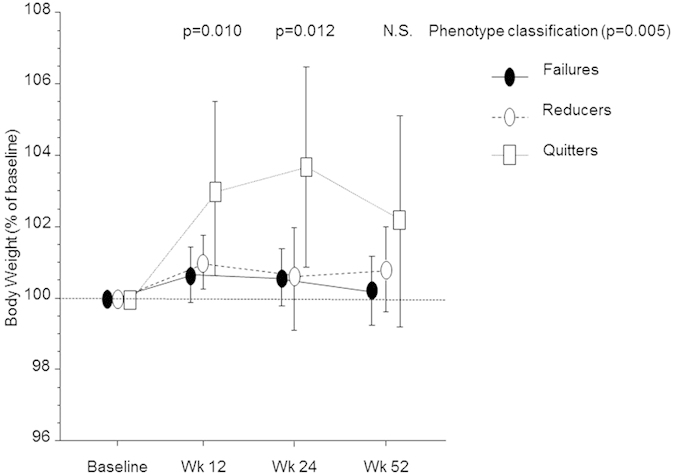
Stop smoking it is often associated to weight gain that is one of the most important causes for relapse. This is the first study to describe long-term changes in body weight in smokers invited to quit or reduce smoking by switching to ECs. Conventional cigarettes consumption and body weight were measured prospectively in a randomized controlled trial of smokers invited to switch to ECs. Post cessation weight changes from baseline at week-12, -24 and -52 were compared among 1) high, medium and zero nicotine strength products and 2) pooled continuous smoking failure, smoking reduction and abstinence phenotypes. Saliva cotinine levels and appetite levels were also measured. No significant changes in body weight were observed among high, medium and zero nicotine strength products. Differences among continuous smoking phenotypes were significant only at week-12 (p = 0.010) and week-24 (p = 0.012) with quitters gaining 2.4{plus minus}4.3 Kg and 2.9{plus minus}4.4 Kg respectively. However, weight gain at week-52 (1.5{plus minus}5.0 Kg) was no longer significant compared to Failures and Reducers. No confounding factors could explain the significant changes in body weight. Smokers who quit smoking by switching to ECs may limit their post-cessation weight gain, with substantial reversal in weight gain being manifest at late time points.


Conflict of interest statement

None of the authors have any competing financial interests to declare, with the exception of RP. RP has received lecture fees and research funding from Pfizer and GlaxoSmithKline, manufacturers of stop smoking medications. He has also served as a consultant for Pfizer, Global Health Alliance for treatment of tobacco dependence, Arbi Group Srl (the Italian distributor for Categoria electronic cigarettes), and ECITA (Electronic Cigarette Industry Trade Association, in the UK). Lectures fees from a number of European electronic cigarette industry and trade associations (including FIVAPE in France and FIESEL in Italy) were directly donated to vaper advocacy organizations. He is currently scientific advisor for LIAF, Lega Italiana Anti Fumo (Italian acronym for Italian Anti Smoking League).

Figures
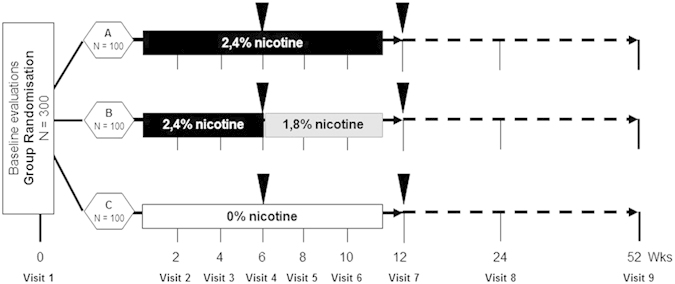
Figure 1
Figure 1. Schematic diagram of the ECLAT study design.
Smokers not currently attempting to quit smoking or wishing to do so in the next 30 days were randomized in three study groups: group A (receiving 12 weeks of “Original” 2.4% nicotine cartridges), group B (receiving 6-weeks of “Original” 2.4% nicotine cartridges and a further 6 weeks with “Categoria” 1.8% nicotine cartridges), and group C (receiving 12 weeks of “Original” 0% nicotine cartridges). Participants in each group were prospectively reviewed for up to 52-weeks during which smoking habits, eCO levels, and MNWS were assessed at each study visits. Body weight was measured at baseline, and at week-12, week-24 and week-52. Saliva samples were collected at week-6 and at week-12 (closed triangles) for cotinine measurement in those who stated they had not smoked and with an eCO ≤7 ppm.
Figure 2
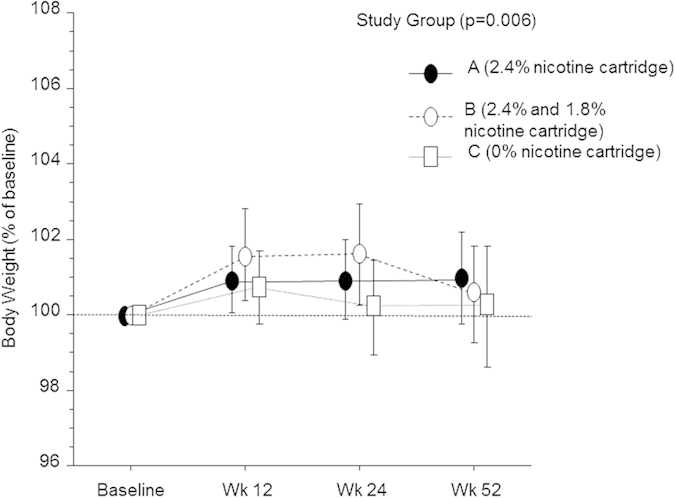
Figure 2. Time-course in body weight changes (expressed as percent of baseline ± 95% confidence intervals) at week-12, -24, and -52 in subjects with continuous smoking phenotype classification, separately for each study group (A–C).
Repeated measures ANOVA demonstrated a significant within factor (body weight) difference (p = 0.006), but no significant effect among study groups for body weight.
Figure 3
Figure 3. Time-course in body weight changes (expressed as percent of baseline ± 95% confidence intervals) at week-12, -24, and -52, separately for each continuous smoking phenotype classification (quitters, reducers, failures).
Repeated measures ANOVA showed that within factor (body weight) differences were significant (p = 0.005); the effect of between phenotype classification showed a significant effect at week-12 (p = 0.010) and week-24 (p = 0.012), but not at week-52.
Figure 4
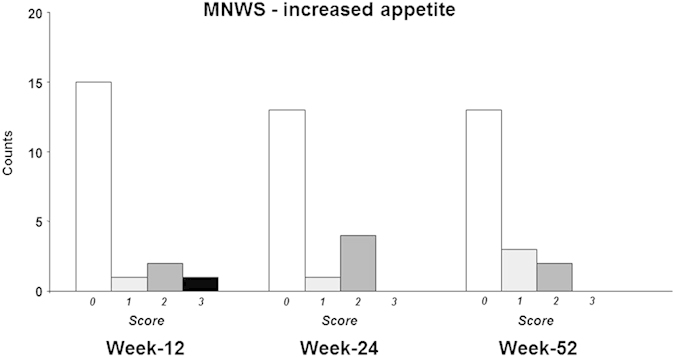
Figure 4. Frequency distribution of incremental MNWS-increased appetite scores for quitters at week-12, -24, and -52; score 0 = “not at all present” (white bars); score 1 = “slight” (light grey bars); score 2 = “moderate” (dark grey bars); score 3 = “quite a bit” (black bars).
Please note that “extreme” increased appetite (i.e. score 4) was never reported.
Figure 5
Figure 5
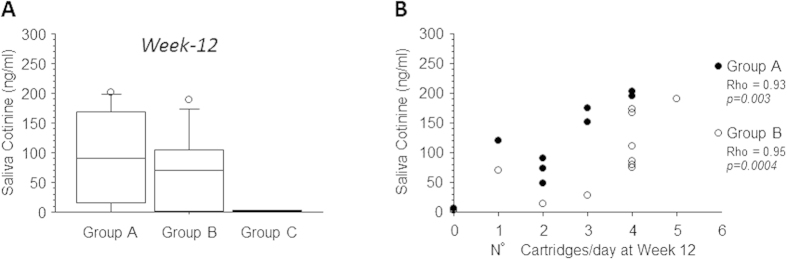
(A)-Box plots representation of saliva cotinine levels in those who stated they did not smoke and with an eCO ≤7 ppm at week-12, separately for each study group (A–C). The difference between groups A and B was assessed by Mann-Whitney U test and found not to be significant. Bars indicate (from the bottom to the top) 10 th, 25 th, 50 th (median), 75 th, and 90 th percentiles. Values below 10 th and above 90 th percentiles (outliers) are shown as circles. (B)-Relationships between saliva cotinine levels and number of e-cigarettes cartridges/day at week-12, separately for study groups A and B. The strength of the association was assessed using Spearman Rank Correlation test and found to be highly significant in both study groups.

References

    1. U.S. Department of Health and Human Services. Tobacco-Related Mortality. http://www.cdc.gov/tobacco/data_statistics/fact_sheets/health_effects/to... (Data of access 28/02/2015).
    1. World Health Organization, WHO Framework Convention on Tobacco Control. ISBN: 9241591013 (2003).
    1. Polosa R & Benowitz N. L. Treatment of nicotine addiction: present therapeutic options and pipeline developments. Trends Pharmacol Sci. 32, 281–9 10.1016/j.tips.2010.12.008 (2011). - DOI - PMC - PubMed
    1. Caponnetto P., Russo C. & Polosa R. Smoking cessation: present status and future perspectives. Curr Opin Pharmacol. 12, 229–37 10.1016/j.coph.2012.02.005 (2012). - DOI - PubMed
    1. Klesges R. C., Meyers A. W., Klesges L. M. & La Vasque M. E. Smoking, body weight, and theireffects on smoking behavior: a comprehensive review of the literature. Psychol Bull. Sep 106, 204–30 (1989). - PubMed

Publication types