Observational Study
. 2016 Jun;144(8):1622-33.
doi: 10.1017/S0950268815003143. Epub 2016 Jan 6.

Prospective clinical and serological follow-up in early childhood reveals a high rate of subclinical RSV infection and a relatively high reinfection rate within the first 3 years of life

Affiliations
Observational Study

Prospective clinical and serological follow-up in early childhood reveals a high rate of subclinical RSV infection and a relatively high reinfection rate within the first 3 years of life

A Kutsaya et al. Epidemiol Infect. 2016 Jun.

Abstract

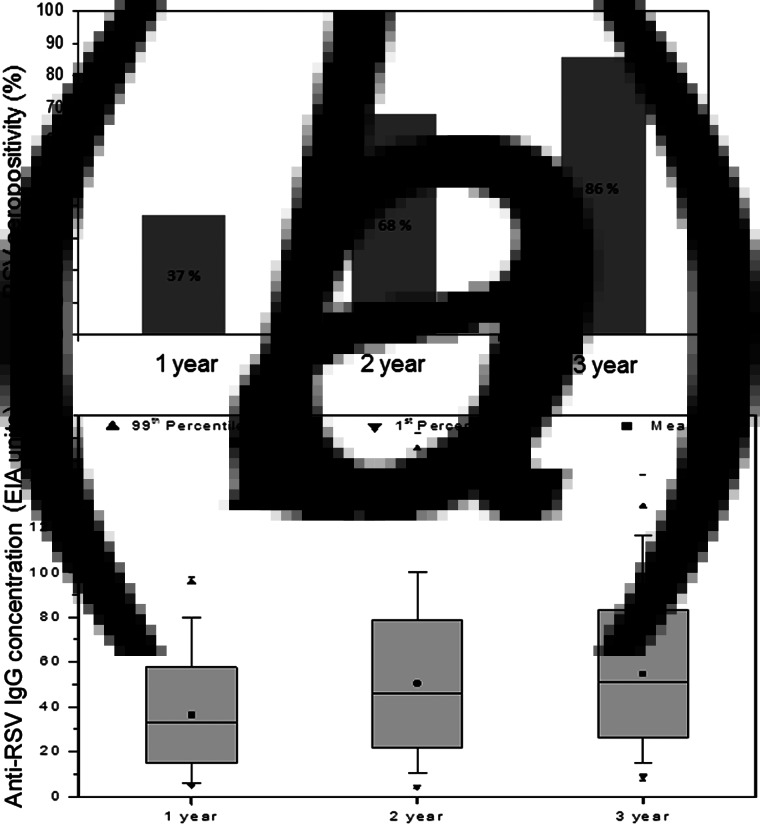
Children encounter repeated respiratory tract infections during their early life. We conducted a prospective clinical and serological follow-up study to estimate the respiratory syncytial virus (RSV) primary infection and reinfection rates in early childhood. Sera were collected from 291 healthy children at the ages of 13, 24 and 36 months and antibody levels against RSV antigens were determined by enzyme immunoassay. The RT-PCR method was also used for identifying the possible presence of RSV in symptomatic patients. At ages 1, 2 and 3 years, 37%, 68% and 86%, respectively, of studied children were seropositive for RSV. In children seropositive at age 1 year, RSV reinfection rate was at least 37%. Only one of reinfected children showed evidence for a third reinfection by age 3 years. Of children who turned RSV seropositive between ages 1 and 2 years, the reinfection rate was 32% during the third year of life. The mean antibody levels at primary infection were very similar in all age groups. The average decrease of antibody levels was 25-30% within a year. In 66 cases RSV infection was identified by RT-PCR. RSV infection rate in early childhood is 86% and reinfection rate is around 35%. This prospective serological follow-up study also provided evidence for the presence of RSV infections in children that did not show clinical signs warranting RSV RNA detection.

Keywords: Antibodies; RSV; infants; reinfection; seroprevalence.


Figures
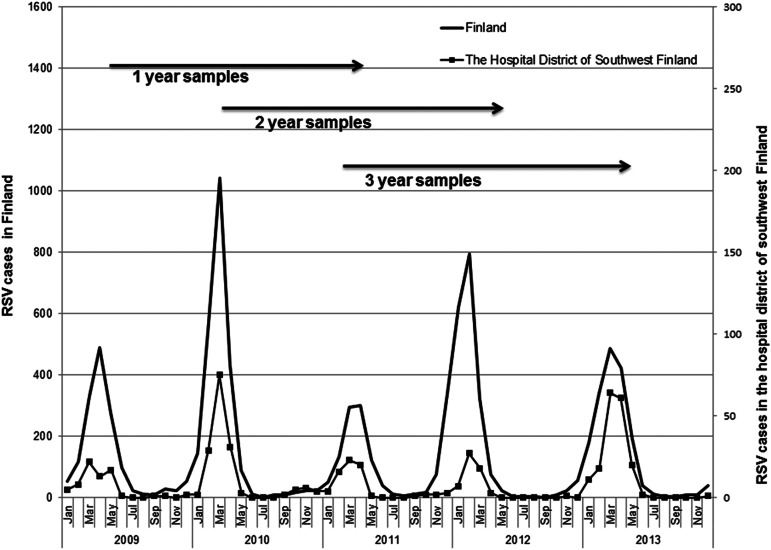
Fig. 1.
Fig. 1.
Epidemiology of respiratory syncytial virus (RSV) infections during the study period. Diagnosed cases of RSV infections (number of cases per month) in children aged 0–4 years in Finland (–––), and in the Hospital District of Southwest Finland (■–■) in 2009–2013. Arrows indicate the time line when the serum samples used in this study were collected. The data are based on National Infections Disease Registry, National Institute for Health and Welfare, Finland.
Fig. 2.
Fig. 2.
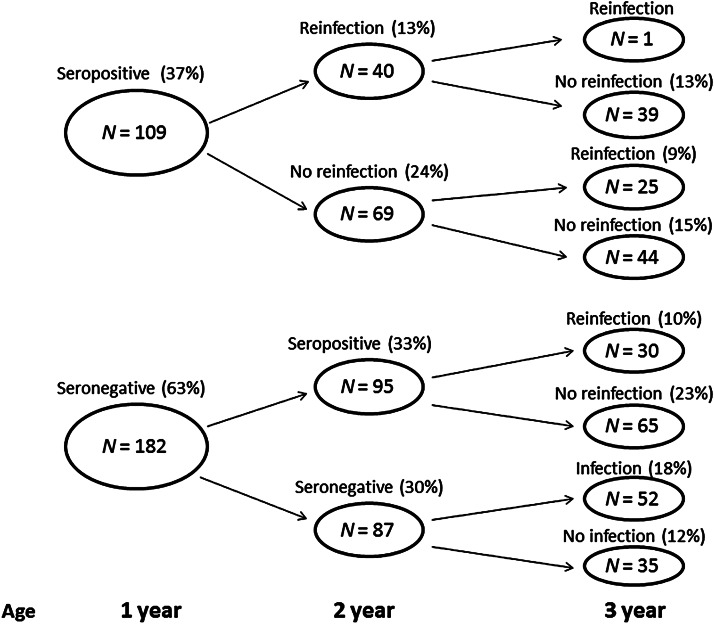
General description of respiratory syncytial virus (RSV) infections in the child cohort during the follow-up. The study included 291 children from whom serum specimens were collected at aged 1, 2 and 3 years. Seropositivity is based on positive anti-RSV IgG antibody test results in whole RSV antigen enzyme immunoassay (EIA). Reinfection is determined as a significant (>25 EIA units) rise in serum anti-RSV IgG antibody levels between the yearly drawn serum specimens. The numbers in circles indicate the number of children and the percentages in parentheses indicate the percentage of children from the whole cohort (n = 291).
Fig. 3.
Fig. 3.
Respiratory syncytial virus (RSV) IgG seroprevalence in relation to the children's age. (a) RSV IgG seropositivity rate in different age groups. (b) The mean RSV IgG antibody levels in different age groups. The boxes represent the interquartile range (25–75%); the whiskers denote 5th and 95th percentiles; the horizontal lines inside boxes show a median; the dashes show minimum and maximum antibody levels. The values are shown as EIA units that have been calculated in relation to the values for negative control specimens (EIA unit value 0) and highly positive serum specimen (EIA unit value 100).
Fig. 4.
Fig. 4.
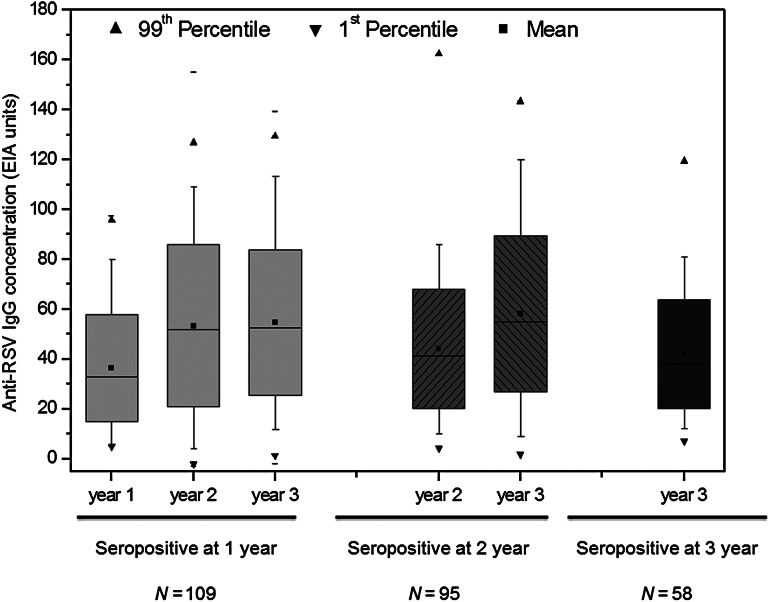
Follow-up of mean respiratory syncytial virus (RSV) IgG levels post-infection and in subsequent years in different age groups. The boxes represent the interquartile range (25–75%); the whiskers denote 5th and 95th percentiles; the horizontal lines inside boxes show a median; the dashes show minimum and maximum. Child serum specimens were separated into three different groups based on their seropositivity at a given time point. The mean RSV IgG antibody levels are shown for the samples of the same children in each part of the figure as indicated.
Fig. 5.
Fig. 5.
Respiratory syncytial virus (RSV) IgG levels in children who were RSV IgG seropositive at 1 year (n = 109). Children were separated into three groups based on their likely RSV reinfection. (a) Mean RSV IgG levels in children showing significantly increased IgG levels at age 2 years compared to the 1-year sample (likely reinfection between 1 and 2 years, P < 0·001). (b) Mean RSV IgG levels in children showing no increase in IgG levels during follow-up (no evidence for reinfection, P = 0·878 and P = 0·230). (c) Mean RSV IgG levels in children showing increased IgG levels at 3 years compared to 2-year samples (likely reinfection between ages 2 and 3 years, P < 0·001). The boxes represent the interquartile range (25–75%); the whiskers denote 5th and 95th percentiles; the horizontal lines inside boxes show a median; the dashes show minimum and maximum; N is the number of children in different subgroups.
Fig. 6.
Fig. 6.
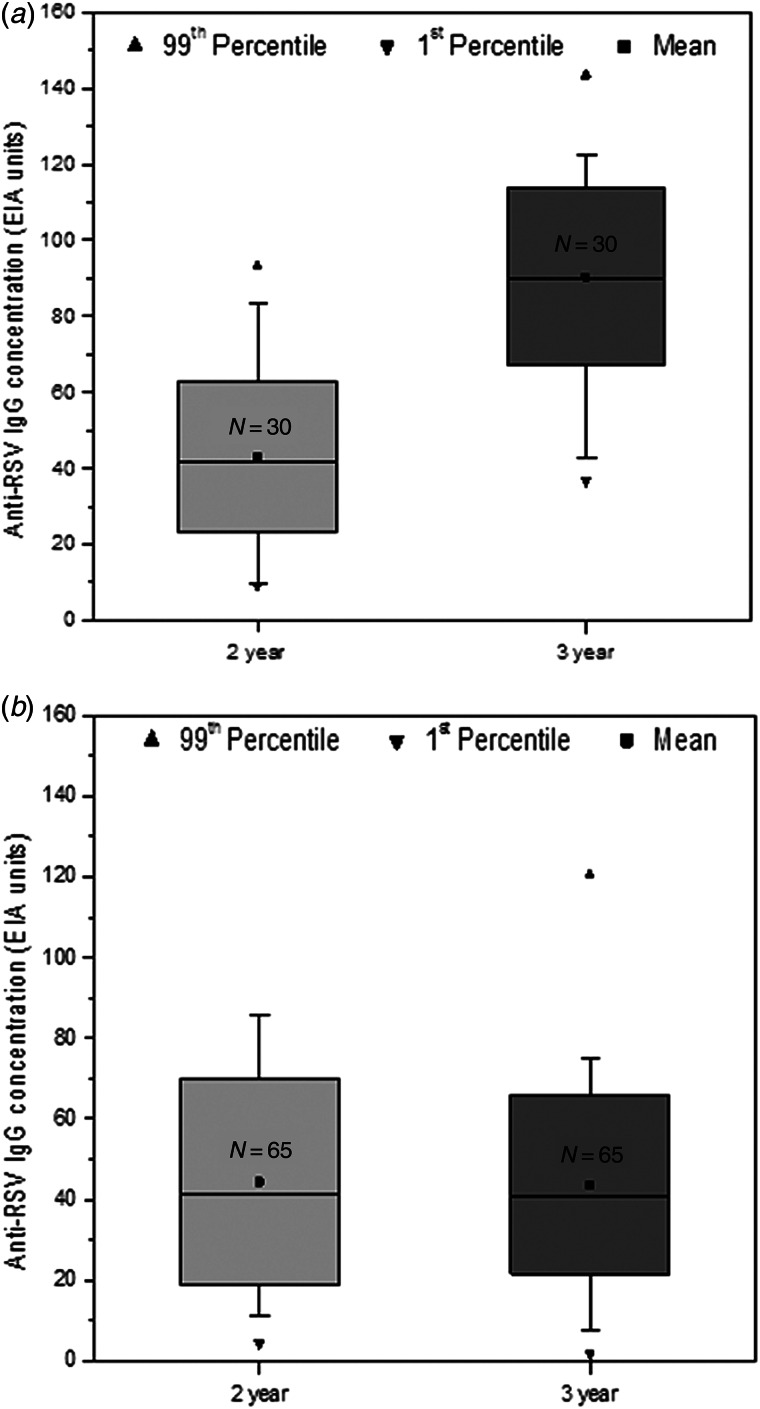
Respiratory syncytial virus (RSV) IgG levels in children (n = 95) who acquired initial infection between ages 1 and 2 years. Children were separated in two groups based on their likely RSV reinfection between the second and third year of follow-up. (a) Mean RSV IgG levels in children (n = 30) showing significantly increased IgG levels (P < 0·001) between ages 2 and 3 years (likely reinfection between 2 and 3 years). (b) Mean RSV IgG levels in children (n = 65) showing no increase in IgG levels (P = 0·863) during the follow-up (no evidence for reinfection). The boxes represent the interquartile range (25–75%); the whiskers denote 5th and 95th percentiles; the horizontal lines inside boxes show a median; the dashes show minimum and maximum; N is the number of children.
Fig. 7.
Fig. 7.
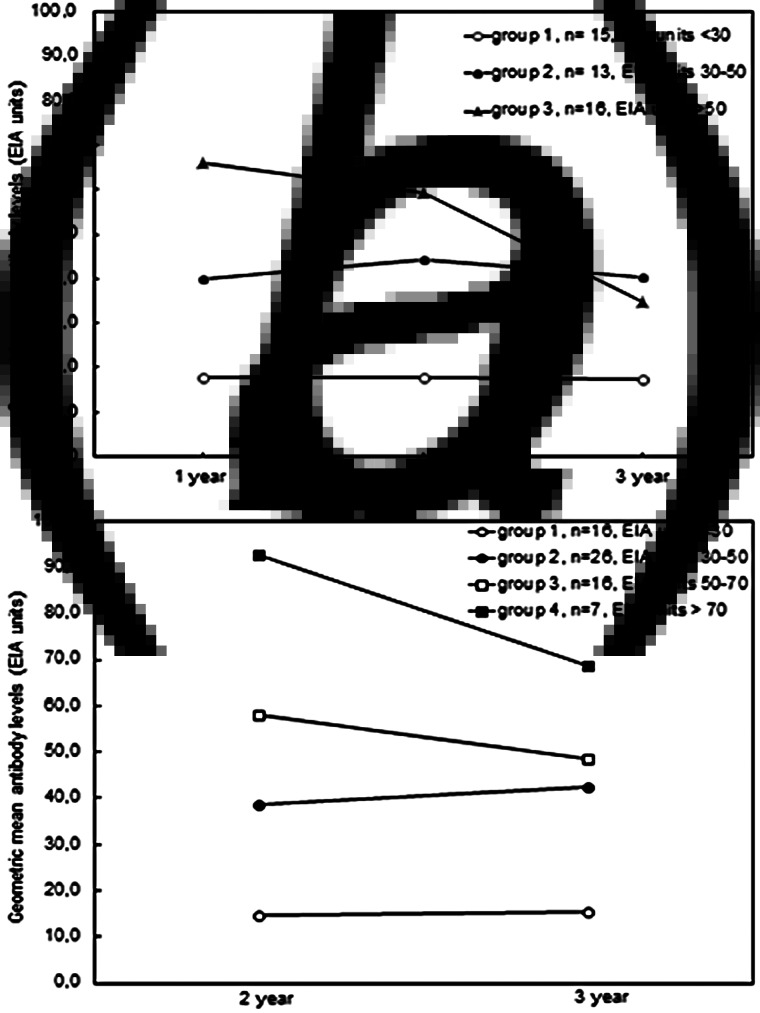
Kinetics of anti-respiratory syncytial virus (RSV) IgG antibody decay after the primary infection. (a) Mean RSV IgG antibody decline in children who acquired the infection by age 1 year (seropositive at 1 year) and who failed to show evidence for reinfection. Seropositive children (n = 44) were separated into three groups based on their RSV IgG antibody level at age 1 year and their mean antibody levels were followed up at ages 2 and 3 years. The children were grouped as high [>50 enzyme immunoassay (EIA) units], moderate (30–50 units) and low (positive to <30 units) responders. (b) Mean RSV IgG antibody decline in children (n = 65) who acquired the infection by age 2 years (seronegative at 1 year). The children were grouped as very high (>70 EIA units), high (50–70 units), moderate (30–50 units) and low (positive to <30 units) responders.

References

    1. Nair H, et al. Global burden of acute lower respiratory infections due to respiratory syncytial virus in young children: a systematic review and meta-analysis. Lancet 2010; 375: 1545–1555. - PMC - PubMed
    1. Berkley JA, et al. Viral etiology of severe pneumonia among Kenyan infants and children. Journal of the American Medical Association 2010; 303: 2051–2057. - PMC - PubMed
    1. Hall CB, et al. The burden of respiratory syncytial virus infection in young children. New England Journal of Medicine 2009; 360: 588–598. - PMC - PubMed
    1. Ohuma EO, et al. The natural history of respiratory syncytial virus in a birth cohort: the influence of age and previous infection on reinfection and disease. American Journal of Epidemiology 2012; 176: 794–802. - PMC - PubMed
    1. Glezen WP, et al. Risk of primary infection and reinfection with respiratory syncytial virus. American Journal of Diseases of Children 1986; 140: 543–546. - PubMed

Publication types

Substances