


Overexpression of Swedish mutant APP in aged astrocytes attenuates excitatory synaptic transmission
- PMID: 26733247
- PMCID: PMC4760399
- DOI: 10.14814/phy2.12665
Overexpression of Swedish mutant APP in aged astrocytes attenuates excitatory synaptic transmission
Abstract
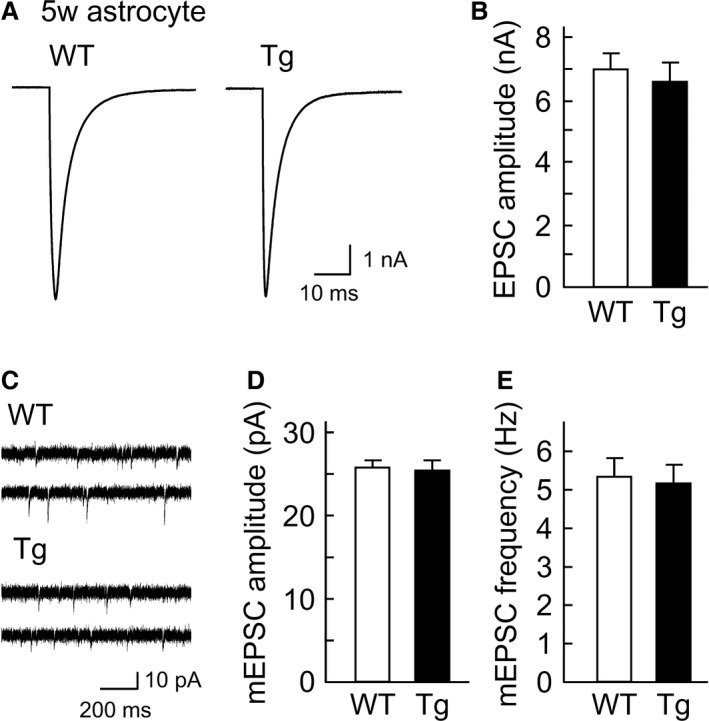
Amyloid precursor protein (APP), a type I transmembrane protein, has different aspects, namely, performs essential physiological functions and produces β-amyloid peptide (Aβ). Overexpression of neuronal APP is responsible for synaptic dysfunction. In the central nervous system, astrocytes - a major glial cell type - have an important role in the regulation of synaptic transmission. Although APP is expressed in astrocytes, it remains unclear whether astrocytic overexpression of mutant APP affects synaptic transmission. In this study, the effect of astrocytic overexpression of a mutant APP on the excitatory synaptic transmission was investigated using coculture system of the transgenic (Tg) cortical astrocytes that express the human APP695 polypeptide with the double mutation K670N + M671L found in a large Swedish family with early onset Alzheimer's disease, and wild-type hippocampal neuron. Significant secretion of Aβ 1-40 and 1-42 was observed in cultured cortical astrocytes from the Tg2576 transgenic mouse that genetically overexpresses Swedish mutant APP. Under the condition, Tg astrocytes did not affect excitatory synaptic transmission of cocultured wild-type neurons. However, aged Tg astrocytes cultured for 9 weeks elicited a significant decrease in excitatory synaptic transmission in cocultured neurons. Moreover, a reduction in the number of readily releasable synaptic vesicles accompanied a decrease in the number of excitatory synapses in neurons cocultured with aged Tg astrocytes. These observations indicate that astrocytic expression of the mutant APP is involved in the downregulation of synaptic transmission with age.
Keywords: Aging; alzheimer's disease; amyloid; astrocyte; synaptic release.
© 2015 The Authors. Physiological Reports published by Wiley Periodicals, Inc. on behalf of the American Physiological Society and The Physiological Society.
Figures



References
-
- Alarcon, R. , Fuenzalida C., Santibanez M., and Von Bernhardi R.. 2005. Expression of scavenger receptors in glial cells. Comparing the adhesion of astrocytes and microglia from neonatal rats to surface‐bound β‐amyloid. J. Biol. Chem. 280:30406–30415. - PubMed
-
- Allen, N. J. , and Barres B. A.. 2009. Neuroscience: glia ‐ more than just brain glue. Nature 457:675–677. - PubMed
-
- Bekkers, J. M. , and Stevens C. F.. 1995. Quantal analysis of EPSCs recorded from small numbers of synapses in hippocampal cultures. J. Neurophysiol. 73:1145–1156. - PubMed
-
- Berkenbosch, F. , Refolo L. M., V. L., Friedrich, Jr , Casper D., Blum M., and Robakis N. K.. 1990. The Alzheimer's amyloid precursor protein is produced by type I astrocytes in primary cultures of rat neuroglia. J. Neurosci. Res., 25:431–440. - PubMed
Publication types
MeSH terms
Substances
LinkOut - more resources
Full Text Sources
Other Literature Sources
Miscellaneous
