. 2016 Jan;82(1):17-26.
doi: 10.1007/s00239-015-9722-8. Epub 2016 Jan 5.

The TIM Barrel Architecture Facilitated the Early Evolution of Protein-Mediated Metabolism

Affiliations

The TIM Barrel Architecture Facilitated the Early Evolution of Protein-Mediated Metabolism

Aaron David Goldman et al. J Mol Evol. 2016 Jan.

Abstract

The triosephosphate isomerase (TIM) barrel protein fold is a structurally repetitive architecture that is present in approximately 10% of all enzymes. It is generally assumed that this ubiquity in modern proteomes reflects an essential historical role in early protein-mediated metabolism. Here, we provide quantitative and comparative analyses to support several hypotheses about the early importance of the TIM barrel architecture. An information theoretical analysis of protein structures supports the hypothesis that the TIM barrel architecture could arise more easily by duplication and recombination compared to other mixed α/β structures. We show that TIM barrel enzymes corresponding to the most taxonomically broad superfamilies also have the broadest range of functions, often aided by metal and nucleotide-derived cofactors that are thought to reflect an earlier stage of metabolic evolution. By comparison to other putatively ancient protein architectures, we find that the functional diversity of TIM barrel proteins cannot be explained simply by their antiquity. Instead, the breadth of TIM barrel functions can be explained, in part, by the incorporation of a broad range of cofactors, a trend that does not appear to be shared by proteins in general. These results support the hypothesis that the simple and functionally general TIM barrel architecture may have arisen early in the evolution of protein biosynthesis and provided an ideal scaffold to facilitate the metabolic transition from ribozymes, peptides, and geochemical catalysts to modern protein enzymes.

Keywords: LUCA; Prebiotic chemistry; RNA world; RNA–protein world; TIM barrel.


Figures
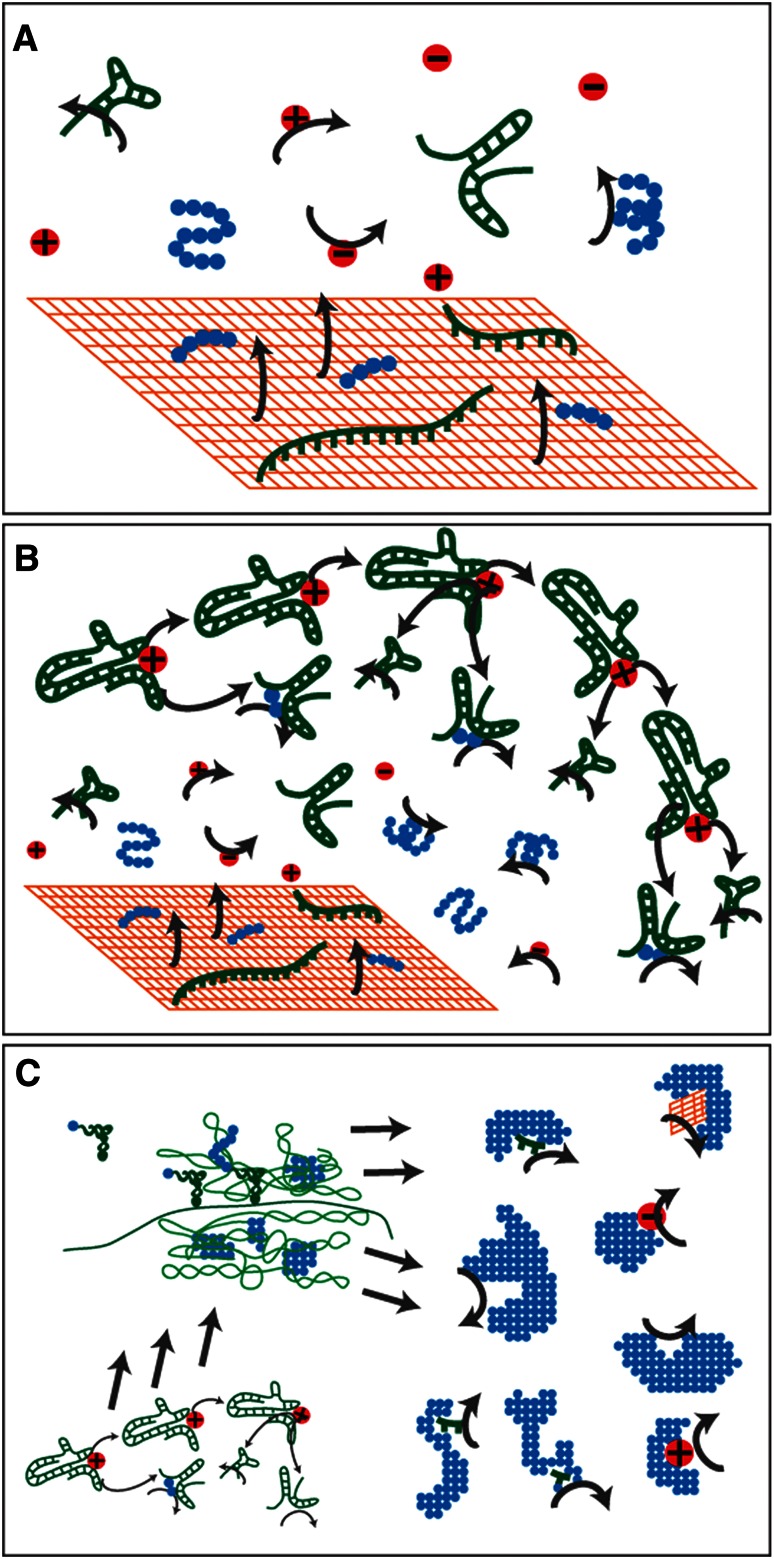
Fig. 1
Fig. 1
A well-supported scheme for the development of metabolism during the emergence of life. a Geochemical reactions catalyzed by mineral surfaces (orange) (Wächtershäuser ; Ertem and Ferris 1998) and metal ions (red) (Mulkidjanian and Galperin 2009) produce macromolecules such as amino acids (blue) and nucleotides (green) that polymerized into short peptides (Huber et al. 2003) and oligonucleotides (Huang and Ferris 2006) which, themselves, facilitated useful reactions. b A simple genetic system arose in which RNA genes encoded functional ribozymes (Gilbert 1986). This RNA-only genetic system was most likely dependent on the geochemical regime from which it emerged and may have co-evolved with catalytic peptides (Caetano-Anollés et al. ; Bowman et al. 2015). c Protein translation developed prior to the establishment of the DNA genome (Freeland et al. 1999), producing an RNA–protein system in which protein enzymes began to play a dominant role in metabolism. Modern enzyme cofactors derived from metals, nucleotides, and amino acids are thought to reflect the previous states in which reactions were catalyzed by ribozymes, peptides, metals, and minerals (White ; Szathmary and Maynard Smith ; Kyrpides and Ouzounis ; Wächtershäuser ; Yarus ; Mulkidjanian and Galperin 2009)
Fig. 2
Fig. 2
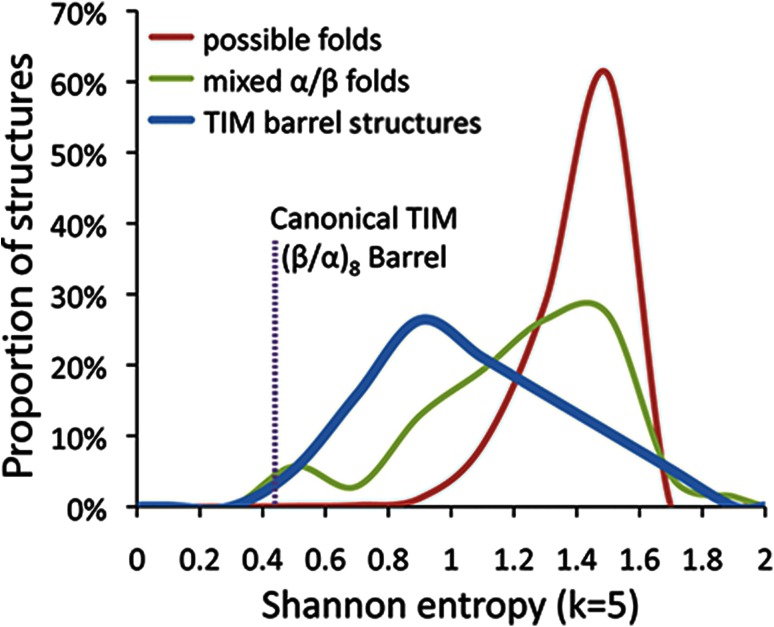
Comparison of the secondary-structural complexity of TIM barrels to other mixed α/β protein architectures. Structural repetitiveness is measured here as the linear Shannon entropy of secondary structure elements. Modern TIM barrel proteins exhibit a lower complexity (i.e., more internal repetition) structure than most other mixed α/β structures. The canonical TIM barrel secondary structure (β/α)8 is far less complex than nearly all other mixed α/β structures. These results give quantitative support to the idea that TIM barrel proteins could have emerged easily from duplication and recombination of partial barrel structures during the early evolution of the protein repertoire (Richter et al. ; Lang et al. ; Henn-Sax et al. 2001)
Fig. 3
Fig. 3
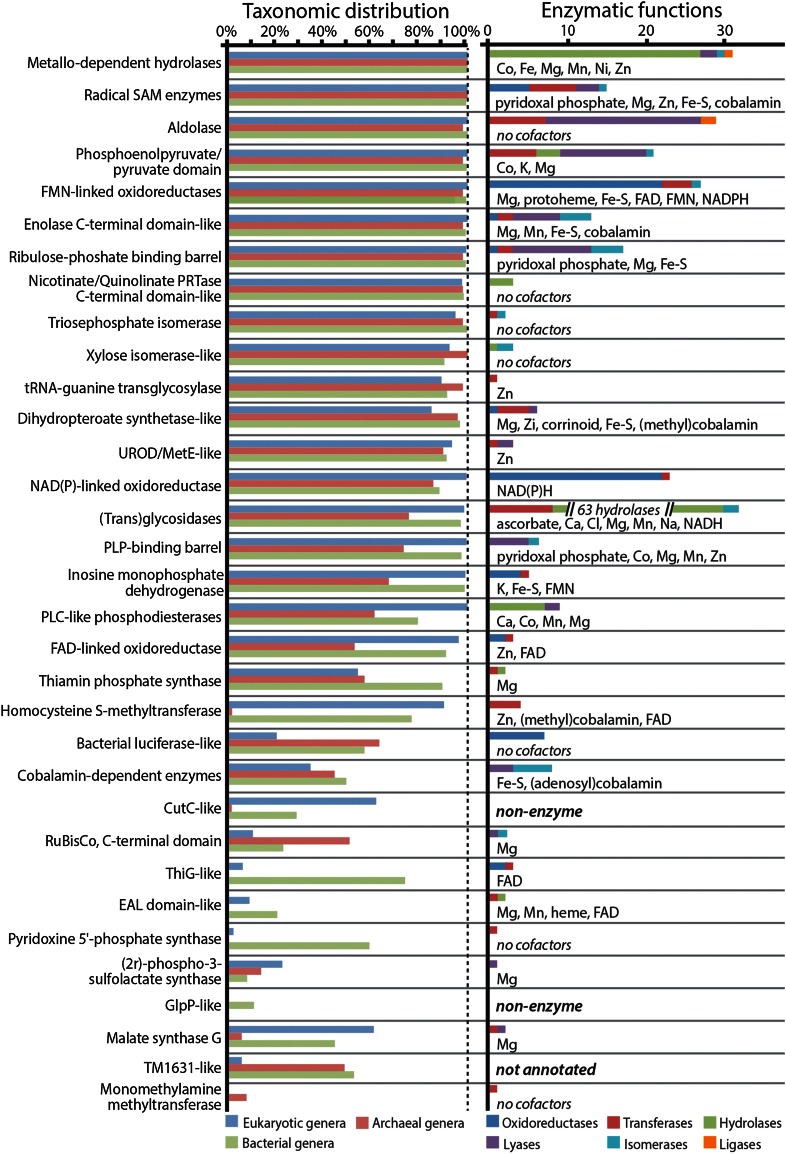
The taxonomic breadth and functional diversity of TIM barrel proteins. TIM barrel superfamilies as defined by the SCOP database are grouped by high structural similarity and low sequence similarity and are assumed to each be the result of a common ancestry. The percentage of genomes per taxonomic domain is presented for all 33 superfamilies. Most TIM barrel superfamilies are present in all three domains of life, indicating that they were also present at least as early as the last universal common ancestor (LUCA). These same taxonomically ubiquitous superfamilies show a very broad range of enzymatic functions (defined by the Enzyme Commission). The functional diversity of these putative TIM barrel superfamilies likely stems in part from the use of a wide range of metal-, nucleotide- and amino acid-derived cofactors, possibly reflecting their role in the transition to protein-mediated metabolism
Fig. 4
Fig. 4
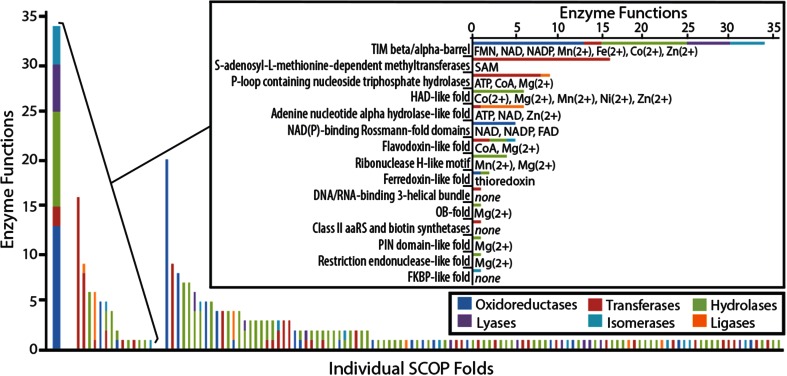
Comparison of the functional diversity of protein folds. The number of unique enzymatic functions performed by single-domain proteins of a given fold are presented as a histogram and color-coded by Enzyme Commission functional category. Ancient folds (Yang et al. ; Wang et al. 2007) are separated from the others in order to determine whether the breadth of the TIM barrel fold is, in part, due to its age. Single-domain TIM barrel proteins impart 34 unique functions spanning five major Enzyme Commission categories. This functional range is 70 % greater than the next most functionally broad structure. Single-domain TIM barrel proteins also use the broadest range of enzymatic cofactors, including the putatively ancient cofactors discussed in the main text
Fig. 5
Fig. 5
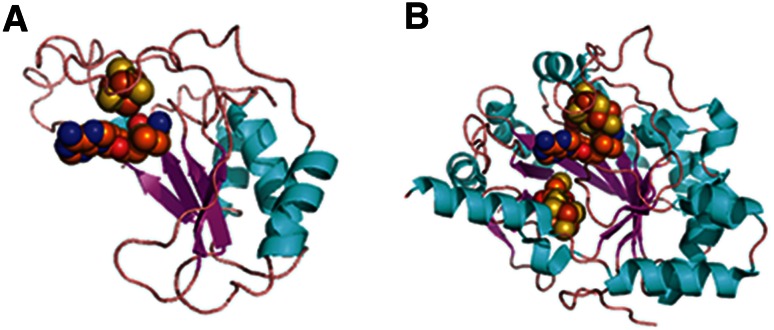
Structural similarity between the ribonucleotide reductase activating enzyme and a TIM barrel protein. The structure of ribonucleotide reductase activating enzyme, the radical redox component of potentially the earliest enzyme capable of making deoxyribonucleotides, is predicted to have a half TIM barrel structure (a) that most closely resembles the structure of the TIM barrel protein, 4Fe–4S-pyruvate formate-lyase activating enzyme (b), over any other structure in the Protein Data Bank. The iron-sulfur cluster and S-adenosyl methione cofactors used by ribonucleotide reductase activating enzyme were modeled based on superimposition with the 4Fe–4S-pyruvate formate-lyase activating enzyme

References

    1. Anantharaman V, Aravind L, Koonin EV. Emergence of diverse biochemical activities in evolutionarily conserved structural scaffolds of proteins. Curr Opin Chem Biol. 2003;7:12–20. doi: 10.1016/S1367-5931(02)00018-2. - DOI - PubMed
    1. Ancel LW, Fontana W. Plasticity, evolvability, and modularity in RNA. J Exp Zool. 2000;288:242–283. doi: 10.1002/1097-010X(20001015)288:3<242::AID-JEZ5>3.0.CO;2-O. - DOI - PubMed
    1. Andreeva A, Howorth D, Chandonia JM, Brenner SE, Hubbard TJ, Chothia C, Murzin AG. Data growth and its impact on the SCOP database: new developments. Nucleic Acids Res. 2008;36:D419–D425. doi: 10.1093/nar/gkm993. - DOI - PMC - PubMed
    1. Becerra A, Delaye L, Islas S, Lazcano A. The very early stages of biological evolution and the nature of the last common ancestor of the three major cell domains. Annu Rev Ecol Evol Syst. 2007;38:361–379. doi: 10.1146/annurev.ecolsys.38.091206.095825. - DOI
    1. Berman HM, Westbrook J, Feng Z, Gilliland G, Bhat TN, Weissig H, Shindyalov IN, Bourne PE. The Protein Data Bank. Nucleic Acids Res. 2000;28:235–242. doi: 10.1093/nar/28.1.235. - DOI - PMC - PubMed

Publication types

LinkOut - more resources